
Most people only think about an RCCB the moment it trips, usually at the worst possible time, right when the lights go out and someone starts wondering whether it’s a fault worth worrying about or just a nuisance trip. But an RCCB tripping is rarely a nuisance. In the vast majority of cases, it’s doing exactly the job it was built for: catching a leakage current before it turns into an electric shock or an electrical fire.
If you’ve ever wondered what’s actually happening inside that small DIN-rail-mounted device every time it senses trouble, this is worth understanding properly not just as a curiosity, but because knowing how an RCCB works makes it far easier to size, install, and troubleshoot one correctly. We’ll walk through the working principle in detail, look at how Elmeasure’s RCCB range applies that principle in practice, and clear up a few misunderstandings that come up constantly around this device.
What an RCCB Is Actually Protecting Against
An RCCB, or Residual Current Circuit Breaker, exists to protect people and property from earth leakage current that has strayed off its intended path and is flowing to earth instead of returning cleanly through the neutral conductor. This can happen for a number of reasons: damaged insulation on a cable, a fault inside an appliance, moisture ingress into a socket or junction box, or a person accidentally coming into contact with a live conductor.
It’s important to be clear about what an RCCB does not do. It doesn’t protect against overload or short-circuit conditions; that’s the job of an MCB (Miniature Circuit Breaker), which is why RCCBs are almost always installed alongside MCBs rather than as a standalone device. An RCCB’s entire purpose is narrower and more specific: detect current that’s leaking to earth, and disconnect the circuit fast enough to prevent injury or fire before that leakage does real damage.
The Core Working Principle: Current Balance
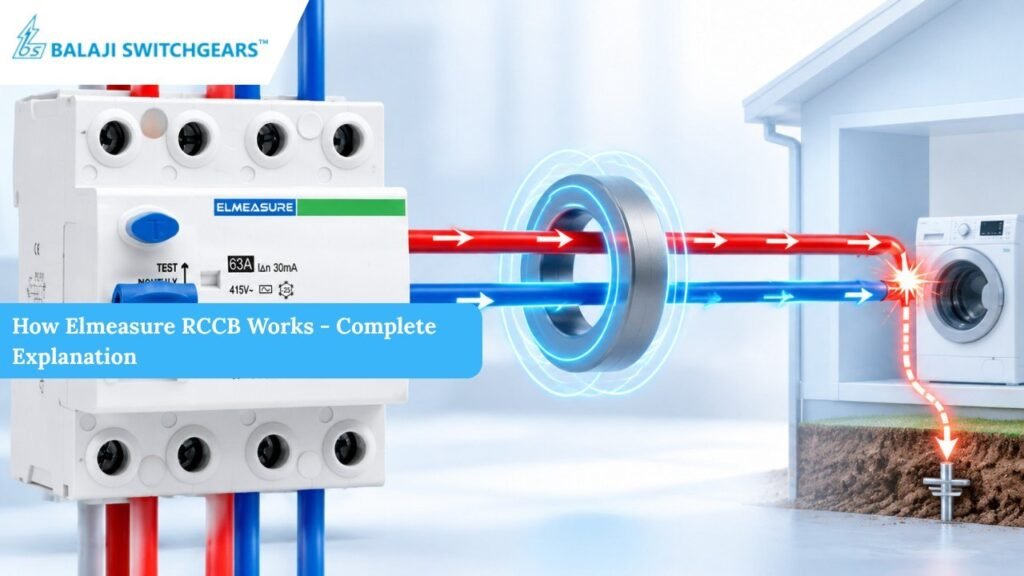
The working principle behind every RCCB, including Elmeasure’s range, comes down to one simple electrical law in a healthy circuit: the current flowing out through the live conductor must exactly equal the current returning through the neutral conductor. What goes out has to come back. If it doesn’t, something has diverted part of that current elsewhere, and in a domestic or industrial wiring context, “elsewhere” usually means an unintended path to earth.
Inside the RCCB, this balance is monitored using a component called a core balance transformer, sometimes referred to as a toroidal current transformer. Both the live and neutral conductors pass through this transformer’s core. Under normal, healthy operating conditions, the magnetic fields generated by the live and neutral currents are equal and opposite, so they cancel each other out completely. No net magnetic flux is produced in the core, and the RCCB stays in its closed, conducting state.
The moment an earth leakage occurs even a small one that balance breaks. The current returning through the neutral is now slightly less than the current that went out through the live, because a portion of it has escaped through the fault path to earth. That imbalance means the magnetic fields inside the core no longer cancel out, and a small residual magnetic flux appears. This flux induces a tiny current in a secondary sensing winding wrapped around the same core.
That induced current is fed to a sensitive relay mechanism inside the RCCB. Once it crosses the device’s rated sensitivity threshold, the relay releases a spring-loaded tripping mechanism that mechanically opens the contacts, disconnecting the circuit live and neutral together within milliseconds. This entire sequence, from the moment leakage starts to the moment the circuit is physically broken, needs to happen fast enough to protect a person from the physiological effects of electric shock, which is why tripping speed is one of the most important performance figures for any RCCB.
Where Elmeasure’s RCCB Range Fits Into This
Elmeasure’s RCCB range is built around exactly this working principle, engineered and tested to the relevant Indian and international standards — IS 12640-1 and IEC 61008-1 — which define how sensitively and how quickly an RCCB must respond under different fault conditions.
A few specifics worth knowing if you’re specifying or installing one:
- Sensitivity options – Elmeasure RCCBs are available with 30mA, 100mA, and 300mA trip sensitivity, so the device can be matched to the application. The 30mA setting is the one most relevant where direct human contact risk is highest, such as bathrooms, kitchens, and general socket outlets, since it’s sensitive enough to trip well before a dangerous shock current develops. Higher settings like 100mA and 300mA are typically used further upstream, for broader circuit or fire protection rather than personal shock protection.
- Tripping speed – the range is built to trip in 100 milliseconds or less once the residual current crosses the rated threshold, which is fast enough to interrupt a fault before it becomes physiologically dangerous.
- Current rating range – Elmeasure offers RCCBs across a range of current ratings from 16A up to 63A, covering everything from a single lighting circuit to a full distribution board feeder.
- Mechanical and electrical durability – the range is designed for around 4,000 operating cycles, which matters more than people usually realise, because an RCCB that’s tested regularly (as it should be) needs to keep performing reliably trip after trip, not just on day one.
- DIN rail mounting – built for standard distribution board installation, making it straightforward to integrate into both new panel builds and retrofits.
Why the Test Button Actually Matters
Every RCCB has a small test button on its front face, and it’s one of the most under-used safety features in any installation. Pressing it doesn’t just simulate a random fault, it deliberately introduces a small, controlled imbalance between the live and neutral paths inside the device, mimicking exactly the kind of leakage the RCCB is designed to detect. If the mechanism, the sensing transformer, and the tripping relay are all functioning correctly, the device should trip immediately.
This matters because an RCCB can sit in a closed, apparently healthy state for years without ever encountering a real fault, which means a mechanical or electronic failure inside the device could go completely unnoticed until the one moment it’s actually needed. Testing it periodically most guidance recommends roughly every one to three months for households and more frequently in industrial settings is the only way to confirm the device will actually do its job when a genuine leakage occurs.
Common Misunderstandings Worth Clearing Up
A few points come up repeatedly when people are troubleshooting RCCB trips or specifying a device for the first time.
An RCCB tripping doesn’t automatically mean the device is faulty. Far more often, it means the device is working exactly as intended and there’s a genuine leakage somewhere in the connected circuit worth investigating before simply resetting and moving on. Nuisance tripping does happen, usually from cumulative leakage across many appliances on one circuit rather than a single serious fault, which is one reason circuit segregation and correct RCCB placement across a distribution board matters as much as the device itself. And no, an RCCB is not a substitute for proper earthing; it works in conjunction with a correctly earthed installation, not instead of one, because the entire principle depends on leakage current having somewhere to go before the imbalance can be detected.
Getting the Selection and Installation Right
Understanding the working principle is only half the picture sizing, sensitivity selection, and correct placement within a distribution board are what actually determine whether an RCCB performs the way it’s meant to in a real installation. At Balaji Switchgears, our team works with residential, commercial, and industrial customers across India to specify the right RCCB sensitivity and rating for each application, drawing on Elmeasure’s tested and certified range alongside the rest of our low voltage switchgear portfolio.
If you’re planning a new distribution board, upgrading an older installation, or simply want to understand which RCCB sensitivity is right for your circuits, the team at Balaji Switchgears is happy to walk through the specification with you. You can explore the full Elmeasure RCCB range, along with our broader switchgear and automation products, or get in touch directly with Balaji Switchgears, at balajiswitchgears.com. A correctly chosen and properly tested RCCB, from Balaji Switchgears, is one of the simplest and most effective safety investments any electrical installation can make.