
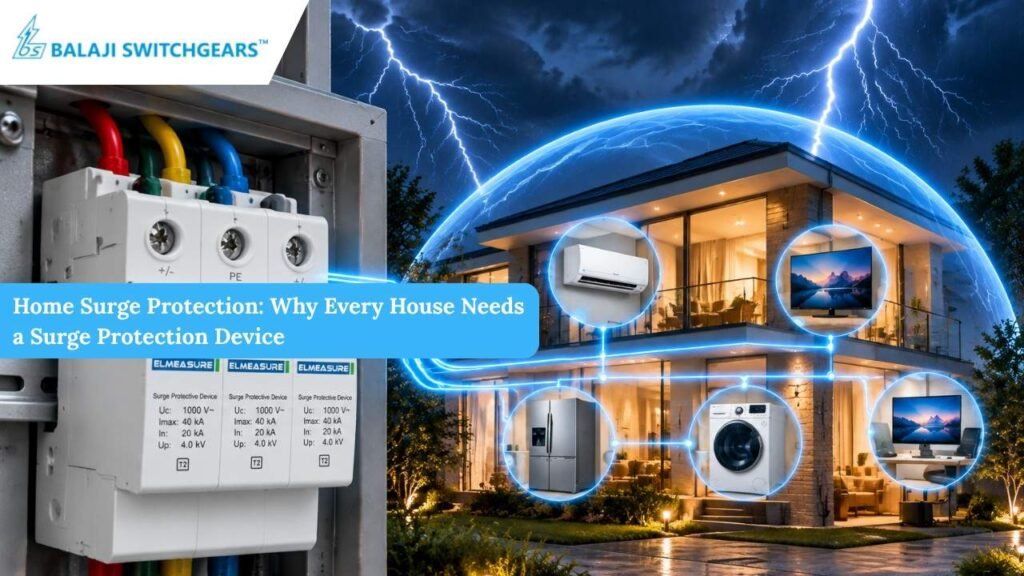
Most homeowners only discover what a power surge can do after it’s already happened: a television that won’t turn on the morning after a thunderstorm, a refrigerator’s control board suddenly dead, a Wi-Fi router that stopped responding for no obvious reason. It usually gets written off as bad luck, or the appliance simply “giving up.” In a lot of cases, though, what actually happened was a transient overvoltage event that passed through the home’s wiring and quietly fried whatever sensitive electronics happened to be plugged in at the time. This is exactly the gap a Surge Protection Device, or SPD, is built to close. It’s one of those pieces of electrical equipment that does its job so silently and so rarely gets a mention that most households don’t even know it exists until they’ve lost a few thousand rupees worth of electronics to something that could have been prevented for a fraction of that cost.
What a Power Surge Actually Is ?
A Power surge is a sudden, short-duration spike in voltage that exceeds the normal operating range of a home’s electrical supply. These spikes typically last a fraction of a second, but that’s more than enough time to damage sensitive electronic components, because modern appliances and devices are built around microprocessors and circuit boards that tolerate very little deviation from their rated voltage.
Surges come from more sources than most people assume. Lightning is the most dramatic and well-known cause even a strike that doesn’t hit the house directly can induce a massive voltage spike through nearby power lines. But a large share of surges are actually generated internally, within the home’s own electrical system: a heavy inductive load like an air conditioner compressor, a water pump, or a refrigerator switching on and off, sends a brief voltage transient back through the wiring every time it cycles. Utility-side switching events, grid faults, and voltage fluctuations from the transformer feeding the neighbourhood add another layer of risk that has nothing to do with weather at all.
The cumulative effect is what makes surges so dangerous. A single dramatic lightning-induced surge can destroy equipment outright, but the far more common story is repeated smaller surges, day after day, slowly degrading the internal components of appliances until they fail well before their expected lifespan without anyone ever connecting the dots back to the electrical supply.
How a Surge Protection Device Actually Works ?
An SPD is designed to sit between the incoming power supply and the rest of the home’s wiring, continuously monitoring voltage and standing ready to react the instant it detects a transient that exceeds a safe threshold. Under normal conditions, the device is effectively invisible to the circuit; it doesn’t interfere with the supply at all. The moment a surge appears, internal components inside the SPD, most commonly metal oxide varistors, change their electrical characteristics almost instantly, creating a low-resistance path that diverts the excess voltage safely to earth rather than letting it continue downstream toward appliances and electronics.
What makes this effective is speed. A well-designed SPD reacts in a matter of nanoseconds, clamping the voltage down to a safe level before it has time to reach and damage connected equipment, and then returns to its normal, invisible standby state once the surge has passed, ready to react again the next time.
Type 1, Type 2, and Type 3: Where Protection Actually Happens
Surge protection isn’t a single device solving a single problem it’s a layered system, and understanding the three recognised types clears up a lot of confusion homeowners run into when they’re told they “already have” surge protection.
Type 1 SPDs sit at the very origin of the installation, essentially the first line of defence against a direct or nearby lightning strike carrying very high energy. Type 2 SPDs are installed at the main distribution board inside the home, protecting the household wiring and everything connected to it from surges that make it past the first line of defence, as well as surges generated internally by the home’s own appliances. Type 3 SPDs are smaller, point-of-use devices installed close to particularly sensitive electronics for an additional layer of fine protection.
For most residential installations in India, a Type 2 SPD fitted at the main distribution board is the practical starting point; it’s the device that protects the entire house’s wiring and every appliance connected to it, rather than protecting one device at a time. Homes in lightning-prone regions, or with overhead service connections particularly exposed to the grid, benefit from adding Type 1 protection upstream as well.
Why Elmeasure’s Approach to Surge Protection Stands Out
This is where the Elmeasure Surge Protection Device range earns its place in a serious electrical panel. Elmeasure SPDs are engineered to connect between the phase conductors and earth, and are built to switch into their protective state in under 25 nanoseconds once a transient surge voltage is detected fast enough to intercept the spike well before it can travel further into the home’s wiring and reach connected appliances.
A few design details make the Elmeasure range particularly well suited to residential and light commercial use. The internal shield structure is built to prevent residual voltage from inrush currents from leaking through after the surge event has been handled, so downstream equipment isn’t left exposed to a secondary voltage bump. The device carries a clear window-style status indicator, so anyone checking the distribution board can see at a glance whether the unit is still healthy or whether it’s absorbed enough surge energy that it needs replacing a detail that matters a great deal, because an SPD that has done its job during a major surge event can reach the end of its working life and needs to be swapped out rather than left in place silently offering no protection at all. The modular, DIN-rail mounted construction means it integrates cleanly into a standard distribution board without demanding a specialised enclosure, and the housing itself is built from UL 94 V-0 rated thermoplastic, a flame-retardant material standard that matters given the device is designed to absorb genuine fault energy during its working life.
Why This Isn’t Optional Anymore
Indian homes are more electronics-dependent than they’ve ever been, inverter air conditioners, smart TVs, Wi-Fi routers, set-top boxes, induction cooktops, washing machines with electronic control boards, and increasingly, home automation and security systems. Every one of these represents a component that can be damaged, sometimes irreparably, by a surge that lasts less than a second and might never even be noticed happening.
The cost of an SPD at the distribution board is genuinely small compared to the combined replacement cost of the appliances it protects, and unlike most electrical upgrades, it’s a one-time installation that keeps working quietly in the background for years, with only the occasional visual check of the indicator to confirm it’s still active.
Getting the Right Protection for Your Home
At Balaji Switchgears, we help homeowners and electrical contractors across India specify the right surge protection setup for a given installation whether that’s a single Type 2 SPD at the main distribution board for a typical apartment or house, or a layered Type 1 plus Type 2 arrangement for homes with greater lightning exposure. We work with Elmeasure’s SPD range because it combines fast response, clear condition monitoring, and rugged build quality in a device that’s genuinely made for the way Indian homes are wired today.
If your home doesn’t have surge protection installed, or you’re not sure whether your existing setup is adequate, the team at Balaji Switchgears can help you review your distribution board and recommend the right SPD configuration. You can explore the Elmeasure surge protection range and the rest of our low voltage switchgear products, or get in touch directly with Balaji Switchgears, at balajiswitchgears.com. It’s a small addition to any home’s electrical panel that quietly protects everything plugged into it.