
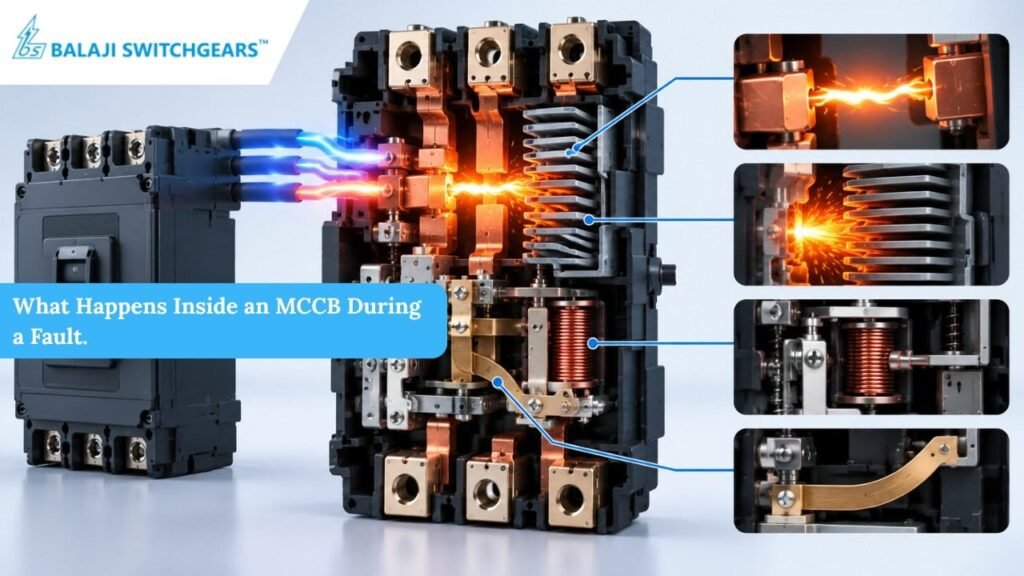
It is 2 AM and the winding of a conveyor motor finally gives way. Within a few thousandths of a second, the current in that feeder jumps from a normal few hundred amperes to many thousands. The breaker upstream has not moved for months, and now it must open against that current, put out the arc that appears across its contacts, and leave the panel intact.
This article walks through exactly what an ABB Tmax XT moulded case circuit breaker (MCCB) does in that moment, which parts do the work, and which numbers on the datasheet tell you whether it will cope at your installation.
The fault, phase by phase
The timings below are indicative. The real figures depend on the fault level, the frame size and the trip unit setting.
| Phase | What happens | What does the work |
| 1. Fault current rises | Current climbs steeply through all three poles | Fault level of the installation |
| 2. Contacts start to repel | The fault current itself pushes the moving contact away from the fixed contact, often before the current reaches its peak | Electrodynamic repulsion in the contact system |
| 3. Trip unit decides | The trip unit confirms the fault and releases the latch | Magnetic element or Ekip electronics |
| 4. Mechanism opens all poles | A spring-driven mechanism opens every pole together; the handle moves to TRIPPED | Trip-free operating mechanism |
| 5. Arc is stretched and split | The arc is pushed into the arc chute, where steel plates split it into many short arcs | Arc chute |
| 6. Current is forced to zero | Total arc voltage rises above the system voltage and the current collapses | Arc voltage across the chute |
Phase 2 is what makes a Tmax XT a current-limiting breaker. It starts opening on its own before the trip unit has finished deciding, so the current is cut off before it can reach its full prospective value. Tmax XT uses a double rotary contact design, so each pole breaks the circuit at two points in series. Two arcs mean twice the arc voltage, and that forces the current down faster.
What a current-limiting breaker saves downstream
Cutting the fault short has two measurable benefits for everything behind the breaker:
- Lower peak current. Cable, busbar and contactor supports see smaller mechanical forces.
- Lower let-through energy (I²t). Conductors and insulation heat up less, so a fault on one feeder is much less likely to damage the equipment around it.
This is also why current limiting supports backup protection and selectivity between upstream and downstream breakers.
Two ways of detecting a fault
Tmax XT breakers come with two families of trip units. They reach the same outcome in different ways.
| Thermal-magnetic | Electronic (Ekip) | |
| Overload | A bimetal strip heats, bends and releases the latch. Higher overload, faster trip | Current sensors feed a microprocessor that follows an adjustable long-time curve |
| Short circuit | An electromagnet pulls in a plunger almost instantly | Instantaneous protection, or a short deliberate delay so that downstream breakers can clear the fault first |
| Adjustment | Limited, set by dial | Fine, set on the display or through software |
| Best suited to | Straightforward feeders | Distribution, motor and generator protection where coordination matters |
Reading the datasheet: what the numbers promise
Three figures tell you whether a Tmax XT is the right breaker at a given point in your installation.
- Icu (ultimate breaking capacity). The highest fault current the breaker can interrupt. It must be above the prospective short-circuit current at the installation point.
- Ics (service breaking capacity). The fault current of the breaker can interrupt and still be expected to keep working afterwards.
- Rated uninterrupted current (Iu). The current the circuit breaker can carry continuously under specified conditions without exceeding its temperature-rise limits.
Breaking capacity is not one number per frame. It depends on the version (B, C, N, S, H, L or V) and on the voltage. From ABB’s published product data at 415 V AC: XT1B is rated 18 kA, XT1C 25 kA, XT4S 50 kA and XT4V 150 kA.
The table below shows the highest breaking capacity available in each frame at 415 V AC. Lower versions of the same frame have lower ratings, so always confirm the exact catalogue number against the ABB datasheet.
| Frame | Rated uninterrupted current (Iu) | Highest Icu at 415 V AC |
| XT1 | 160 A | 70 kA |
| XT2 | up to 160 A | 150 kA |
| XT3 | up to 250 A | 50 kA |
| XT4 | up to 250 A | 150 kA |
The larger XT5, XT6 and XT7 frames extend the family to higher currents. Ratings may vary depending on the model, version and voltage, so refer to the ABB datasheet for the exact figures.
What the Ekip trip unit tells you after the fault
An electronic Ekip Touch trip unit does more than trip. Its display records what tripped it and which protection function operated, which saves time when you look for the cause of the fault.
It can also measure power and energy. With the Class 1 Power & Energy Metering package, Ekip Touch measures both active power and energy to Class 1 accuracy (1%) as defined in IEC 61557-12. Without that package the accuracy is lower, so check which configuration you are ordering. Ekip Touch units can also be connected to automation and energy management systems through communication modules, which lets the same breaker that protects the feeder report on it.
After a trip: a short field routine
- Find the cause before resetting. A breaker that trips on a short circuit is reporting a real fault. Check the feeder, the cable and the load first.
- Inspect the breaker. Look for discolouration, damaged terminals or signs of overheating around the case.
- Be careful after a severe fault. If the breaker has cleared a fault close to its rated breaking capacity, follow ABB’s guidance on inspection or replacement before returning it to service.
- Operate and test routinely. Operate the handle periodically so the mechanism does not stiffen, check terminal tightness, and test electronic trip units as ABB instructs.
Frequently asked questions
Does a higher breaking capacity make the breaker trip faster? No. Breaking capacity is the maximum fault current the breaker can safely interrupt. How quickly it trips depends on the trip unit and its settings, and on the current-limiting action of the contact system.
Why does the handle move to a middle position after a trip? The TRIPPED position shows that the breaker opened on a fault rather than being switched off by hand. The breaker has to be reset before it can be closed.
Can I hold the handle on to keep a breaker closed during a fault? No. The operating mechanism is trip-free, so the contacts open even if the handle is held in the ON position.
When should I choose an electronic trip unit instead of a thermal-magnetic one? Choose electronic when you need adjustable protection, selectivity with other breakers, metering or communication. Thermal-magnetic units suit simpler feeders.
Choosing a Tmax XT with Balaji Switchgears
Established in 1990, Balaji Switchgears is an ABB authorized distributor in Delhi, supplying genuine ABB products with expert support and fast delivery. Our ABB range includes MCCBs, MCBs, motor protection breakers, air circuit breakers, contactors, overload relays, surge protection devices and distribution boards.
Over 95% of our orders are dispatched the same day, and our in-house service engineers respond by phone or on site within 24 to 48 hours. We also offer panel commissioning and programming support.
Send your load, fault level and mounting requirements to our team at 011-47093969 or through the website, and we will help you pick the right ABB Tmax XT breaker.
Balaji Switchgears: your technology partner for ABB MCCBs and complete low voltage power solutions.