
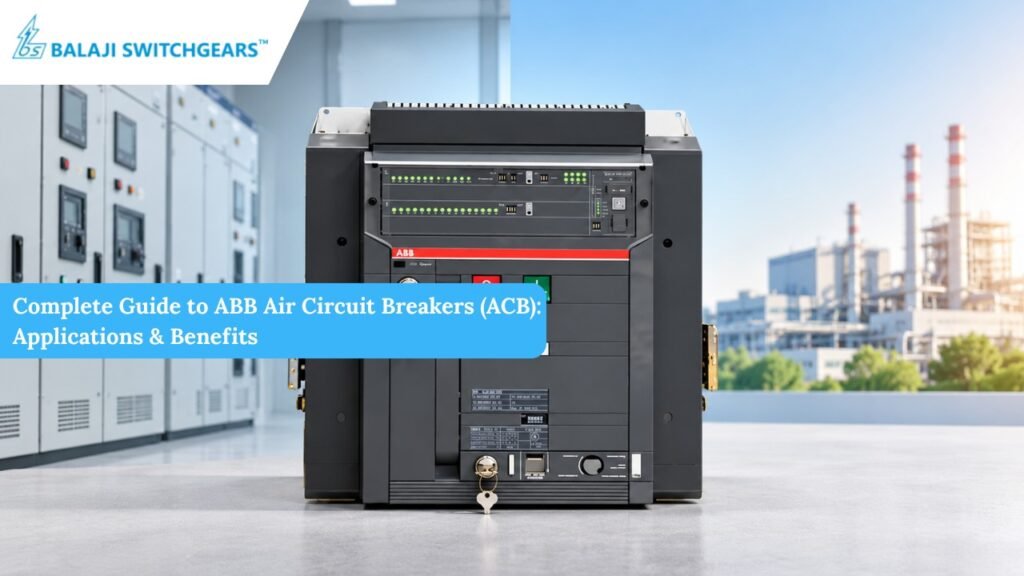
Air circuit breakers are the first line of defence in an industrial electrical system. They sit at the main incomer or on a bus coupler and protect everything downstream, so a wrongly specified unit can stop an entire plant, not just one feeder. ABB’s air circuit breakers (ACBs), led by the SACE Emax 2 range, are a widely trusted choice for this role in factories, large buildings and infrastructure projects.
This guide explains what an ACB is, how ABB’s range is built, where it is used and what to check before you order one. It is written for OEMs, panel builders, system integrators and end users who specify, build or maintain low-voltage power distribution.
What Is an Air Circuit Breaker and How Does It Work?
An Air circuit breaker is a low-voltage protective device that interrupts current in air. It is built for high-current circuits. In ABB’s SACE Emax 2 range, rated currents run from the E1.2 frame (up to 1600 A) to the E6.2 frame (up to 6300 A), depending on version, and the breaker normally serves as a main breaker, tie breaker or large feeder breaker in switchgear and large switchboards.
Three parts do the work:
- Contacts and operating mechanism. A stored-energy mechanism closes and opens the main contacts quickly and repeatably, manually or through a motor operator and remote control.
- Arc chutes. When contacts separate under load or fault, an arc forms. The chutes split and cool it until it is extinguished.
- Electronic trip unit. Current sensors feed a microprocessor that decides when to trip. It provides long-time, short-time, instantaneous and ground fault protection, so designers can set selective coordination with upstream and downstream devices.
ACBs come in fixed and withdrawable versions. A withdrawable breaker can be racked out of its cradle for inspection or replacement, which shortens maintenance shutdowns.
ABB’s ACB Range: SACE Emax 2
ABB’s flagship ACB platform is SACE Emax 2, available in four frame sizes. ABB’s published IEC figures are below.
| Frame | Rated current (IEC) | Breaking capacity (IEC) |
| E1.2 | up to 1600 A | up to 66 kA |
| E2.2 | up to 2500 A | up to 100 kA |
| E4.2 | up to 4000 A | up to 150 kA short-circuit capacity |
| E6.2 | up to 6300 A | up to 150 kA |
Source: ABB SACE Emax 2. Ratings vary by version and voltage, so confirm them on the datasheet for the exact catalogue number.
What sets the range apart:
- Ekip Touch trip units. Protection, measurement and logic can be customised, and software packages can be installed from a phone or tablet through the EPiC app. Advanced functions include load shedding, ATS, synchrocheck and adaptive protection.
- Built-in connectivity. The breaker supports eight communication protocols for automation and energy management, plus Bluetooth for local access.
- Compact design. The E1.2 is described as ABB’s most compact power breaker, and ABB claims up to 25% savings in footprint and copper.
- Certification. Relevant versions and configurations are certified to UL, CCC and IEC standards, and marine and naval versions carry their own approvals. Not every model holds all three certifications, so confirm the certificates for your exact catalogue number.
Applications Across Industries
An ACB protects the point where power enters or is shared inside an installation, so it appears wherever loads are large or downtime is costly.
- Industrial plants. Main incomers and bus couplers in heavy engineering, cement, textiles, chemicals, pharmaceuticals, food and beverage, and similar process plants.
- Data centers and large commercial buildings. Service entrance and tie breakers where continuity of supply is critical.
- Infrastructure projects. Water and sewage treatment, railways and material handling systems, where one main breaker feeds several motor control centres.
- Generator and changeover schemes. Ekip Touch supports automatic transfer (ATS) functions for source switching.
- Naval and offshore installations. Compact frames and marine-certified versions suit space-limited sites.
By customer type
- OEMs use ACBs as the main protection in large machines and production lines.
- Panel builders build main LT panels, PCCs and incomer sections around withdrawable ACBs.
- System integrators connect the breaker’s data into SCADA and energy management systems.
- End users gain remote load monitoring and simpler maintenance planning.
Key Benefits of ABB ACBs
- Selective protection. Adjustable long-time, short-time, instantaneous and ground fault settings let you trip only the faulted section while the rest of the plant keeps running.
- Protection, metering and control in one unit. The trip unit can replace separate relays, meters and communication devices, which reduces wiring and panel space.
- Remote visibility. Communication options allow remote load monitoring and review of energy trends, and a built-in display shows breaker status and electrical data.
- Smaller footprint. ABB claims up to 25% savings in footprint and copper, which matters when floor space and busbar cost are tight.
- Easier servicing. Withdrawable versions can be isolated and inspected without dismantling the switchboard.
- Upgradeable functions. Software packages can be added to the trip unit later, so protection needs can grow without replacing the breaker.
- Recognised standards. Relevant versions are built to IEC 60947 and UL 1066, which supports acceptance in both domestic and export projects.
ACB vs MCCB, and How to Select the Right ACB
Use an ACB where current is high and the breaker must stay closed briefly during a downstream fault. Use an MCCB for feeders and sub-distribution.
| ACB | MCCB | |
| Typical current range | High-current frames, up to 6300 A in ABB Emax 2 | up to about 1600 A |
| Typical position | Main incomer, bus coupler, large feeder | Feeders, motors, sub-boards |
| Servicing | Serviceable, often withdrawable | Sealed, usually replaced |
| Trip unit | Fully adjustable electronic | Thermal-magnetic or electronic |
Before ordering, confirm these seven points:
- Rated current, with margin for future load growth.
- Prospective short-circuit current at the busbar. Breaking capacity and short-time withstand must exceed it.
- Poles and construction: 3-pole or 4-pole, fixed or withdrawable.
- Trip unit features: protection functions, metering and communication protocol.
- Coordination with upstream and downstream devices.
- Ambient temperature and derating inside the panel.
- Accessories: shunt trip, undervoltage release, motor operator and interlocks.
Maintenance Tips
Follow the maintenance schedule in ABB’s manual, and inspect after any fault trip. At each service, check contact wear and arc chutes, clean dust from the unit and cradle, operate the mechanism, tighten power connections to the specified torque and test the trip unit. A thermographic scan of terminals under load helps catch loose joints before they fail. Keep a record of trip events and settings.
Sourcing ABB ACBs with the Right Support
Choosing the right ACB is half the job. The other half is getting a genuine product on time, with engineering help behind it.
Established in 1990, Balaji Switchgears is an ABB authorized distributor in Delhi, supplying genuine ABB products with expert support and fast delivery. Our ABB range includes air circuit breakers for main incomer, bus coupler and large feeder duties, and our team helps OEMs, panel builders, system integrators and end users match the right frame, trip unit and accessories to the application.
We dispatch over 95% of orders the same day, and our in-house service engineers respond by phone or on site within 24 to 48 hours. Panel commissioning and programming support is available for projects that need it.
Share your rated current, fault level and configuration with our team at 011-47093969 or through the website, and we will help you shortlist the right ABB ACB.
Balaji Switchgears: your technology partner for ABB air circuit breakers and complete low voltage power solutions.