
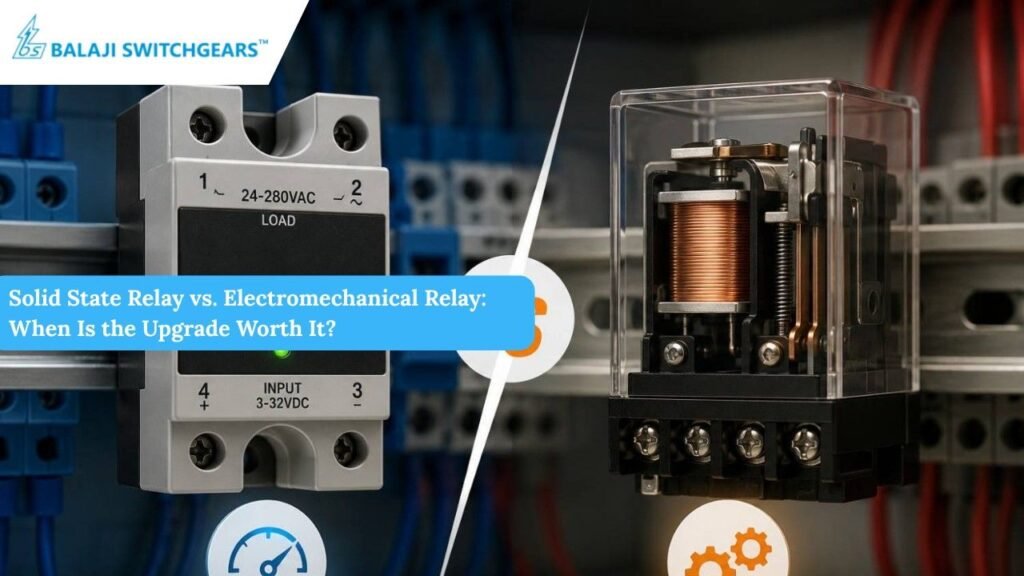
A practical product-selection guide for panel builders, automation engineers, OEM machine builders, and sales teams comparing EMR and SSR switching for reliability, lifecycle cost, and panel performance.
Why Relay Selection Still Matters in Modern Control Panels
Every control panel eventually comes down to the same question at the component level: how should this load be switched for the best balance of reliability, cost, and service life? Electromechanical relays (EMRs) have done the job reliably for over a century and still make complete sense in many applications. Solid state relays (SSRs) solve real problems – speed, silence, cycle life, and reduced maintenance, but they solve them at a cost that must be justified by the application.
For sales teams, the practical value of this discussion is simple: it helps customers avoid over-specifying SSRs where an EMR is enough, while clearly justifying the higher SSR relay price premium where faster switching, lower maintenance, and higher cycle life reduce total cost of ownership.
The mistake we see most often on the shop floor isn’t choosing the “wrong” technology outright. It’s applying one default relay type across an entire panel design without checking whether the specific load, cycle rate, and environment actually call for it. This piece lays out how the two technologies differ, when the EMR is still the smarter choice, and when upgrading to an SSR earns back its premium.
How Each Technology Actually Switches a Load
Electromechanical Relay (EMR)
An EMR uses a coil, a movable armature, and a set of physical contacts. Energising the coil creates a magnetic field that pulls the armature across, closing or opening the contacts and completing the load circuit. It is a mechanically simple, well-understood design, and the open contacts provide physical separation between the control and load sides when the relay is not energised.
Solid State Relay (SSR)
A Solid-state relay working replaces the coil-and-contact assembly with semiconductor switching typically a MOSFET, TRIAC, or thyristor actuated through an opto-isolated input stage. There is no armature and nothing physically moves in a solid-state relay circuit, so switching happens electronically in microseconds rather than milliseconds, and the device produces no audible click and no contact arcing.
SSR solid state relays are not immune to ageing; they simply age through different mechanisms. Photo-isolated SSRs, such as those used in Connectwell’s CSER and IMSER1 series, rely on an internal LED to drive the output stage. Sustained over-temperature, over-current operation, or inadequate derating can gradually reduce optical drive strength, which is why correct current selection, thermal design, and protection against surge conditions are essential for long SSR life.
EMR vs. SSR: The Factors That Actually Matter
| Factor | Electromechanical Relay (EMR) | Solid State Relay (SSR) |
| Switching mechanism | Coil, movable armature, and physical contacts | Semiconductor (MOSFET / TRIAC / thyristor) — no moving parts |
| Switching speed | Milliseconds | Microseconds |
| Life / duty cycle | Mechanically limited by contact wear | No contact wear; life is governed mainly by thermal design |
| Audible noise | Audible click on every operation | Silent operation |
| Heat generation | Very low on-state resistance, minimal self-heating | Higher on-state losses; heat sinking matters at higher currents |
| Inrush / surge tolerance | Contacts tolerate brief overloads well | Needs derating or added protection against inrush and surge |
| EMI / contact arcing | Contact oscillation with inductive loads can cause arcing; after repeated cycles, contacts can weld shut | No mechanical arcing; often cleaner switching for EMI-sensitive systems when correctly selected and wired |
| Vibration / shock resistance | Sensitive to vibration and mechanical shock | Well suited to vibration and shock; enclosure and installation conditions still determine dust performance |
| Leakage current (off-state) | True metal contacts give essentially zero leakage current | Semiconductor output can carry a small off-state leakage current |
| Package size / footprint | Larger — coil, spring, and armature all need physical space | Smaller — no coil or moving mechanism to house |
| Control-to-load isolation | Full galvanic isolation | Opto/photo isolation, sufficient for most panel applications |
| Upfront unit cost | Lower | Typically, higher |
| Cost over the panel’s life at high cycle rates | Rises with replacement parts and downtime | Often lower once cycling and maintenance are factored in |
When the Electromechanical Relay Is Still the Right Call
• Infrequent switching. If the load cycles a handful of times a shift rather than thousands of times an hour, contact wear is a non-issue and the EMR’s lower upfront cost wins.
• High inrush or surge loads. Motor starts, transformer inrush, and capacitive loads throw brief current spikes that mechanical contacts tolerate more forgivingly than many SSRs without derating.
• Budget-sensitive, low-complexity panels. Where first cost is the primary constraint and duty cycle is light, the EMR’s simplicity is a genuine advantage, not a compromise.
• Applications needing absolute galvanic isolation. EMR contacts physically separate control and load circuits in a way some safety-critical designs specifically require.
When Upgrading to an SSR Is Worth the Premium
• High-frequency or continuous cycling. Applications switching many times per minute temperature control, process heaters, high-speed sorting will wear out EMR contacts quickly; SSRs have no contact wear mechanism to begin with.
• Noise- or vibration-sensitive installations. Machine builders working in panels mounted on moving equipment, or environments where audible clicking is undesirable, benefit from the SSR’s silent, shock-tolerant operation.
• EMI-sensitive control loops. No contact arcing means cleaner switching transitions, which matters near sensitive instrumentation or communication wiring.
• Long-life, low-maintenance requirements. For panels that are hard to access after commissioning, the absence of moving parts reduces the odds of an unplanned field visit.
• PLC-to-load interfacing at 24 V logic levels. Low drive current and TTL/CMOS compatibility make SSR interface modules a clean fit for switching field loads (whether an AC load or a solid-state relay dc load) directly off PLC digital outputs.
Where Connectwell Fits: Relay Modules for Both Sides of the Decision
For customers, the advantage is continuity: they can choose EMR or SSR technology from the same Connectwell relay ecosystem without changing DIN-rail practices, panel layout philosophy, or service approach. That keeps the discussion focused on the application need rather than forcing a supplier or platform change.
On the EMR side, the Modular / Power Relays (CRM Series) supports standard-duty and high-performance switching with 1CO, 2CO, and 4CO contact configurations, IP20 protection, and a V0 flammability rating for continuous operation at full contact rating. For space-constrained panels that still need mechanical contacts, the Slim Relays (CSR Series) offers a compact, CE/UL-compliant footprint that helps customers save up to 66% panel space compared with conventional relay modules
On the SSR side, the CSER Slim Relay (SSR Series) and Interfacing Boards (IMSER1 Series) bring speed, silent operation, and high cycle-life advantages into a DIN-rail-mounted, pluggable format. This gives sales teams a strong upgrade story for customers facing frequent switching, PLC interface requirements, vibration, noise sensitivity, or maintenance-access challenges.
| Tech | Relay Type | Series | Input / Rating | Key Features | Best Fit |
| EMR | Modular Relay | CRM Series | 24–230 V AC/DC input | 1CO / 2CO / 4CO high-performance modular relays; IP20, V0 flammability rating, full contact rating on continuous duty | Standard-duty panel switching where proven EMR robustness and easy replacement matter |
| EMR | Slim Relay | CSR Series | 24–230 V AC/DC input | Compact slim EMR relay modules saving up to 66% panel space vs. conventional modules; CE/UL compliant, 1CO/2CO contacts | Space-constrained panels needing electromechanical switching without giving up density |
| EMR | Relay Modules | CIMRE Series | 12 -230V AC/DC | Modular Configuration for connecting 2 to 32 channels of electrical signals between PLCs and field devices. | In many applications, the Controllers cannot switch loads directly. In such applications, interface modules are used. |
| SSR | Slim relay | CSER Slim SSR Series | 24 VDC / 24 VUC input, up to 380 VAC output, 2 A | 6.0–6.2 mm slim pitch, pluggable SSR, LED status indicator, zero-cross turn-on (AC solid state relay output) | Panels where DIN rail space is at a premium and channel density matters |
| SSR | Relay Modules | IMSER1 Series | 24 VAC input, up to 380 VAC output, 2 A | Photo isolation, 2500 V dielectric strength, low 20 mA drive current, TTL/CMOS compatible | PLC-to-load interfacing where AC to AC solid state relay input rating, output load rating, leakage current, and thermal design match the application |
Across both technologies, Connectwell’s modular relay ranges share a consistent profile and pluggable base, so a failed unit can be swapped without disturbing panel wiring and a panel that mixes EMR and SSR modules for different loads keeps a uniform, easy-to-service appearance throughout.
A Simple Decision Framework
| Ask these four questions before specifying the relay: • How many switching cycles per day, and over what expected panel life? • Does the load have significant inrush current (motors, transformers, capacitive loads)? • Does the installation environment involve vibration, dust, or noise-sensitivity? • Is the panel easily accessible for maintenance, or is unplanned downtime expensive? |
If cycling is light, inrush is significant, and the panel is easy to service, the EMR remains a sound, economical choice. If cycling is heavy, the environment is harsh, or downtime is costly, the higher solid state relay price is usually recovered well within the panel’s service life
The Bottom Line
Neither technology is obsolete, and neither is universally correct. EMRs remain a smart choice where simplicity, inrush tolerance, and lower upfront cost matter most. SSRs become the stronger value case when high cycle rates, silent operation, vibration resistance, faster switching, or lower maintenance exposure can reduce total cost over the panel’s life. The right upgrade decision is therefore not about replacing EMRs by default; it is about matching the relay technology to the application’s technical and commercial reality.
Specifying the right interface module up front helps customers avoid over-engineering lightly cycled circuits while protecting high-duty applications from premature contact wear. With Connectwell’s CRM and CSR EMR ranges alongside CSER and IMSER1 SSR modules, offers a practical, application-based recommendation across both technologies from one relay portfolio.