
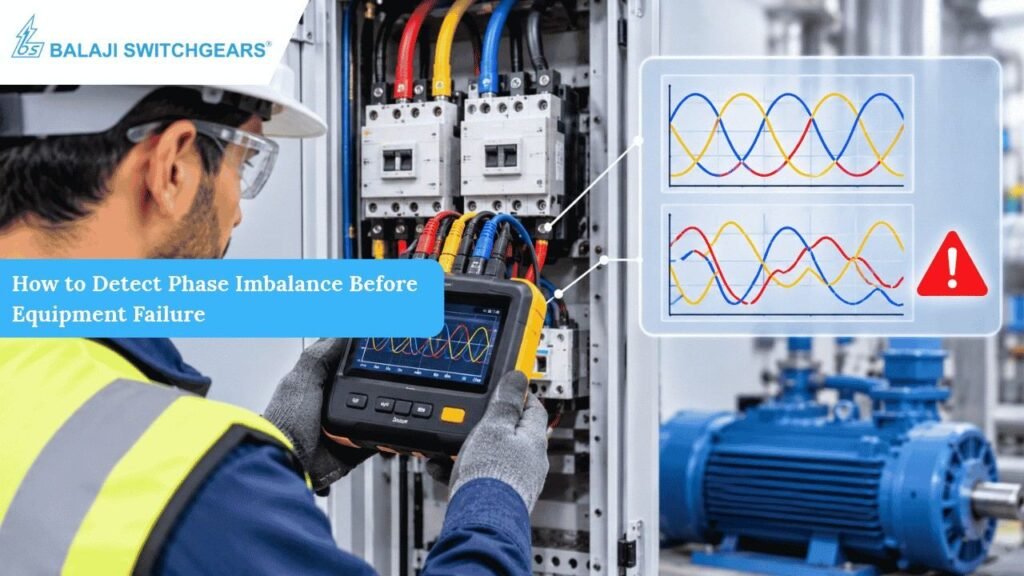
In an industrial facility, a motor may continue running even when the electrical supply is not operating as it should. Production may appear normal, but one phase could be carrying more load than the others, causing the motor to draw uneven current and generate excess heat. Over time, this condition can damage winding insulation, reduce equipment efficiency and lead to unexpected breakdowns.
This is the challenge with phase imbalance: it often develops without an immediate shutdown or visible warning.
For industries that depend on three-phase motors, pumps, compressors, HVAC systems and production machinery, detecting phase imbalance early is essential. Regular electrical measurements, power quality monitoring and suitable protection devices can help identify irregularities before they turn into costly equipment failures.
In this blog, we explain what phase imbalance is, what causes it, how to detect it and what industries can do to prevent its impact.
What Is Phase Imbalance in an Electrical System?
A three-phase electrical system uses three alternating voltages, commonly identified as L1, L2 and L3. Under balanced operating conditions, the three phase voltages are equal in magnitude and separated by approximately 120 degrees.
Phase imbalance occurs when the voltage or current across these three phases differs beyond an acceptable level.
For example, in a balanced three-phase system, the voltage across all three phase combinations (L1–L2, L2–L3 and L3–L1) should be approximately 415V. However, if the readings are 415V, 405V and 395V, the variation indicates a possible voltage imbalance that needs investigation.
It is important to understand that voltage imbalance and current imbalance are related but not identical. An uneven voltage supply can cause a motor to draw significantly uneven current. Current imbalance can also occur because of internal motor problems, loose connections or other electrical faults, even when the incoming voltage appears balanced.
That is why checking both voltage and current is important when diagnosing three-phase equipment.
Why Is Phase Imbalance Dangerous for Industrial Equipment?
A three-phase motor is designed to operate with a reasonably balanced electrical supply. When the voltage becomes unbalanced, the motor may experience additional electrical and thermal stress.
Even a relatively small voltage imbalance can create a much larger current imbalance. This can result in several operational problems.
1. Motor Overheating
Unequal phase currents increase losses within the motor windings. The additional heat can gradually deteriorate winding insulation and shorten motor life.
2. Reduced Motor Efficiency
An imbalanced supply affects the motor’s operating performance. More electrical energy may be lost as heat instead of being converted into useful mechanical output.
3. Increased Vibration and Mechanical Stress
Uneven electromagnetic forces can contribute to torque pulsations and increased vibration. If left unresolved, this can place additional stress on bearings, couplings and connected machinery.
4. Unexpected Equipment Shutdowns
Excessive current or abnormal operating conditions can trigger protective devices. Repeated tripping can interrupt production and affect overall plant productivity.
5. Premature Equipment Failure
Continuous operation under unbalanced conditions can accelerate insulation deterioration and increase the risk of motor failure, resulting in repair costs and unplanned downtime.
For industrial facilities, the concern is not limited to the motor itself. A motor failure can interrupt an entire production process, particularly when the equipment is connected to critical pumps, compressors or conveyor systems.
What Causes Phase Imbalance?
Phase imbalance can originate from the incoming power supply or develop within the facility’s electrical distribution system.
Some common causes include:
Uneven Load Distribution: When single-phase loads are not distributed properly across the three phases, one phase may carry more current than the others. This can create unequal voltage drops and affect connected equipment.
Loose Electrical Connections: Loose terminals, damaged cables and poor contact points can increase resistance in one phase. Under load, this may create abnormal voltage drops and heating.
Faulty Switching Components: Worn contactor contacts, damaged fuses or deteriorating connections inside electrical panels can affect the supply reaching equipment.
Transformer-Related Issues: Uneven loading, connection problems or other transformer-related faults may contribute to voltage imbalance.
Damaged Motor Windings: Sometimes, the incoming supply is balanced, but a motor develops unequal current consumption because of winding damage or internal electrical problems.
Changing Industrial Loads: Large machines switching on and off, along with unevenly distributed loads, can cause electrical conditions to vary throughout the day.
Identifying the actual cause is important. Simply replacing a motor or resetting a protective device without investigating the source may allow the same problem to return.
How to Detect Phase Imbalance Before Equipment Failure
Early detection requires more than waiting for a machine to overheat or trip. Electrical teams should regularly monitor phase voltage, current and overall power quality.
Here are some practical ways to identify phase imbalance.
1. Measure Voltage Across All Three Phases
The first step is to measure the voltage between the three phase combinations:
- L1–L2
- L2–L3
- L3–L1
Compare the readings to identify differences between the phases. Measurements should be taken under actual operating conditions because an imbalance may become more noticeable when equipment is carrying a load.
A single measurement provides only a snapshot. Repeated measurements can help identify whether the imbalance is occasional or persistent.
2. Check Current in All Three Phases
Voltage readings alone may not reveal the complete condition of a motor.
Measure the current flowing through L1, L2 and L3 using a suitable current-measuring instrument. Compare the readings to identify whether one phase is carrying significantly more or less current.
For example, if a motor draws 30A, 35A and 30A across its three phases, the current distribution is uneven. This difference needs investigation, even if the motor is still operating.
Current measurements can help identify problems such as uneven loading, poor electrical connections, phase loss or possible motor winding issues.
3. Use a Power Quality Analyser
Manual measurements are useful for initial checks, but they may not capture variations that occur throughout an operating shift.
A power quality analyser can help assess electrical parameters across the three phases and identify irregularities over a period of time. Depending on the instrument’s capabilities, it can record voltage, current, power, frequency, harmonics and voltage imbalance.
This is particularly useful in facilities where equipment operates continuously or where electrical loads change frequently.
Balaji Switchgears lists Elmeasure Power Quality Analysers within its low-voltage switchgear portfolio. Such monitoring solutions can support a more informed assessment of electrical conditions and help maintenance teams investigate power quality concerns.
4. Monitor Temperature and Equipment Behaviour
Electrical measurements should be supported by physical observations.
Look for warning signs such as:
- Motors operating at unusually high temperatures.
- Excessive vibration or unusual operating noise.
- Frequent motor overload trips.
- Contactor terminals showing signs of overheating.
- Changes in machine performance.
These symptoms do not automatically confirm phase imbalance. However, when they appear alongside unequal voltage or current readings, they indicate that a detailed electrical inspection may be required.
5. Install Suitable Phase Monitoring Protection
For critical three-phase applications, suitable phase monitoring and protection devices can help identify abnormal supply conditions.
Depending on the selected device, monitoring functions may include phase failure, incorrect phase sequence, under-voltage, over-voltage and phase imbalance detection.
When an abnormal condition is detected, the device can initiate an alarm or a protective switching response, depending on the system design.
The selection should be based on the equipment requirements, operating conditions, protection settings and the manufacturer’s specifications. A monitoring device should complement, not replace, the correct motor protection and electrical system design.
How to Calculate Voltage Imbalance
A basic percentage calculation can help maintenance teams understand the difference between the three phase voltage readings.
The commonly used maximum-deviation method is:
Voltage Imbalance (%) = (Maximum deviation from average voltage ÷ Average voltage) × 100
For example, consider these three voltage readings:
- L1–L2 = 415V
- L2–L3 = 405V
- L3–L1 = 410V
Step 1: Calculate the average voltage
(415 + 405 + 410) ÷ 3 = 410V
Step 2: Find the maximum deviation from the average
The maximum deviation is 5V.
Step 3: Calculate the percentage
(5 ÷ 410) × 100 = 1.22%
The calculated voltage imbalance is approximately 1.22%.
This method provides a useful field calculation, but it is not the same as the negative-sequence voltage method used by some power quality analysers. The measurement method and applicable equipment limits should always be considered when evaluating the result.
There is no single acceptable threshold for every installation. Motor manufacturers, applicable standards and equipment specifications should guide the assessment. Even a small voltage imbalance deserves attention when sensitive equipment or heavily loaded motors are involved.
How Can Industries Prevent Phase Imbalance?
Detecting an imbalance is only the first step. Consistent maintenance and proper electrical distribution practices help reduce the possibility of recurring problems.
Balance the Electrical Load: Distribute single-phase loads as evenly as practical across all three phases. Review load distribution whenever new equipment is added.
Inspect Electrical Connections: Regularly check terminals, cable joints, contactors and switching components for loose connections, wear or signs of overheating.
Monitor Power Quality: Use suitable meters and power quality analysers to track electrical parameters and identify unusual variations before they affect critical equipment.
Maintain Motors and Panels: Include motor current measurements, thermal inspections and electrical connection checks in preventive maintenance schedules.
Use Appropriate Protection: Select protective devices according to motor ratings, system requirements and the nature of the connected load. Ensure that protection settings are correctly configured.
Investigate Repeated Tripping: Repeated overload or protection trips should never be treated as a routine inconvenience. Identify the underlying cause instead of repeatedly resetting the equipment.
Why Early Detection Matters for Industrial Operations
Phase imbalance is not always visible, but its impact can be significant. A motor that continues running under abnormal electrical conditions may gradually experience overheating, reduced efficiency and insulation damage.
The right approach is to combine regular voltage and current measurements with power quality monitoring, suitable protection and preventive maintenance.
For panel builders, OEMs, system integrators and industrial end users, this also highlights the importance of selecting the right electrical monitoring and protection components during panel design. A well-planned electrical panel should not only distribute power but also support reliable monitoring and safe equipment operation.
At Balaji Switchgears, we understand that reliable industrial operations depend on more than simply supplying electrical power. Through our range of low-voltage switchgear, metering and power quality solutions, we support customers in building electrical systems that are easier to monitor, maintain and manage.
Balaji Switchgears works with industries to help them identify suitable electrical products and solutions for their applications. From power quality analysers and meters to low-voltage switchgear and panel-related requirements, we help customers make informed choices for dependable electrical distribution and protection.
When it comes to preventing equipment failure, early detection makes the difference. Monitor your three-phase system before a small electrical imbalance becomes a major operational problem.