
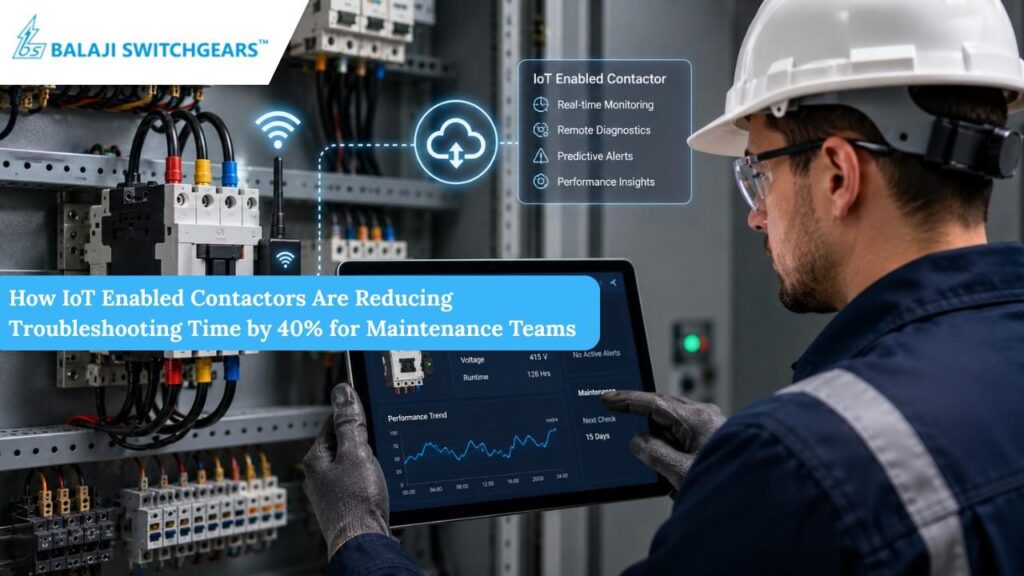
Every maintenance manager knows the feeling. A production line stops without warning, a motor refuses to start, and the whole team scrambles to figure out which component failed. In most factories, the humble contactor is often the last place anyone looks, yet it is one of the most common points of electrical failure. Today, that is changing fast. IoT enabled contactor are transforming how maintenance teams detect, diagnose, and resolve electrical faults, cutting troubleshooting time by as much as 40 percent in many industrial settings.
This shift is not just a buzzword trend. It reflects a genuine change in how plants approach reliability, and it is reshaping the way maintenance teams spend their time and budget.
What Exactly Is an IoT Enabled Contactor
A Contactor is an electromechanical switch that controls power to motors, pumps, compressors, heating systems, and lighting circuits. Every time a machine starts or stops, a contactor is doing the switching work behind the scenes. Traditional contactors operate silently and give no indication of internal wear until something goes wrong, usually in the form of overheating, arcing, or complete coil failure.
An IoT enabled contactor adds sensors and connectivity to this basic switching device. These sensors continuously track parameters such as coil temperature, contact wear, switching cycles, current load, vibration, and voltage fluctuations. That data is transmitted wirelessly to a cloud platform or local dashboard, where algorithms analyze it for early signs of trouble. Instead of waiting for a breakdown, maintenance teams receive alerts well before the actual failure happens.
Why Traditional Troubleshooting Takes So Long
To understand why IoT connected contactors save so much time, it helps to look at how troubleshooting usually works in a conventional setup.
When a machine stops unexpectedly, a technician has to physically walk to the panel, open it, and begin testing components one by one. This process often includes checking fuses, relays, wiring, sensors, and finally the contactor itself. Since a contactor failure looks similar to several other electrical issues, technicians frequently spend a large chunk of their time simply ruling out possibilities rather than fixing the actual fault.
Add to this the challenge of locating spare parts, coordinating with other departments, and documenting the issue for future reference, and a single fault can easily eat up several hours of downtime. In large facilities with hundreds of contactors spread across multiple panels, this reactive approach becomes even more time consuming and costly.
How IoT Connectivity Speeds Up Diagnosis
IoT enabled contactor remove much of the guesswork from this process. Here is how they help maintenance teams work faster and smarter.
Real Time Condition Monitoring
Instead of inspecting equipment on a fixed schedule, maintenance teams can monitor contactor health continuously. Sensors track coil resistance, contact bounce, temperature rise, and switching frequency around the clock. Any deviation from normal patterns is flagged instantly, so technicians know exactly where to look the moment something changes.
Early Warning Alerts
One of the biggest advantages of connected contactors is predictive alerting. Based on industry research, IoT based monitoring systems can often flag abnormal trends well in advance of an actual failure, sometimes weeks before symptoms would normally appear. This gives maintenance teams the chance to plan repairs during scheduled downtime rather than scrambling during an unplanned stoppage.
Precise Fault Location
In a traditional panel, a technician may need to test dozens of components before finding the faulty one. With IoT enabled contactor, the exact device reporting the anomaly is already identified on the dashboard. This alone removes a huge portion of the manual search process and is a major reason troubleshooting time drops so significantly.
Remote Diagnostics
Modern IoT platforms allow facility managers and engineers to view contactor performance data from a laptop or mobile device without stepping onto the plant floor. For facilities with multiple production lines or locations, this means issues can be assessed and prioritized remotely before a technician is even dispatched, saving travel time and speeding up response.
Data Driven Decision Making
Over time, connected contactors build a performance history for every device in the system. Maintenance teams can review switching cycles, load patterns, and wear trends to understand which units are approaching the end of their service life. This turns maintenance from a guessing game into a data backed process, allowing teams to replace components proactively rather than reactively.
The Real Numbers Behind the 40 Percent Improvement
Industry studies on predictive maintenance consistently point to major gains in operational efficiency once IoT monitoring is introduced. Reports from manufacturing case studies show repair resolution times accelerated by around 40 percent after IoT sensor data was integrated into maintenance workflows, along with noticeable improvements in equipment uptime and a meaningful reduction in critical failures. Separate research comparing predictive maintenance to traditional reactive approaches also shows downtime reductions in the range of 35 to 45 percent, along with lower overall maintenance costs.
These numbers make sense once you consider what is actually happening. Troubleshooting time is largely made up of diagnosis time, not repair time. When a system tells a technician precisely which contactor is degrading and why, the diagnosis phase practically disappears. What used to take hours of testing and isolation can now take minutes, since the system has already done the detective work.
Beyond Time Savings, What Else Improves
While faster troubleshooting is the headline benefit, IoT enabled contactor bring a wider range of advantages to maintenance teams and plant operations as a whole.
Reduced unplanned downtime means production schedules stay on track, which protects revenue and customer commitments. Extended equipment life becomes possible because components are replaced based on actual condition rather than a fixed calendar, avoiding both premature replacement and unexpected failure. Improved safety is another major factor, since early detection of overheating or arcing conditions reduces the risk of fire hazards or equipment damage. Better resource planning also results, as maintenance teams can order spare parts in advance instead of relying on emergency procurement, which often comes with higher costs and longer lead times.
For plant managers, this also means better visibility into overall equipment reliability. Instead of relying on anecdotal reports from the floor, decisions can be backed by actual performance data collected over months or years.
Industries Benefiting the Most
While any facility using motor driven equipment can benefit from IoT enabled contactor, certain sectors see especially strong returns. Manufacturing plants with continuous production lines rely heavily on uptime, making early fault detection extremely valuable. HVAC and building automation systems benefit from predictive alerts that prevent costly compressor and motor failures. Water treatment facilities, where pump reliability is critical to public service continuity, also gain significantly from remote monitoring capabilities. Similarly, food processing, pharmaceutical manufacturing, and heavy industrial operations all depend on consistent power switching, making connected contactors a natural fit for reducing operational risk.
Choosing the Right IoT Contactor Solution
Not every connected contactor solution is built the same way, and selecting the right one matters. Facilities should look for contactors with reliable sensor accuracy, secure data transmission, compatibility with existing control systems, and dashboards that are genuinely easy for maintenance staff to use without extensive training. A system that generates too many false alerts can be just as frustrating as no monitoring at all, so quality of the underlying algorithm matters as much as the hardware itself.
It is also worth considering scalability. A solution that works well for a single panel should be able to expand across an entire facility, or even multiple facilities, without requiring a complete system overhaul.
Looking Ahead
As industrial automation continues to advance, the gap between plants using smart, connected equipment and those relying on traditional reactive maintenance will only widen. Maintenance teams that adopt IoT enabled contactor today are positioning themselves for lower downtime, safer operations, and significantly better use of their engineering time. Instead of spending hours chasing down a fault, technicians can focus on planned improvements and higher value tasks, which ultimately makes for a good time to be working in industrial maintenance rather than a stressful one.
For manufacturers and facility operators looking to modernize their electrical systems, working with a trusted switchgear partner makes the transition smoother. Balaji Switchgears has built a strong reputation for delivering reliable, well engineered contactor and switchgear solutions that help maintenance teams reduce downtime and work with greater confidence. As IoT technology continues to reshape industrial maintenance, choosing dependable equipment and a knowledgeable partner like Balaji Switchgears can make all the difference in keeping operations running smoothly.