
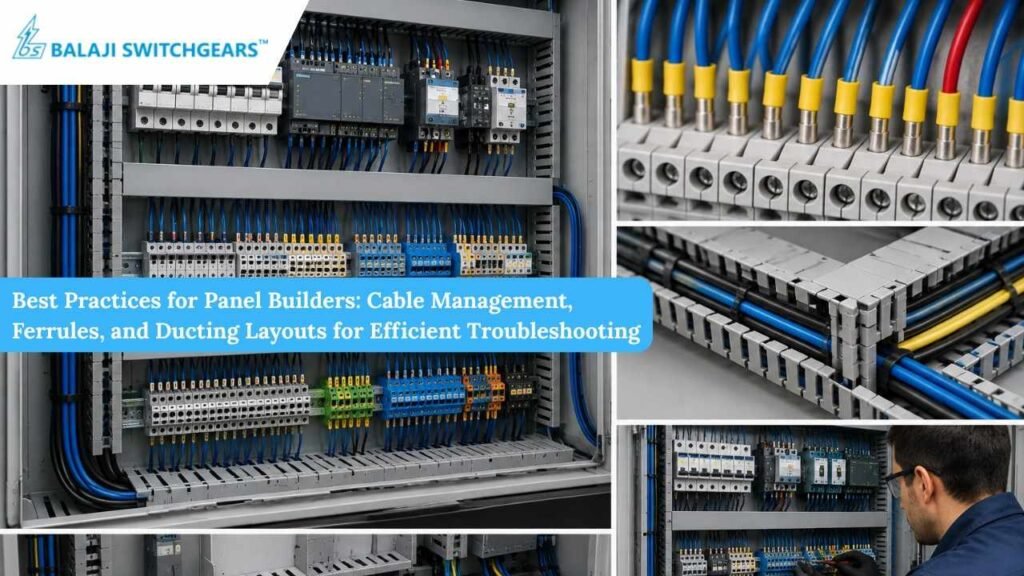
Industrial control panels are the backbone of every automated facility. They house critical electrical components that control machines, manage production processes, distribute power, and ensure smooth communication between equipment. While the selection of quality components such as PLCs, MCCBs, relays, contactors, and terminal blocks is essential, the overall performance of a control panel also depends heavily on how well it is built.
One of the most overlooked aspects of panel building is cable management. A neatly wired control panel is not just visually appealing; it directly impacts reliability, maintenance, safety, and troubleshooting efficiency. Poor cable routing, improper ferrule selection, overcrowded wiring ducts, and inconsistent labelling can turn even the best-designed panel into a maintenance nightmare.
For panel builders and OEMs, following structured wiring practices is not simply about aesthetics. It is about creating electrical systems that are easier to install, faster to maintain, safer to operate, and capable of supporting future upgrades.
This blog explores the best practices for cable management, ferrule usage, and ducting layouts that every panel builder should follow to improve troubleshooting efficiency and ensure long-term panel reliability.
Why Good Panel Wiring Matters
A control panel may contain hundreds or even thousands of individual wire connections. Every wire plays a specific role in ensuring that power, control signals, and communication data reach the correct destination.
When wiring is poorly organized, maintenance engineers spend unnecessary time identifying cables, tracing circuits, and locating faults. This increases machine downtime and maintenance costs.
A well-organised control panel offers several operational advantages.
It improves installation quality.
It simplifies future modifications.
It reduces wiring errors.
It speeds up maintenance.
It enhances electrical safety.
It improves airflow inside the enclosure.
It supports long-term reliability.
For industries where downtime directly affects productivity, efficient panel design becomes a valuable investment.
Planning Before Wiring Begins
Efficient cable management starts long before the first wire is installed.
Successful panel builders begin by carefully studying electrical drawings, component layouts, and wiring diagrams.
Proper planning helps determine:
Cable routing paths
Terminal block locations
Wire lengths
Duct sizes
Entry and exit points
Future expansion space
This approach minimizes unnecessary wire crossings and prevents congestion later in the assembly process.
Planning also helps maintain a clean and professional panel layout.
Organize Cables by Function
One of the most effective wiring practices is separating cables according to their function.
Different cable categories should be routed independently whenever possible.
Typical cable groups include:
Power cables
Control wiring
Communication cables
Instrumentation cables
Safety circuits
Analogue signal cables
Digital input and output wiring
Separating these cable types reduces electrical interference and makes troubleshooting much easier.
Maintenance engineers can quickly identify the relevant wiring without tracing through unrelated circuits.
Keep Cable Routing Logical and Consistent
Every wire inside a control panel should follow a logical route.
Random cable routing creates confusion during maintenance.
A structured routing approach allows technicians to predict where cables will travel before opening the panel.
Horizontal and vertical routing is generally preferred.
Avoid unnecessary diagonal wiring whenever possible.
Maintain consistent routing throughout the panel.
This organized appearance significantly improves troubleshooting speed.
Select the Correct Wire Size
Proper conductor sizing is essential for both safety and performance.
Undersized wires may overheat under load.
Oversized wires create unnecessary congestion inside wiring ducts.
Panel builders should always select conductor sizes according to:
Current rating
Voltage requirements
Applicable standards
Environmental conditions
Using the correct wire size ensures safe operation while improving cable management.
Use Ferrules for Reliable Wire Termination
Ferrules are small metal sleeves crimped onto the ends of stranded conductors before they are inserted into terminals.
Although they appear to be simple accessories, ferrules play a major role in improving connection quality.
Without ferrules, individual wire strands may spread during installation.
Loose strands can create poor electrical contact or accidental short circuits.
Properly crimped ferrules provide a compact, secure, and reliable conductor termination.
Benefits of Using Ferrules
Ferrules offer several important advantages.
They improve electrical contact.
They prevent strand damage.
They reduce the risk of loose connections.
They simplify wire insertion.
They improve vibration resistance.
They create professional-looking wiring.
They increase long-term reliability.
For industrial control panels, ferrules have become a standard best practice rather than an optional accessory.
Select the Right Ferrule Size
Using the wrong ferrule size can compromise connection quality.
The ferrule should always match the conductor size.
A ferrule that is too small cannot accommodate the conductor properly.
A ferrule that is too large creates loose electrical connections.
Proper crimping tools should also be used to ensure uniform compression.
High quality crimping improves both electrical conductivity and mechanical strength.
Label Every Wire Clearly
Wire identification is one of the most valuable troubleshooting tools.
Every wire should have a unique identification number corresponding to the electrical drawings.
Clear labelling allows technicians to locate circuits quickly without manually tracing each conductor.
Labels should be:
Easy to read
Durable
Resistant to heat
Resistant to chemicals
Permanent throughout the equipment life
Well labelled panels dramatically reduce maintenance time.
Design Wiring Ducts with Future Expansion in Mind
Cable ducts are often underestimated during panel design.
Many panels become overcrowded because ducts were sized only for the initial installation.
Future modifications become extremely difficult.
Whenever possible, allow spare capacity inside wiring ducts.
Extra space simplifies:
Future wiring additions
Maintenance activities
Cable replacement
System upgrades
Expansion planning improves long-term usability.
Avoid Overcrowding Cable Ducts
Overfilled ducts create multiple problems.
Cables become difficult to identify.
Air circulation decreases.
Maintenance becomes more complicated.
Wire insulation may become damaged during installation.
Industry best practices recommend maintaining spare capacity inside cable ducts rather than filling them completely.
Organized ducts improve both appearance and serviceability.
Maintain Proper Cable Bend Radius
Every cable has a minimum recommended bend radius.
Excessive bending places mechanical stress on conductors and insulation.
Sharp bends may eventually cause conductor damage or insulation failure.
Gentle cable routing improves long-term reliability.
It also creates a cleaner panel appearance.
Separate Power and Signal Wiring
Power cables generate electromagnetic fields.
Sensitive communication and instrumentation cables can be affected by these fields.
Routing these cable types together may result in:
Signal interference
Communication errors
Measurement inaccuracies
Unstable automation performance
Separate routing significantly improves system reliability.
When crossings are unavoidable, they should occur at right angles whenever practical.
Create Accessible Wiring Paths
Maintenance engineers frequently need access to wiring during troubleshooting.
Avoid routing cables directly over critical components.
Terminal blocks, relays, PLC modules, and power supplies should remain easily accessible.
Accessible layouts reduce maintenance time and improve technician safety.
Use Colour Coding Consistently
Consistent colour coding improves wiring identification.
Although standards vary between industries and regions, maintaining consistency throughout the panel is essential.
Colour coding allows technicians to distinguish:
Power circuits
Neutral conductors
Protective earth
Control wiring
Safety circuits
Communication wiring
Visual identification speeds maintenance and reduces errors.
Secure Cables Properly
Loose cables create mechanical stress on electrical connections.
Proper cable fastening prevents unnecessary movement during transportation and equipment operation.
Cable ties, clamps, and mounting accessories should provide secure support without excessively compressing the cable insulation.
Proper support extends cable life and improves overall panel quality.
Design for Easy Troubleshooting
A well-built control panel should allow maintenance engineers to identify problems quickly.
Several design practices contribute to efficient troubleshooting.
Logical wire numbering
Clearly labelled terminal blocks
Accessible components
Consistent cable routing
Adequate spacing between devices
Well-organized ducting
Accurate documentation
These practices reduce troubleshooting time significantly.
Keep Documentation Updated
Panel documentation is just as important as physical wiring.
Electrical drawings should accurately reflect the installed panel.
Whenever modifications occur, documentation should also be updated.
Current documentation helps technicians identify circuits quickly and avoid wiring errors during maintenance.
Use High Quality Wiring Accessories
The quality of accessories directly affects panel reliability.
Reliable panel builders use trusted products for:
Terminal blocks
Ferrules
Cable ducts
Cable glands
Markers
Cable ties
DIN rail accessories
Low-quality accessories often become the weakest point of the electrical system.
Choosing dependable products improves long-term performance.
Plan Ventilation Around Cable Layout
Cable management also influences enclosure cooling.
Poor routing may block airflow around heat generating components.
Adequate spacing between cable bundles and equipment allows better heat dissipation.
Improved airflow helps maintain lower enclosure temperatures and extends equipment life.
Consider Future Automation Requirements
Industrial control panels continue to evolve.
New communication devices, sensors, drives, and monitoring systems are frequently added during plant expansion.
Panel layouts should anticipate future technologies.
Providing spare duct capacity, additional DIN rail space, and organized cable routing simplifies future upgrades.
Future-ready designs reduce modification costs.
Common Cable Management Mistakes
Many panel builders unintentionally create maintenance challenges by making avoidable mistakes.
Common issues include:
Overfilled wiring ducts
Inconsistent wire numbering
Poor cable segregation
Incorrect ferrule selection
Improper crimping
Loose cable routing
Sharp cable bends
Missing documentation
Insufficient expansion space
Avoiding these mistakes improves both reliability and serviceability.
The Long-Term Value of Good Panel Building Practices
Well-organized panels deliver benefits throughout the equipment lifecycle.
Installation becomes faster.
Commissioning is smoother.
Maintenance requires less time.
Troubleshooting becomes more efficient.
Future modifications are easier.
Equipment reliability improves.
Although good cable management requires additional attention during assembly, it significantly reduces operational costs over many years.
For OEMs and panel builders, investing time in quality workmanship creates long-term value for both the manufacturer and the end user.
Conclusion
Efficient cable management is one of the defining characteristics of a high-quality electrical control panel. Proper cable routing, correct ferrule selection, organised ducting layouts, clear labelling, and structured wiring practices not only create a professional appearance but also improve safety, simplify maintenance, reduce downtime, and enhance long-term reliability.
As industrial automation systems become increasingly complex, the importance of organised panel building will continue to grow. Following proven best practices enables panel builders to deliver electrical systems that are easier to commission, troubleshoot, expand, and maintain throughout their operational life.
For panel builders and industrial customers seeking dependable electrical solutions, Balaji Switchgears offers a comprehensive range of premium wiring accessories, terminal blocks, cable management solutions, and panel components from leading global brands. With extensive expertise in industrial automation, power distribution, and electrical panel solutions, Balaji Switchgears helps customers build reliable, organised, and future-ready control panels that support efficient operations and simplified maintenance for years to come.