
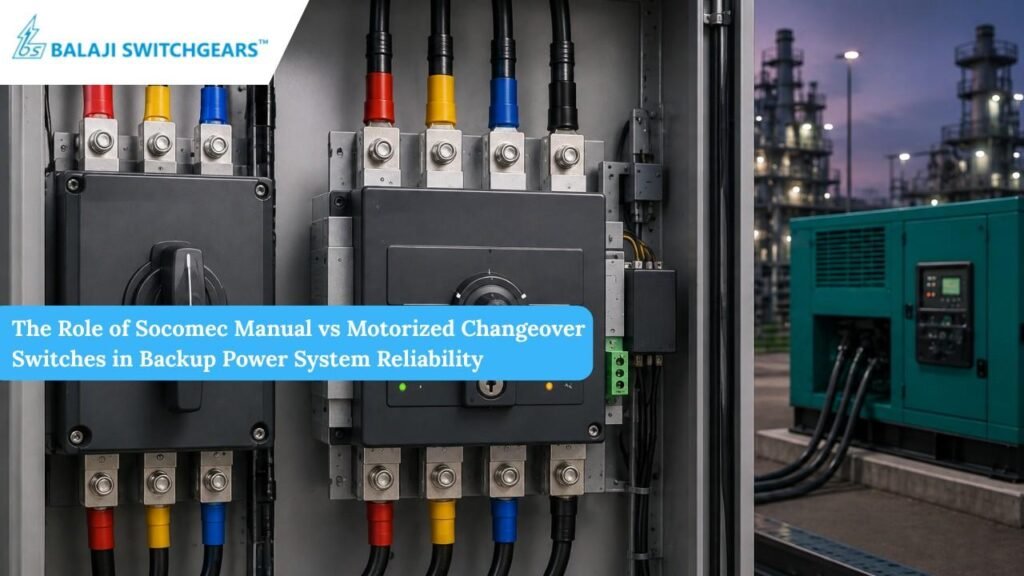
In today’s industrial and commercial world, uninterrupted power is no longer optional. Every minute of power loss can disrupt manufacturing, halt production lines, interrupt critical services, damage equipment, and result in significant financial losses. Industries such as healthcare, pharmaceuticals, data centres, airports, manufacturing plants, commercial buildings, and infrastructure projects all depend on reliable backup power systems to ensure continuous operations during utility power failures.
A backup power system is made up of several important components, including generators, Uninterruptible Power Supplies (UPS), switchgear, protection devices, and one often overlooked but highly critical device: the changeover switch.
A changeover switch acts as the bridge between the primary power source and the backup power source. Its job is to transfer the electrical load safely whenever the main power supply becomes unavailable. The efficiency of this switching process has a direct impact on system reliability.
Among the trusted names in power switching solutions, Socomec has built a strong reputation for manufacturing reliable manual and motorized changeover switches that serve a wide range of industrial applications. While both technologies perform the same fundamental function, they differ significantly in operation, response time, automation capability, and suitability for different environments.
Understanding these differences helps engineers, OEMs, consultants, and facility managers select the right solution based on operational requirements rather than simply choosing the most economical option.
Understanding the Purpose of a Changeover Switch
A changeover switch is an electrical switching device that safely transfers an electrical load between two independent power sources.
Typically, these sources include:
Utility power and diesel generator
Utility power and UPS
Two independent utility supplies
Generator and solar power
Generator and battery storage systems
The primary objective is to ensure that only one power source supplies the electrical load at any given time.
This prevents dangerous situations such as back feeding, protects electrical equipment, and maintains operational safety.
Without a properly designed changeover switch, switching between power sources becomes unsafe and unreliable.
Why Backup Power Reliability Matters
Power interruptions affect every industry differently, but the consequences are often severe.
Manufacturing facilities may experience production losses.
Hospitals cannot afford interruptions to life saving equipment.
Data centres risk losing valuable information.
Commercial buildings may experience complete operational shutdowns.
Even a brief outage can lead to:
Production downtime
Equipment damage
Data loss
Safety hazards
Financial losses
Reduced customer confidence
A reliable backup power system minimizes these risks.
The changeover switch plays a central role in ensuring that backup power becomes available safely and efficiently.
What Is a Manual Changeover Switch?
A manual changeover switch requires human intervention to transfer the electrical load from one power source to another.
When utility power fails, an operator must physically move the switch from the main supply position to the backup supply position.
Once normal power returns, the operator manually transfers the load back to the primary source.
Manual changeover switches are widely used in installations where short interruptions are acceptable and trained personnel are always available.
Socomec manual changeover switches are engineered for safe operation, robust mechanical performance, and long service life, making them suitable for a variety of industrial and commercial applications.
How Manual Changeover Switches Work
The operating sequence is straightforward.
The main power supply fails.
The generator starts, either manually or automatically.
The operator verifies generator stability.
The operator manually moves the changeover switch.
The backup source begins supplying the load.
When utility power returns, the process is repeated in reverse.
The simplicity of this operation makes manual changeover switches reliable and easy to maintain.
Advantages of Manual Changeover Switches
Manual changeover switches offer several practical benefits.
Simple Design
The operating mechanism is straightforward with fewer moving parts.
This contributes to long term mechanical reliability.
Lower Initial Cost
Manual switches generally require a smaller investment compared to automated systems.
This makes them attractive for smaller facilities.
Minimal Maintenance
The simple mechanical design results in fewer maintenance requirements.
Routine inspection is usually sufficient.
High Reliability
With fewer electrical components involved, manual switches perform reliably for many years when properly maintained.
Suitable for Small Installations
Facilities with limited critical loads often find manual switching adequate for their operational needs.
Limitations of Manual Changeover Switches
Despite their advantages, manual systems also have limitations.
Human intervention is always required.
Power restoration takes longer.
Switching depends on operator availability.
Response time varies.
Not suitable for unmanned facilities.
Critical operations may experience unacceptable downtime.
These limitations become increasingly important as operational continuity becomes more critical.
What Is a Motorized Changeover Switch?
A motorized changeover switch automates the transfer process using an electric motor and intelligent control system.
Instead of waiting for an operator, the switch automatically transfers the electrical load whenever the primary power source becomes unavailable.
Once utility power is restored and stabilised, the system automatically transfers the load back.
Socomec motorized changeover switches are designed to provide safe, reliable, and fast source transfer while integrating seamlessly with modern automation systems.
How Motorized Changeover Switches Work
The system continuously monitors the incoming utility supply.
When power failure is detected:
The controller verifies the fault.
The generator receives a start command.
Once generator voltage and frequency stabilize, the motorized mechanism transfers the load automatically.
When utility power returns:
The system confirms stable voltage.
The load transfers back automatically.
The generator shuts down after an appropriate cooling period.
The entire sequence occurs without human intervention.
Advantages of Motorized Changeover Switches
Faster Power Restoration
Automatic switching significantly reduces interruption time.
Critical equipment resumes operation much faster.
Improved Reliability
Automation eliminates delays associated with manual operation.
The switching process remains consistent every time.
Continuous Monitoring
Motorized systems continuously monitor power quality.
They respond immediately to abnormal conditions.
Ideal for Critical Facilities
Hospitals
Data centres
Airports
Industrial automation
Telecommunication facilities
Commercial complexes
These facilities require uninterrupted power where automatic switching becomes essential.
Remote Operation
Many modern motorized changeover switches support remote monitoring and control.
Operators can supervise system status without being physically present.
Limitations of Motorized Changeover Switches
Motorized systems involve higher initial investment.
They require electrical control circuits.
Installation is more sophisticated.
Periodic testing of automation functions is necessary.
However, for critical operations, these considerations are generally outweighed by the operational benefits.
Comparing Manual and Motorized Changeover Switches
Although both technologies perform the same basic function, they serve different operational requirements.
Manual changeover switches depend on operator intervention, making them suitable for facilities where brief interruptions are acceptable and trained personnel are always available. They are simple, economical, and require minimal maintenance.
Motorized changeover switches, on the other hand, operate automatically without human involvement. They provide faster transfer times, improve operational continuity, support remote monitoring, and are ideal for mission critical applications where uninterrupted power is essential.
Rather than asking which technology is better, the more important question is which technology best matches the facility’s operational needs.
Applications Best Suited for Manual Changeover Switches
Manual systems remain an excellent choice for:
Small commercial buildings
Warehouses
Small manufacturing units
Agricultural facilities
Residential backup systems
Temporary installations
Locations where occasional outages are acceptable
These applications benefit from simplicity and lower installation costs.
Applications Best Suited for Motorized Changeover Switches
Automatic systems are preferred in:
Hospitals
Data centres
Industrial production facilities
Pharmaceutical manufacturing
Oil and gas installations
Airports
Large commercial buildings
Water treatment plants
Critical infrastructure
In these environments, uninterrupted power directly impacts safety, productivity, and business continuity.
Why Socomec Changeover Switches Stand Out
Socomec has decades of experience in designing reliable power switching solutions.
Its changeover switches are engineered to provide:
High operational reliability
Robust mechanical construction
Safe switching between power sources
Excellent electrical endurance
Compliance with international standards
Compatibility with industrial automation systems
Compact installation
Long service life
Whether selecting a manual or motorized solution, users benefit from proven engineering designed for demanding industrial environments.
Factors to Consider Before Selecting a Changeover Switch
Choosing the correct changeover switch requires careful evaluation of several factors.
Criticality of the Load
Determine whether the connected equipment can tolerate brief power interruptions.
Response Time
Critical operations often require immediate source transfer.
Availability of Operators
Facilities without permanent personnel generally benefit from automation.
Future Expansion
Backup systems should support future operational growth.
Integration Requirements
Modern facilities may require communication with Building Management Systems or automation platforms.
Budget
The initial investment should be balanced against long term operational benefits.
Evaluating these factors helps ensure the selected solution delivers both performance and value.
Best Practices for Reliable Backup Power Systems
Regardless of the type of changeover switch selected, certain practices improve overall system reliability.
Conduct regular functional testing.
Inspect mechanical components periodically.
Verify generator readiness.
Monitor power quality.
Follow manufacturer maintenance recommendations.
Train operating personnel.
Document switching procedures.
Preventive maintenance remains essential for maintaining dependable backup power performance.
The Future of Backup Power Switching
As industries continue adopting smart manufacturing and digital infrastructure, backup power systems are becoming increasingly intelligent.
Future changeover solutions will incorporate:
Remote diagnostics
Predictive maintenance
Cloud based monitoring
Real time power analytics
IoT connectivity
Advanced automation
Motorized switching technology will continue evolving alongside Industry 4.0, enabling greater visibility, improved operational efficiency, and enhanced system reliability.
At the same time, manual changeover switches will remain a practical solution for installations where operational simplicity and cost effectiveness are the primary priorities.
Conclusion
A reliable backup power system depends on more than just generators and UPS systems. The changeover switch plays a vital role in ensuring safe, efficient, and dependable power transfer during utility failures. Choosing between a manual and a motorized changeover switch should be based on the facility’s operational requirements, the criticality of connected loads, and the level of automation required.
Manual changeover switches provide a dependable and economical solution for applications where operator intervention is acceptable, while motorized changeover switches deliver faster response, automatic operation, and enhanced reliability for mission critical environments.
For businesses looking to strengthen their backup power infrastructure, Balaji Switchgears offers a comprehensive range of Socomec manual and motorized changeover switches tailored to diverse industrial and commercial applications. With extensive expertise in power distribution, industrial automation, and electrical protection, Balaji Switchgears helps customers select the right Socomec solutions to build safe, reliable, and future ready backup power systems that ensure uninterrupted operations when power matters most.