
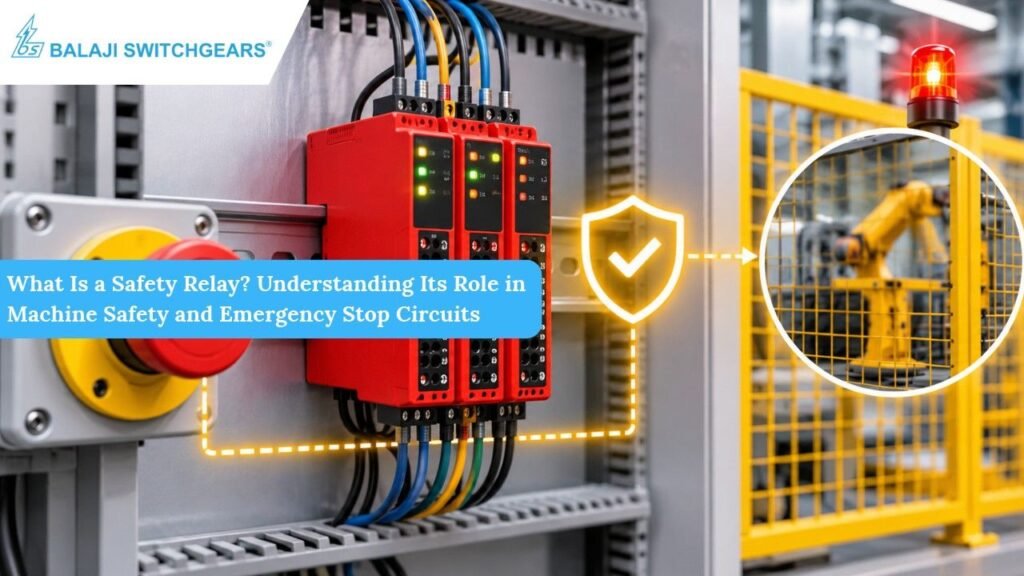
Industrial machines are designed to operate with speed, precision and efficiency. But what happens when an operator opens a machine guard while equipment is running, presses an emergency stop button or a safety sensor detects someone entering a hazardous area?
In such situations, stopping the machine is not simply a matter of switching off the power. The safety system must detect the condition, evaluate the signal and initiate the required safe response. This is where a safety relay plays an important role.
Unlike a conventional control relay, a safety relay is specifically designed for safety-related control functions. It monitors safety devices, such as emergency stop switches, safety door switches and light curtains, and helps ensure that the machine responds appropriately when a safety condition is triggered.
For manufacturers, machine builders and industrial facilities, understanding safety relays is essential for designing reliable machine safety systems. At Balaji Switchgears, we support industrial customers with automation and safety solutions, including Omron safety relays, to help meet their machine control and safety requirements.
Let us understand how safety relays work, why they are used in emergency stop circuits and what engineers should consider when selecting them.
1. What Is a Safety Relay?
A Safety relay is an electrical safety component used to monitor safety devices and control the operation of machinery when a potentially hazardous condition is detected.
It receives signals from safety-related input devices, checks their status and controls safety outputs connected to appropriate stopping or isolation devices.
For example, consider an industrial machine with a protective door. If an operator opens the door while the machine is running, the door safety switch sends a signal to the safety relay. The relay processes this input and changes its safety output state, initiating the required machine stop through the connected control components.
The main purpose is to help prevent hazardous machine operation when a safety condition is not satisfied.
Safety relays are commonly used in:
- Industrial machinery and machine tools
- Packaging and bottling equipment
- Conveyor and material-handling systems
- Robotic workstations
- Automated production lines
- Manufacturing and assembly systems
A safety relay is not simply another switching component inside a control panel. It is part of a safety-related control system designed to reduce risks to operators and maintenance personnel.
2. How Does a Safety Relay Work?
To understand its operation, it helps to look at a basic machine safety arrangement.
A typical safety relay system involves three main stages:
Input → Safety Logic → Output
Input: Safety devices detect a condition
The safety relay receives signals from connected safety devices, such as:
- Emergency stop push buttons
- Safety door switches
- Guard interlock switches
- Safety light curtains
- Other compatible safety sensors
These devices communicate whether the machine’s safety conditions are satisfied.
Safety logic: The relay monitors the signals
The safety relay checks the incoming signals according to its designed safety logic. Depending on the model and configuration, it may monitor dual-channel inputs, detect certain wiring faults and check the condition of connected output devices through a feedback circuit.
If an unsafe condition or a monitored fault is detected, the relay changes its safety output state.
Output: The machine is brought to a safe state
The safety outputs are connected to suitable final switching devices, such as contactors or other safety-related actuators.
When the safety relay removes its output, these devices initiate the required stopping or energy-isolation action.
The exact stopping behaviour depends on the machine design, the selected components and the safety function.
This input, logic and output arrangement allows different safety devices to work together as part of a coordinated machine safety system.
3. Why Is a Safety Relay Important in Emergency Stop Circuits?
An emergency stop button is one of the most recognisable safety devices on industrial machinery. Its purpose is to allow an operator to initiate an emergency stop when a dangerous situation occurs.
However, an emergency stop button alone does not automatically provide a complete safety system.
The signal from the emergency stop device must be processed by a suitable safety-related control arrangement, and the machine must have appropriate output devices capable of carrying out the required stopping action.
A safety relay helps perform this monitoring and control function.
Consider an example:
An operator notices an unsafe situation near a conveyor and presses the emergency stop button.
- The emergency stop device changes the state of its safety contacts.
- The safety relay detects the change in its input circuit.
- The relay switches its safety outputs to the required safe state.
- Connected contactors or other final switching devices initiate the machine stop.
- The machine remains prevented from restarting until the required release and reset conditions are satisfied.
This arrangement helps ensure that an emergency stop signal is handled through a dedicated safety-related circuit rather than relying only on an ordinary control command.
It is also important to understand that an emergency stop is a supplementary protective measure. It does not replace machine guarding, interlocking or other risk-reduction measures.
4. Safety Relay vs Conventional Relay: What Is the Difference?
Both safety relays and conventional relays are used in electrical control systems, but their intended applications are different.
A conventional relay is generally used to switch electrical circuits according to a control signal. It may be used for automation sequences, interlocking functions and general machine control.
A safety relay is designed for safety-related applications and incorporates features intended to help detect certain faults and maintain the required safety function.
Here are the main differences:
| Parameter | Conventional Relay | Safety Relay |
| Primary purpose | General electrical switching | Safety-related monitoring and control |
| Typical inputs | Control signals | Emergency stops, guard switches and safety sensors |
| Contact arrangement | Depends on relay design | Safety-oriented contact arrangements |
| Fault monitoring | Not necessarily provided | Designed to detect specified faults |
| Typical application | General automation | Machine safety circuits |
| Safety standards | Depends on application | Selected according to relevant safety requirements |
One important feature found in many safety relays is forcibly guided contacts. This mechanical arrangement helps maintain a defined relationship between normally open and normally closed contacts, allowing certain contact-welding faults to be detected through the appropriate monitoring circuit.
However, not every safety relay has identical functions. Engineers must check the manufacturer’s specifications before selecting a device.
A conventional relay should not be substituted for a safety relay in a safety-related application simply because its voltage and current ratings appear suitable.
5. Key Features to Look for in a Safety Relay
Selecting a safety relay requires more than checking its supply voltage or the number of output contacts. The device must match the safety function and the overall machine design.
Some important features include:
Dual-channel input monitoring
Many safety applications use two input channels to improve fault detection. A suitable safety relay can monitor these channels and detect certain discrepancies or wiring faults, depending on its design.
Forcibly guided contacts
These contacts help the monitoring arrangement identify certain internal contact failures, such as contact welding.
Manual and automatic reset options
Some safety applications require manual reset after a safety event. This means an operator must deliberately initiate the reset after the safety conditions have been restored. Automatic reset may be suitable for specific applications, but it must be selected only after evaluating the machine’s risk and restart behaviour.
Feedback monitoring
External Device Monitoring (EDM) checks the condition of connected output devices, such as contactors, through suitable feedback contacts. This can help prevent a restart if an output device has failed to return to its expected state.
Diagnostic indicators
LED indicators and status displays can help maintenance personnel identify the operating condition of safety inputs and outputs, making troubleshooting more efficient.
Response time
The relay’s response time is one factor in determining how quickly the safety system reacts. The complete machine stopping time must also account for the connected switching devices and the machine’s mechanical stopping characteristics.
6. Where Are Safety Relays Used in Industrial Applications?
Safety relays are used wherever machinery requires monitored safety functions.
Packaging and bottling machines
Packaging lines contain moving belts, cutting mechanisms, sealing units and other moving components. Safety relays can monitor emergency stop buttons, protective doors and compatible safety sensors to initiate the required stop when a safety condition is triggered.
Conveyor systems
Conveyors are widely used in warehouses, factories and material-handling facilities. Emergency stop switches and rope-pull switches can be connected to suitable safety relay arrangements to help stop the conveyor during an emergency.
Machine tools
Machines such as drilling, milling and cutting equipment may include rotating components and moving work surfaces. Safety door interlocks and emergency stop circuits can be monitored through suitable safety control devices.
Robotic workstations
Robotic systems may operate at high speeds and within defined working zones. Safety relays can be used in suitable applications to monitor protective guards, access doors and emergency stop devices.
Automated production lines
In automated facilities, several machines may operate together. Safety functions must be planned according to the risks and operating requirements of each machine or safety zone.
The safety architecture should always be designed according to the application rather than using the same relay arrangement for every machine.
7. Understanding Safety Standards and Performance Requirements
Safety relay selection should be based on the risk assessment of the machine and the required performance of its safety functions.
Two important standards used in machinery safety design are:
EN ISO 13849-1
This standard addresses safety-related parts of control systems and provides a framework for determining and evaluating their required performance levels.
Performance Levels range from PL a to PL e, with PL e representing the highest level in this classification.
IEC 62061
This standard addresses the functional safety of safety-related control systems for machinery. It uses Safety Integrity Levels (SIL) to specify and evaluate safety performance requirements.
A safety relay may have a stated capability such as PL e or SIL 3, depending on the product and applicable certification. However, installing a relay with a high safety rating does not automatically make the entire machine compliant.
The complete safety function must be assessed, including input devices, wiring, logic, output devices, architecture, diagnostics and other relevant factors.
Machine risk assessment and safety validation should be carried out by qualified professionals using the applicable standards and regulations.
8. How to Choose the Right Safety Relay for Your Machine
The right safety relay depends on the machine’s safety requirements, connected devices and required stopping behaviour.
Before selecting a model, consider the following:
- Identify the safety function: Determine whether the application requires emergency stop monitoring, guard-door monitoring, light curtain monitoring or multiple safety functions.
- Check input requirements: Confirm the number of channels, input compatibility and monitoring requirements of the connected safety devices.
- Evaluate safety performance: Establish the required Performance Level or SIL through the machine risk assessment.
- Check output requirements: Verify the number and type of safety outputs and whether they are suitable for the connected contactors or other final switching devices.
- Consider reset and feedback: Determine whether manual reset, automatic reset or external device monitoring is required.
- Review response and stopping time: Ensure that the complete safety system meets the machine’s required stopping performance.
- Consider panel installation: Check mounting dimensions, supply voltage, terminal arrangement and available diagnostic features.
Selecting the relay without evaluating the complete circuit can create gaps in the intended safety function. Proper integration and validation are just as important as choosing the device itself.
9. Omron Safety Relays and Balaji Switchgears
When it comes to industrial machine safety, choosing a reliable safety component and integrating it correctly are both important.
Balaji Switchgears is an authorised Omron distributor, offering industrial automation products that include safety relays, safety door switches, sensors, PLCs, power supplies and other control components.
One relevant example is the Omron G9SE Safety Relay Unit. The G9SE range is designed for safety applications involving devices such as emergency stop switches, door switches and light curtains.
Depending on the model, the G9SE series offers:
- Compact housing to help save control-panel space
- Safety output configurations for different applications
- Models with OFF-delay safety outputs
- Push-In Plus terminal blocks for easier wiring
- Diagnostic indicators for monitoring safety inputs and outputs
The range includes models such as G9SE-201, G9SE-401 and G9SE-221 variants. The appropriate model should be selected according to the required safety function, output arrangement and application specifications.
At Balaji Switchgears, we support OEMs, panel builders, system integrators and industrial end users in identifying suitable automation and safety products for their requirements.
Our focus is not simply on supplying a component, but on helping customers make informed selections based on their machine applications and control-panel requirements.
Final Thoughts
Machine safety should never be treated as an afterthought. A machine may have emergency stop buttons, protective doors and safety sensors, but these devices need to work together through an appropriately designed safety-related control system.
A safety relay plays an important role in this arrangement by monitoring safety inputs, detecting specified faults and controlling safety outputs to initiate the required machine response.
For industrial facilities, selecting the right safety relay involves understanding the machine’s risks, input devices, output requirements, performance level and stopping behaviour.
At Balaji Switchgears, we help customers explore suitable industrial automation and machine safety solutions from trusted brands such as Omron. As an authorised Omron distributor, we aim to support reliable product selection for safer and more dependable industrial operations.
Looking for an Omron safety relay for your machine safety application? Connect with Balaji Switchgears for product assistance and automation solutions.