
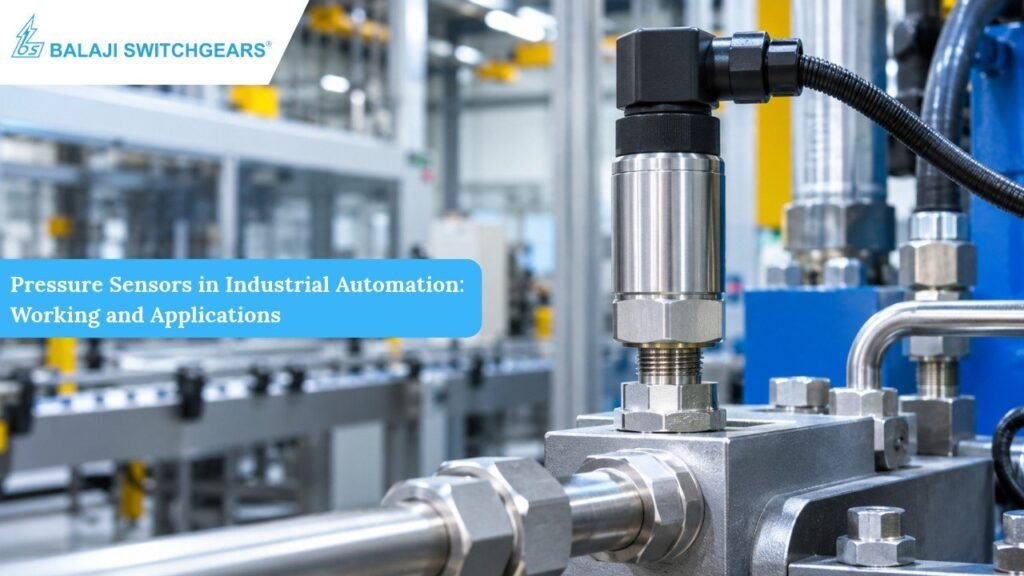
In an industrial production line, pressure is often an important indicator of whether a machine is operating correctly. A hydraulic system may need consistent pressure to move a component, a pneumatic machine may depend on compressed air to operate its actuators, and a cooling system must maintain suitable pressure to support continuous equipment operation.
But what happens when the pressure suddenly drops, rises beyond the required level or starts fluctuating without being noticed?
The result can be reduced machine performance, product quality issues, leakage, equipment damage or unexpected production downtime.
This is where pressure sensors in industrial automation play an important role. They continuously measure pressure in gases or liquids and convert the measurement into an electrical signal that can be monitored by controllers, automation systems and operators.
For industrial facilities, pressure sensors are not just measurement devices. They are an important part of process monitoring, machine control and early fault detection.
In this blog, we explain how industrial pressure sensors work, their different types, applications and the important factors to consider when selecting one.
What Is a Pressure Sensor?
A pressure sensor is an electronic device that measures the pressure of a gas or liquid and converts it into an electrical output.
It contains a pressure-sensitive element, commonly involving a diaphragm, that responds when pressure is applied. The resulting physical change is converted into an electrical signal that represents the measured pressure.
This signal can be displayed locally, transmitted to a PLC or connected to a monitoring system, depending on the sensor’s output and the automation arrangement.
For example, consider a hydraulic machine used in industrial manufacturing. The machine requires a specific pressure level to operate its hydraulic mechanism. A pressure sensor installed in the hydraulic circuit measures the pressure continuously. If the pressure changes unexpectedly, the system can identify the abnormal condition and initiate an appropriate response through the connected control system.
In this way, pressure sensors help operators understand what is happening inside a machine or process without relying only on manual inspection.
How Does a Pressure Sensor Work?
The working principle of a pressure sensor begins with the physical pressure applied to its sensing element.
Here is how the process generally works:
Step 1: Pressure Application
The sensor is connected to a pipe, tank, hydraulic line or pneumatic system. The pressure of the medium acts on its pressure-sensitive element.
Step 2: Sensing Element Responds
The pressure causes a small mechanical change in the diaphragm or sensing structure. The amount of deformation depends on the applied pressure and the sensor’s design.
Step 3: Conversion into an Electrical Signal
An internal sensing technology converts this physical change into an electrical variation. In piezoresistive sensors, for example, diaphragm deformation changes the electrical resistance of the sensing element.
Other sensor designs may use changes in capacitance or different measurement technologies.
Step 4: Signal Processing and Output
The sensor’s electronics process the measured signal and provide an output. Depending on the model, this may be a switching output, an analogue signal or a digital communication output.
Step 5: Monitoring and Control
The output can be used by a PLC, controller, display or monitoring system to observe pressure conditions and take suitable action.
This continuous measurement helps industrial systems identify pressure changes and respond according to the programmed control requirements.
Types of Pressure Measurement
Before selecting an industrial pressure sensor, it is important to understand what type of pressure the application needs to measure.
1. Gauge Pressure
Gauge pressure measures pressure relative to the surrounding atmospheric pressure.
For example, a pressure sensor installed in a compressed-air line generally measures how much pressure exists above atmospheric pressure.
This measurement is commonly used in pneumatic systems, compressors and industrial utility lines.
2. Absolute Pressure
Absolute pressure measures pressure relative to a perfect vacuum.
It is useful in applications where atmospheric pressure variations must be included in the measurement, such as certain vacuum systems and process applications.
3. Differential Pressure
Differential pressure measures the difference between pressure at two separate points.
It can be used to monitor pressure drops across filters, equipment or other components. It is also useful in applications where pressure difference is used to assess flow conditions.
The correct measurement type depends on the process and the reference pressure required.
Major Applications of Pressure Sensors in Industrial Automation
Pressure sensors are used across different industries because pressure affects the performance of machines, fluid systems and production processes.
1. Hydraulic Systems
Hydraulic machines use pressurised fluid to generate force and perform mechanical operations.
Applications include hydraulic presses, injection moulding machines, lifting systems and industrial machinery.
A pressure sensor monitors the hydraulic pressure and helps identify unusual changes that may indicate leakage, pressure loss or abnormal operating conditions.
For example, if a hydraulic press requires a particular pressure to perform a production operation, continuous pressure monitoring helps operators verify whether the system is operating within the required range.
2. Pneumatic Automation Systems
Pneumatic systems use compressed air to operate cylinders, valves and other machine components.
Pressure sensors help monitor the compressed-air supply and identify insufficient or fluctuating pressure.
This is particularly important in automated packaging lines, assembly machines and material handling equipment, where inconsistent air pressure can affect actuator movement and machine performance.
3. Compressor and Air Supply Monitoring
Industrial compressors supply compressed air to multiple machines and production areas.
Pressure monitoring helps ensure that the supply remains within the required operating range. It can also help identify abnormal pressure drops, possible leakage or changes in compressor performance.
When connected to an appropriate control system, pressure measurements can support automatic monitoring and operational decisions.
4. Water and Cooling Systems
Industrial equipment often requires cooling water to maintain suitable operating temperatures.
A pressure sensor can monitor pressure in the cooling circuit and help identify abnormal conditions such as pressure loss or unexpected fluctuations.
Omron’s E8FC IoT Flow Sensor is also relevant in cooling applications because it measures flow rate and temperature together. Although it is a flow sensor rather than a pressure sensor, it demonstrates how combining process measurements can help identify abnormal cooling conditions.
5. Chemical and Process Industries
Chemical processing systems may involve liquids and gases moving through pipes, tanks and processing equipment.
Pressure monitoring helps operators observe process conditions and identify deviations from the required operating range.
Sensor selection is particularly important in these applications. The sensing element, housing and process connection must be compatible with the medium, operating pressure and environmental conditions.
6. Leak Detection and Machine Monitoring
A gradual pressure drop in a pneumatic or hydraulic system may indicate leakage or another developing issue.
Pressure sensors can help identify these changes by continuously monitoring the system. Depending on the application, the measurements can be used to generate alarms, trigger maintenance checks or initiate suitable control actions.
This helps maintenance teams investigate problems before they lead to larger operational interruptions.
Why Are Pressure Sensors Important for Industrial Automation?
Pressure sensors support more than basic pressure measurement. When integrated into an automation system, they help improve visibility into machine and process conditions.
Some important benefits include:
Real-Time Monitoring: Continuous measurement allows operators to observe pressure conditions while equipment is running.
Early Abnormality Detection: Unexpected pressure changes can indicate leakage, blockages, supply problems or developing equipment issues.
Improved Process Control: Pressure readings can be used by PLCs and controllers to regulate valves, pumps and other connected equipment.
Reduced Manual Inspection: Digital displays and connected monitoring systems can make pressure readings easier to access.
Better Equipment Protection: Suitable alarms and control logic can help prevent operation under abnormal pressure conditions.
Improved Maintenance Planning: Pressure trends can help maintenance teams investigate recurring problems and identify changes in equipment behaviour.
The benefits depend on the quality of the sensor installation, monitoring arrangement and response programmed into the control system.
Omron E8PC: Pressure and Temperature Monitoring Together
For industrial applications where pressure changes can indicate developing equipment problems, Omron offers the E8PC IoT Pressure Sensor.
Unlike a basic pressure measurement device, the E8PC measures pressure and temperature simultaneously. Omron positions it for detecting signs of abnormalities in hydraulic oil and sealant applications.
This combined measurement can provide additional information about the operating condition of the monitored system.
For example, in a hydraulic application, pressure and temperature trends can help maintenance teams investigate changes in operating conditions. A change in either parameter may indicate that the system needs attention.
The E8PC is part of Omron’s IoT sensor portfolio, which supports more informed equipment monitoring.
It is important to select the exact model according to the required pressure range, medium compatibility, installation arrangement and communication requirements. Product availability and supported models should also be verified for the intended market.
7 Important Factors to Consider When Selecting an Industrial Pressure Sensor
Not every pressure sensor is suitable for every industrial application. Before selecting a model, evaluate the following factors.
1. Pressure Range
Identify the minimum and maximum pressure expected during normal operation. The selected sensor should cover the required measurement range while accounting for possible pressure fluctuations.
2. Type of Medium
Check whether the sensor will measure air, water, hydraulic oil, sealant or another medium. The sensing element and wetted materials must be compatible with the application.
3. Measurement Type
Determine whether the application requires gauge, absolute or differential pressure measurement.
4. Output and Communication
Check whether the automation system requires an ON/OFF switching output, an analogue signal or a digital communication interface.
The output must be compatible with the connected PLC, controller or monitoring equipment.
5. Accuracy and Response Time
For applications requiring precise pressure regulation, evaluate measurement accuracy, repeatability and response time.
The sensor should be capable of detecting changes at a speed suitable for the process.
6. Installation and Process Connection
Consider the available mounting space, pressure port size, connection type and orientation. Correct installation helps ensure reliable measurement.
7. Environmental Conditions
Industrial sensors may operate in areas exposed to vibration, moisture, dust, temperature variations or electrical noise.
Check the specified operating conditions and protection rating before selecting the sensor.
Common Mistakes to Avoid When Selecting Pressure Sensors
Even a suitable pressure sensor may not deliver reliable results if it is incorrectly selected or installed.
Some common mistakes include:
- Selecting a pressure range that does not match the actual operating conditions.
- Ignoring the compatibility of the sensor with the measured liquid or gas.
- Choosing an output that cannot communicate with the existing control system.
- Overlooking pressure spikes and fluctuating operating conditions.
- Installing the sensor without considering vibration, mounting or process connection requirements.
- Ignoring calibration, inspection and maintenance requirements.
A proper assessment of the complete application helps avoid these issues and supports dependable pressure monitoring.
How Balaji Switchgears Supports Your Omron Automation Requirements
Selecting the right pressure sensor involves more than matching the pressure range. Understanding the application, measured medium, output requirements and operating conditions is equally important.
As an authorised Omron distributor, Balaji Switchgears offers access to Omron’s industrial automation portfolio, backed by technical guidance to help OEMs, panel builders, system integrators and industrial end users identify suitable products for their applications.
From pressure sensors and other sensing solutions to PLCs, temperature controllers and relays, we support your automation requirements with genuine Omron products and application-based assistance.
Whether you are selecting a new sensor or looking for a suitable replacement, our team can help you evaluate the right options.
Final Thoughts
Pressure sensors play an important role in industrial automation by monitoring pressure variations across hydraulic systems, pneumatic equipment, cooling circuits and industrial processes.
Accurate pressure measurement helps improve process monitoring, identify abnormal conditions and support reliable machine operation.
However, selecting the right sensor requires careful consideration of pressure range, medium compatibility, measurement type, output and installation requirements.
Looking for the right Omron pressure sensor or other industrial automation components?
Connect with Balaji Switchgears, your authorised Omron distributor, for genuine products, technical selection support and assistance with your automation requirements.