
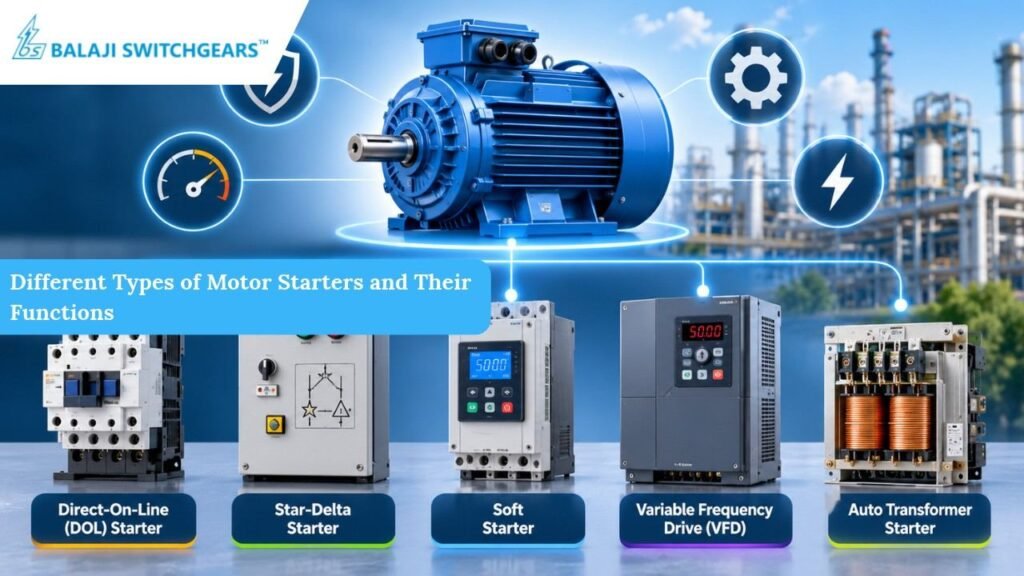
Every pump, fan, compressor and conveyor in an industrial facility depends on a reliable motor-starting system. However, starting an electric motor is not as simple as switching on the power supply. At the moment of starting, an induction motor can draw several times its normal full-load current. This sudden surge can cause voltage drops, unnecessary tripping, mechanical stress and additional wear on connected equipment.
A motor starter helps manage this starting process. It controls the switching of the motor and, depending on its type, can limit starting current, control torque and provide essential motor protection.
Different applications require different starting methods. A small water pump may operate effectively with a Direct-on-Line starter, while a heavy conveyor or industrial compressor may require a soft starter or Variable Frequency Drive (VFD).
Understanding the different types of motor starters and their functions helps plant engineers, OEMs and panel builders select equipment according to motor ratings, load characteristics and operating requirements.
1. Direct-on-Line (DOL) Starter
A Direct-on-Line starter is one of the simplest and most commonly used motor-starting methods. It connects the motor directly to the power supply through a contactor, allowing the motor to receive full supply voltage from the beginning.
A typical DOL starter consists of a contactor, an overload relay and suitable short-circuit protection. When the start command is given, the contactor closes and the motor begins accelerating.
Function: To start and stop motors directly while providing overload and short-circuit protection through the appropriate protective devices.
Starting current: A DOL starter can draw approximately 6–8 times the motor’s full-load current, depending on the motor design.
Suitable applications: Small pumps, fans, workshop machinery, compressors and light-duty conveyors where the electrical supply can accommodate the starting current.
Advantages:
- Simple design and easy installation.
- Lower initial cost.
- High starting torque.
- Straightforward operation and maintenance.
Limitations: The high inrush current can cause voltage dips and place additional stress on mechanical components. It may not be suitable for larger motors or installations with limited supply capacity.
2. Star-Delta Starter
A star-delta starter is a reduced-voltage starting method used with suitable three-phase induction motors. Instead of applying full voltage immediately, it initially connects the motor windings in a star configuration.
Once the motor reaches a predetermined speed, a timer and contactor arrangement changes the winding connection from star to delta for normal operation.
During star starting, each motor winding receives approximately 58% of the line voltage. As a result, the starting line current is typically around one-third of the DOL starting current. Starting torque is also reduced to approximately one-third of the DOL value.
Function: To reduce starting current and limit the initial electrical and mechanical stress on the motor and connected equipment.
Suitable applications: Pumps, fans and compressors that can accelerate under relatively light or moderate starting loads.
Advantages:
- Reduces starting current compared with DOL.
- Relatively economical for suitable motor applications.
- Uses conventional contactors and control components.
- Does not require a power-electronic soft starter.
Limitations: The motor must have the required winding connections and six accessible terminals. Starting torque is lower, which makes this method unsuitable for certain heavy-load starting conditions. The transition from star to delta can also produce a temporary current and torque disturbance.
3. Autotransformer Starter
An autotransformer starter reduces the voltage supplied to the motor during starting. It uses transformer taps to apply a selected percentage of the supply voltage, after which the motor is connected to the full supply for normal operation.
The reduced starting voltage helps limit the current drawn from the supply. Unlike a star-delta starter, an autotransformer starter offers different voltage tap settings, allowing the starting conditions to be selected according to the application.
Function: To reduce motor starting current while providing a more favourable starting-torque-to-line-current relationship than some other reduced-voltage methods.
Suitable applications: Larger motors, industrial pumps, compressors and machinery where direct starting would place excessive demand on the electrical supply.
Advantages:
- Different voltage tap options.
- Reduced supply-side starting current.
- Suitable for larger motor applications.
- Can provide higher starting torque for a given supply current than star-delta starting.
Limitations: The arrangement is more expensive and occupies additional panel space because of the transformer and switching components. The selected tap must also provide sufficient starting torque for the connected load.
4. Rotor Resistance Starter
A rotor resistance starter is used with slip-ring induction motors, also known as wound-rotor motors. In this method, external resistance is connected to the motor’s rotor circuit through slip rings.
At the time of starting, higher resistance is introduced into the rotor circuit. This helps limit starting current while producing high starting torque. As the motor accelerates, the external resistance is gradually removed in stages until the rotor circuit reaches its normal operating configuration.
Function: To provide high starting torque with controlled starting current for heavy-load applications.
Suitable applications: Cranes, hoists, crushers, mills and other machinery that requires high starting torque.
Advantages:
- High starting torque.
- Controlled acceleration under demanding load conditions.
- Suitable for heavy-duty applications using slip-ring motors.
Limitations: This method can only be used with suitable wound-rotor motors. Slip rings, brushes and external resistance equipment require additional maintenance. For many new installations, VFDs are considered as an alternative depending on the application’s requirements.
5. Soft Starter
A soft starter gradually increases the voltage supplied to the motor during starting. It uses power electronic devices, typically thyristors, to control the voltage and help the motor accelerate more smoothly than with direct starting.
Unlike conventional reduced-voltage starters, soft starters can also provide controlled stopping on supported models. This is useful in applications where sudden stopping can cause mechanical stress or process-related problems.
For example, in pumping systems, a controlled stop can help reduce pressure surges and water hammer. In conveyor applications, smoother acceleration can reduce sudden stress on belts, gearboxes and other mechanical components.
Function: To control motor acceleration and, where supported, deceleration by managing the voltage supplied during starting and stopping.
Suitable applications: Pumps, fans, compressors, conveyors and other applications where smoother starting and stopping are required.
Advantages:
- Reduces starting current through configurable starting methods.
- Helps minimise sudden mechanical stress.
- Supports controlled stopping on suitable models.
- Offers features such as current limiting, motor protection and diagnostics depending on the model.
Limitations: A soft starter does not provide continuous motor speed control. Its initial cost is generally higher than conventional DOL and star-delta arrangements.
ABB’s soft starter portfolio includes different ranges for varying application requirements:
- PSR: A compact range for basic soft-start and soft-stop requirements.
- PSE: A general-purpose range with additional functions for applications such as pumps, fans and compressors.
- PSTX: An advanced range offering features such as current limitation, kick-start, braking, diagnostics and communication options, depending on the model.
The appropriate range should be selected according to motor rating, starting frequency, load characteristics and required control functions.
6. Variable Frequency Drive (VFD)
A Variable Frequency Drive controls the speed of an AC motor by adjusting the frequency and voltage supplied to it. Unlike a soft starter, which primarily manages the starting and stopping process, a VFD can control motor speed throughout operation.
It allows the motor to accelerate gradually and operate at different speeds according to process requirements. This makes it particularly useful in applications where the required output changes during operation.
For example, a pump may not need to run at full speed throughout the day. A VFD can adjust its speed according to demand, potentially reducing energy consumption compared with operating the motor continuously at full speed using throttling or other mechanical control methods.
Function: To control motor starting, running speed and deceleration according to the application requirements.
Suitable applications: Variable-flow pumping systems, HVAC equipment, conveyors, mixers, process machinery and applications requiring speed control.
Advantages:
- Provides continuous motor speed control.
- Supports controlled acceleration and deceleration.
- Can improve energy efficiency in suitable variable-load applications.
- Allows motor operation to be adjusted according to process demand.
Limitations: VFDs generally involve a higher initial investment and require consideration of harmonics, motor insulation, cable length, cooling and installation conditions. Correct drive sizing and configuration are essential.
Comparing Different Types of Motor Starters
| Starter Type | Starting Current | Speed Control | Typical Applications |
| DOL | High; typically 6–8 times FLC | No | Small pumps, fans and machinery |
| Star-Delta | Approximately one-third of DOL starting current | No | Pumps, fans and light-starting-load applications |
| Autotransformer | Reduced according to voltage tap | No | Larger motors and heavier loads |
| Rotor Resistance | Controlled starting current with high starting torque | Limited starting-stage control | Cranes, hoists and slip-ring motors |
| Soft Starter | Adjustable through starting settings and current limits | No continuous speed control | Pumps, compressors and conveyors |
| VFD | Controlled according to drive and motor configuration | Yes | Variable-speed processes and energy management |
There is no universal starter that suits every motor. The selection depends on motor power, starting torque, load characteristics, supply capacity, starts per hour and whether speed control is required.
Essential Protection Components in a Motor Starter
Selecting the starting method is only one part of motor control. The starter assembly must also include suitable switching, protection and control components to support safe motor operation.
Contactor: The contactor switches the motor supply on and off. It must be selected according to the motor’s operating current, utilisation category and switching frequency.
Overload Relay: It protects the motor against sustained overload conditions. Thermal and electronic overload relays are commonly used depending on the application. Overload protection must be provided even when the starting arrangement includes other protective devices.
Manual Motor Starter: Also known as a motor protection circuit breaker, this device combines manual switching with thermal and short-circuit protection in a compact arrangement. ABB’s MS132 range, for example, offers motor protection for applications within its specified current range. The exact device rating and required accessories must be checked before selection.
Short-Circuit Protection: Fuses or appropriately selected MCBs and MCCBs help protect the motor feeder against short-circuit faults. Their selection must consider the available fault current and coordination requirements.
Protection Coordination: The contactor, overload relay and short-circuit protective device must be selected as a coordinated combination. IEC Type 1 coordination permits damage to the starter after a short circuit, provided it does not create danger to people or the installation. Type 2 coordination is intended to allow the starter to remain suitable for further service after the fault, subject to the standard’s requirements and manufacturer verification.
For panel builders and plant engineers, using the manufacturer’s coordination tables helps identify compatible combinations for the required motor rating and protection level.
Selecting the Right Motor Starter for Your Application
Before finalising a motor starter, it is important to evaluate the motor and the equipment it operates. A starter that works well for a small centrifugal pump may not be suitable for a loaded conveyor or a high-inertia crusher.
Consider these factors during selection:
- Motor rating: Check the motor’s power, voltage, full-load current and starting characteristics.
- Load type: Identify whether the application involves a pump, fan, compressor, conveyor or heavy machinery.
- Starting torque: Determine the torque required to accelerate the load from standstill.
- Supply capacity: Check whether the electrical supply can accommodate the expected starting current.
- Starting frequency: Consider how many times the motor needs to start and stop during an operating period.
- Control requirements: Establish whether the application needs only starting and stopping or continuous speed control.
- Protection and coordination: Ensure that the contactor, overload relay and short-circuit protective device are correctly selected together.
These checks help avoid oversized or undersized equipment, unsuitable starting methods and unnecessary operating complications.
Motor Starter Selection and ABB Product Support from Balaji Switchgears
Choosing a motor starter is ultimately about matching the starting method and protection arrangement to the motor, load and electrical supply. Whether the application requires a conventional DOL starter, a reduced-voltage starting arrangement, a soft starter or a VFD, the selection must be based on the actual operating requirements.
At Balaji Switchgears, we work with OEMs, panel builders, plant engineers and industrial customers to help identify suitable electrical products for motor control and protection applications.
As an authorised distributor of ABB, we support enquiries for relevant ABB motor control and protection products, including soft starters and motor protection devices. Our focus is on helping customers evaluate the required product ratings, configurations and accessories according to their applications.
For a new motor control panel or an existing installation that needs an upgrade, sharing the motor rating, load type, starting frequency and control requirements helps establish the appropriate product options.
Have a motor control requirement to address? Share your application details and ABB product requirements with Balaji Switchgears. Our team can assist with relevant product enquiries and supply coordination for your motor starting and protection needs.