
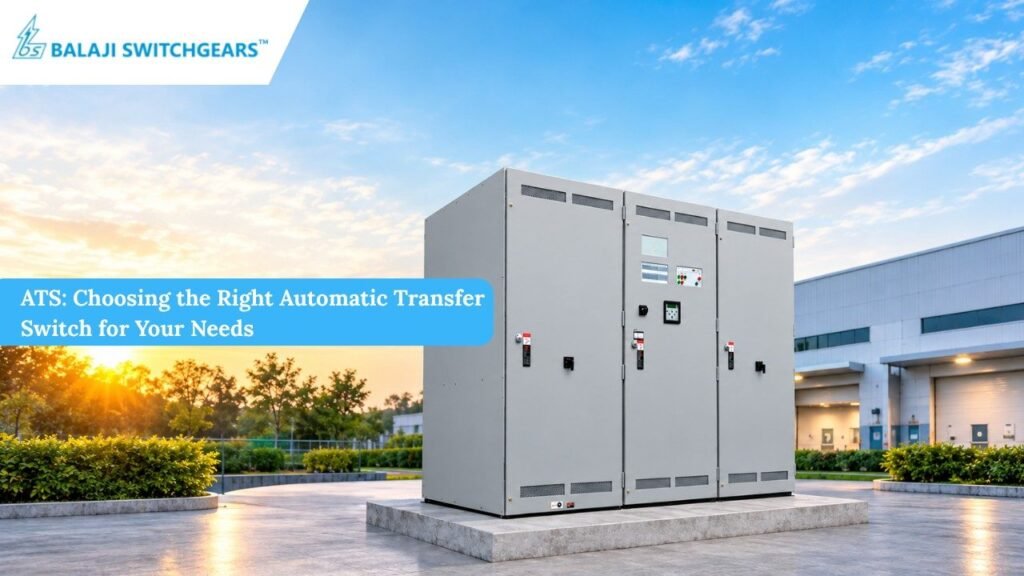
A power outage may last only a few seconds but for a critical operation, those few seconds can be enough to stop production, disrupt essential services, affect sensitive equipment, or create costly downtime.
That is why a backup generator alone is not always enough.
The real question is: when the main power source fails, how quickly and reliably can your electrical system switch to the alternate source?
This is where an Automatic Transfer Switch (ATS) and its controller play a critical role.
An ATS is designed to automatically transfer electrical loads from the primary power source to an alternate source, such as a generator, when predefined power conditions are no longer acceptable. Once the primary supply is restored and stable, the system can transfer the load back according to its programmed operating sequence.
However, choosing an ATS is not simply about selecting an ampere rating and installing a changeover device. The right solution depends on the application, load characteristics, power sources, switching requirements, protection coordination, control requirements and the level of operational continuity needed.
This guide will help you understand the role of an ATS controller and the key factors to consider when selecting the right Automatic Transfer Switch for your needs.
What Is an Automatic Transfer Switch?
An Automatic Transfer Switch is an electrical switching device that manages the transfer of power between two available sources.
In a typical utility-generator application, the process works like this:
- The utility supply powers the connected load under normal conditions.
- The ATS continuously monitors the primary source.
- If the utility supply fails or falls outside the acceptable operating parameters, the ATS controller detects the abnormal condition.
- The system initiates the required transfer sequence.
- The load is transferred to the alternate source once it is ready and suitable.
- When the primary source returns and remains stable for the programmed time, the system can transfer the load back.
This process helps reduce dependence on manual intervention during a power failure.
But the intelligence behind this operation comes from the ATS controller.
The ATS Controller: The Decision-Making Centre of the System
If the transfer switch is responsible for physically changing the power source, the controller is responsible for determining when and how that transfer should happen.
The controller monitors the condition of the available sources and manages the transfer logic based on configured settings.
Depending on the ATS and application, controller functions may include monitoring parameters such as:
- Voltage
- Frequency
- Phase conditions
- Source availability
- Time delays
- Transfer and retransfer sequences
- Generator start and stop commands
- Alarm conditions
- Operating modes
- Event and status information
Modern ATS solutions can also offer local interfaces, communication capabilities and monitoring functions that provide greater visibility into system operation.
This is why the controller should never be treated as an afterthought.
A well-selected ATS controller allows the switching sequence to match the actual requirements of the facility. A poorly matched controller, on the other hand, can result in unnecessary transfers, incorrect timing or operational complexity that adds little value to the application.
Why Choosing the Right ATS Matters
Every facility has a different relationship with power continuity.
For some applications, a short interruption may only cause temporary inconvenience. For others, even a brief loss of power can affect operations, equipment or essential services.
Consider the difference between:
- A commercial office
- A manufacturing plant
- A hospital
- A data centre
- A residential complex
- A hotel
- A water treatment facility
- A pharmaceutical plant
- A process industry
- A critical infrastructure facility
The electrical load, backup power arrangement and required level of continuity may be completely different in each case.
That is why selecting an ATS purely based on its current rating can be a costly mistake.
The right selection should consider the entire electrical system, not just the transfer switch itself.
1. Start with Your Application and Critical Load Requirements
The first step in selecting an ATS is understanding what the switch will be required to support.
Ask:
- Which loads need uninterrupted or rapid restoration of power?
- Are all loads equally critical?
- Is the alternate source a generator, another utility source or another power system?
- How much downtime can the application tolerate?
- Does the system include motors, UPS systems, drives or other sensitive loads?
- Is the installation commercial, industrial or mission-critical?
A small backup system serving essential lighting has very different requirements from an industrial facility supporting production equipment.
For example, motor loads may introduce different electrical and operational considerations compared with resistive loads or sensitive electronic equipment.
Understanding the application first helps determine the type of ATS, switching performance and controller functionality required.
2. Select the Right Current Rating
Current rating is one of the most visible specifications when selecting an ATS, but it should be evaluated carefully.
The ATS must be appropriately rated for the electrical load it will carry under the expected operating conditions. Simply matching the switch rating to an estimated normal load without considering the wider system can lead to poor selection.
Factors to consider include:
- Total connected load
- Maximum demand
- Future expansion
- Load diversity
- Continuous operating requirements
- Type of connected equipment
- Starting or inrush characteristics where relevant
Selecting an oversized solution without a clear engineering reason may increase project cost, while undersizing can create operational and safety concerns.
The right approach is to understand the present load requirement while also considering how the facility may grow in the future.
3. Understand the Number and Type of Power Sources
Not every ATS application is simply a choice between utility and generator.
Common arrangements can include:
- Utility to generator
- Utility to utility
- Generator to generator
- Main source to alternate source
- Multiple-source electrical configurations
The switching logic and controller requirements can vary depending on the source arrangement.
For example, a utility-generator system may require generator start commands and suitable delays to allow the alternate source to become available. A utility-to-utility arrangement may require different source monitoring and transfer logic.
Before selecting the ATS, it is important to clearly define:
What are the two sources, and under what conditions should the system transfer between them?
4. Choose the Right Switching Configuration
The switching configuration should match the electrical distribution system and application requirements.
Important considerations can include:
- 2-pole, 3-pole or 4-pole requirements
- Neutral switching requirements
- Earthing arrangement
- Type of distribution system
- System voltage
- Frequency
- Load characteristics
These are not details to be decided only after the ATS has been purchased.
The pole configuration and switching arrangement can directly affect compatibility with the electrical system. This is why system details should be reviewed during the selection stage.
A proper technical evaluation helps ensure that the selected ATS integrates correctly with the rest of the electrical installation.
5. Look Closely at Transfer Time and Operating Sequence
When the main source fails, speed matters but faster is not always the only consideration.
The transfer sequence must also be suitable for the connected equipment and alternate power source.
The ATS controller manages programmed delays that can include:
- Delay before starting the generator
- Time allowed for the generator to stabilise
- Transfer delay
- Retransfer delay
- Cool-down period before generator shutdown
These settings help prevent unnecessary switching caused by momentary disturbances and support a controlled transfer process.
For a critical application, the acceptable interruption period may be extremely important. For another application, a controlled transfer sequence with appropriate delays may be more suitable.
The key is to select a controller and ATS configuration that gives the required level of control without making the system unnecessarily complex.
6. Consider Short-Circuit and Protection Coordination Requirements
An ATS operates as part of a larger electrical system.
Its selection must therefore be coordinated with upstream and downstream protective devices and the fault levels present at the installation.
Key considerations include:
- Available fault current
- Withstand and closing capability where applicable
- Upstream protective devices
- Selective coordination requirements
- Circuit breaker or switch-disconnector configuration
- Overall system protection philosophy
This is an area where technical selection is especially important.
A transfer switch should not be selected in isolation. The entire electrical distribution architecture must be considered to ensure that the ATS is suitable for the application and coordinated with the protection system.
7. Decide How Much Control and Visibility You Need
Not every application requires the same level of monitoring.
A basic application may only require reliable automatic source transfer. A larger facility may need additional visibility into the system.
Depending on the selected solution, modern ATS controllers can support features such as:
- Local status indication
- LCD or HMI interfaces
- Adjustable thresholds
- Alarm information
- Event logs
- Remote monitoring
- Communication capabilities
- Integration with building or power management systems
The important question is not simply, “What features are available?”
It is:
“Which features will actually improve the operation and management of this facility?”
For a critical site, remote visibility and event information can help maintenance teams understand how the system is performing. For a smaller application, a simpler interface may be entirely sufficient.
Choosing the right level of functionality helps balance performance, usability and investment.
8. Plan for Future Expansion
An ATS is usually installed as part of a long-term electrical infrastructure investment.
Therefore, the selection should not be based only on today’s load requirement.
Consider future questions such as:
- Will the facility expand?
- Will additional loads be added?
- Is there a possibility of generator capacity increasing?
- Will remote monitoring be required later?
- Could the power system become more complex in the future?
A scalable solution can help avoid unnecessary replacement or redesign later.
This does not mean that every project needs the most advanced configuration from day one. It means the system should be selected with a clear understanding of the facility’s future direction.
Schneider Electric ATS Solutions and the Importance of the Right Selection
As part of the channel-partner ecosystem, Schneider Electric offers a broad range of transfer switching solutions for different applications and electrical requirements.
Schneider Electric’s TransferPacT portfolio includes automatic, remote and manual transfer switching solutions across a wide range of current ratings and configurations. Depending on the selected solution, features can include automatic source transfer, controller-based operation, local HMI, adjustable settings, communication options and other functions designed for modern power distribution requirements.
For example, TransferPacT Active Automatic solutions are designed with integrated control and operating features, helping users manage source transfer through a compact, application-oriented solution.
However, the product alone is only one part of the decision.
The right selection depends on understanding the application, electrical design and operational requirements. That is where the experience of the solution provider becomes important.
How to Choose the Right ATS for Your Application
Selecting an Automatic Transfer Switch should involve more than comparing catalog specifications.
A practical ATS selection process should consider:
- Application and criticality of loads
- Electrical load and current requirements
- Primary and alternate power sources
- Voltage and pole configuration
- Transfer and retransfer requirements
- Generator integration
- Protection coordination considerations
- Control and monitoring needs
- Future expansion requirements
Based on these requirements, the most suitable solution can be identified from the available channel-partner portfolio.
This approach helps move the discussion from simply buying an ATS to selecting the right power transfer solution.
Whether the requirement is for a commercial building, industrial facility, healthcare environment, infrastructure project or a specialised electrical panel, the objective remains the same: to support reliable power continuity with a solution suited to the application.
Key Questions to Ask Before Finalising an ATS
Before making your selection, ask the following:
- What loads need backup power?
- How critical are those loads?
- What are the primary and alternate power sources?
- What is the actual load current and expected future expansion?
- What voltage and pole configuration does the system require?
- How quickly does the application need power to be transferred?
- What source monitoring and controller functions are required?
- Does the system require generator start/stop control?
- What are the protection and fault-level requirements?
- Is local or remote monitoring required?
- How will the ATS integrate with the existing electrical panel?
- Is the selected solution suitable for future system requirements?
Answering these questions before purchasing can help avoid incorrect sizing, compatibility issues and unnecessary modifications later.
The Right ATS Is About More Than Switching Power
An Automatic Transfer Switch is often one of the most important components in a backup power architecture.
When the primary source becomes unavailable, the ATS and its controller determine how the system responds. For this reason, the selection should be based on more than price or current rating alone.
The right ATS solution should bring together:
- Reliable source monitoring
- Suitable switching performance
- Correct electrical ratings
- Application-specific control logic
- Compatibility with the power system
- Appropriate protection coordination
- Required monitoring and communication
- Scope for future needs
The goal is simple: when the power source changes, your electrical system should be ready to respond in the right way.
For businesses planning a new electrical panel, generator integration, facility upgrade or power continuity system, choosing the right ATS at the design stage can make a significant difference to long-term performance and reliability.
Balaji Switchgears supports customers in evaluating ATS and power transfer requirements with an application-focused approach and access to solutions through its trusted channel-partner network.
Whether you are a panel builder, OEM, contractor, consultant or project team, the right ATS selection starts with understanding the electrical requirement not simply choosing a product from a catalogue.
Talk to Balaji Switchgears to discuss your ATS and power transfer requirements and identify a solution suited to your application.