
In industrial manufacturing, maintaining the correct temperature is not just about achieving a desired reading on a display. It is about keeping the temperature stable throughout the production process. Even small temperature variations can affect product quality, material properties, machine performance and production consistency.
Consider a plastic moulding machine. If the heating temperature fluctuates beyond the required range, the material may not melt uniformly, affecting the quality of the finished component. Similarly, in industrial ovens, packaging machines and chemical processing systems, inconsistent temperature control can lead to production defects, material wastage and unnecessary energy consumption.
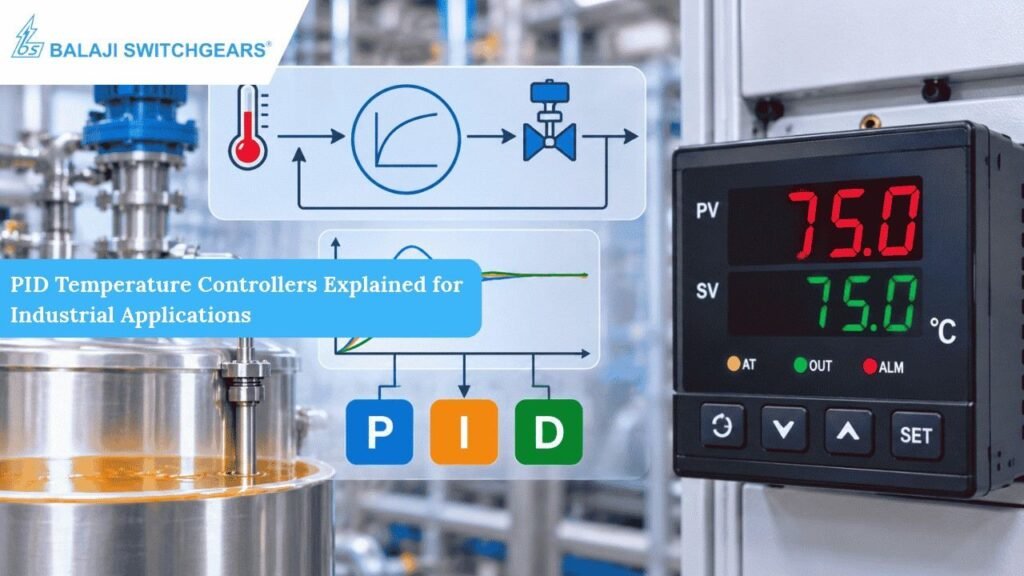
This is where PID temperature controllers become important. They continuously monitor the actual temperature, compare it with the desired set point and adjust the heating or cooling output to maintain the required conditions.
For industries that depend on accurate thermal management, choosing the right temperature controller can make a significant difference. In this blog, we explain how PID temperature controllers work, their industrial applications, important features and what to consider when selecting one.
What Is a PID Temperature Controller?
A PID temperature controller is an electronic device used to regulate temperature automatically by controlling a heating or cooling process.
PID stands for:
- P – Proportional
- I – Integral
- D – Derivative
These three control actions work together to minimise the difference between the actual temperature and the desired temperature.
A PID controller receives temperature information from a sensor, such as a thermocouple or RTD. It compares this measurement with the set point and calculates how much control action is required.
The output can then operate a suitable heating or cooling device through a relay, solid-state relay (SSR), contactor or other compatible control arrangement, depending on the application and controller output type.
For example, if an industrial oven is set to 180°C but its current temperature is 165°C, the controller identifies the temperature difference and adjusts the heater output accordingly. As the temperature approaches the set point, it modifies the output to help prevent excessive temperature rise.
The objective is to maintain a stable temperature without unnecessary fluctuations.
How Does PID Temperature Control Work?
To understand why PID controllers are widely used in industrial temperature regulation, it is important to understand the function of each control action.
1. Proportional Control (P)
Proportional control responds to the difference between the set temperature and the actual temperature. This difference is known as the error.
The greater the error, the greater the proportional control response.
For example, if an industrial heating system is significantly below its required temperature, the controller increases the heating output. As the temperature approaches the set point, the proportional response reduces.
Proportional control helps the system respond to temperature changes, but it may leave a small difference between the actual temperature and the set point under certain operating conditions.
2. Integral Control (I)
Integral control considers how long the temperature error continues.
If the system remains slightly below the set point for an extended period, integral action gradually increases the control response to help eliminate the remaining error.
This is particularly useful in industrial processes where maintaining the required temperature is important over long operating periods.
However, excessive integral action can cause temperature overshoot or slow recovery, depending on the process characteristics and controller settings.
3. Derivative Control (D)
Derivative control responds to how quickly the temperature error is changing.
It helps the controller anticipate temperature movement and adjust the output to reduce excessive changes near the set point.
For example, when the temperature is rising rapidly towards the target, derivative action can help moderate the control response and reduce overshoot.
When these three actions work together, the controller can provide a more balanced response to changing thermal conditions.
How Does a PID Temperature Controller Work in an Industrial System?
A typical industrial temperature control arrangement involves four main stages.
Step 1: Temperature Measurement
A temperature sensor, such as a thermocouple or RTD, measures the temperature of the equipment, material or process.
Step 2: Signal Processing
The sensor sends its measurement to the PID temperature controller. The controller compares the measured value, known as the Process Value (PV), with the desired Set Point (SP).
Step 3: PID Calculation
The controller calculates the required output using proportional, integral and derivative actions.
Step 4: Output Adjustment
The controller sends a suitable output signal to the connected control device. Depending on the system design, this may regulate an electric heater, cooling equipment or another temperature-control mechanism.
This process continues automatically, allowing the system to respond whenever the measured temperature moves away from the set point.
Why Are PID Temperature Controllers Important in Industrial Applications?
Industrial processes often involve changing loads, varying production speeds and different environmental conditions. A basic temperature control arrangement may not provide the stability required for such operations.
PID controllers help address these challenges through continuous temperature regulation.
Here are some important advantages.
Improved Temperature Stability: PID control helps minimise temperature fluctuations and maintain process conditions closer to the required set point.
Consistent Product Quality: Many manufacturing processes depend on specific temperature ranges. Stable control helps reduce defects caused by overheating or insufficient heating.
Reduced Temperature Overshoot: Properly configured PID parameters can help prevent the process temperature from rising significantly above the target.
Better Process Efficiency: By adjusting the control output according to process requirements, PID controllers can help avoid unnecessary heating and cooling.
Automated Operation: Temperature regulation takes place automatically, reducing the need for continuous manual adjustments by operators.
The actual results depend on the sensor, heating or cooling equipment, controller configuration and characteristics of the process.
Common Industrial Applications of PID Temperature Controllers
PID temperature controllers are used across industries where accurate and repeatable temperature regulation is required.
1. Plastic Processing and Injection Moulding
Plastic processing machines require controlled temperatures during material heating and moulding. Temperature variations can affect material flow, mould filling and the quality of finished components.
PID controllers help regulate heating zones and maintain the required temperature conditions throughout the process.
2. Industrial Ovens and Furnaces
Industrial ovens and furnaces are used for heating, drying, curing and heat treatment operations.
A PID temperature controller helps maintain the required temperature by adjusting the heating output according to the measured process temperature.
3. Food and Beverage Processing
Temperature plays an important role in processes such as heating, baking, pasteurisation and other food production operations.
Consistent temperature regulation helps maintain process conditions and supports product quality. Food safety requirements must still be addressed through validated process controls and appropriate monitoring.
4. Pharmaceutical Manufacturing
Many pharmaceutical production processes require carefully controlled thermal conditions during heating, drying and material preparation.
PID temperature controllers can help maintain the specified operating temperature, while suitable independent monitoring and safety systems address process and regulatory requirements.
5. Packaging and Printing Machines
Certain packaging and printing applications use heated rollers, sealing jaws and thermal processing units.
If the temperature is too low, sealing or processing quality may be affected. Excessive temperature can damage packaging materials. PID control helps maintain the required operating conditions.
6. Chemical Processing
Chemical processes may require heating or cooling to maintain specific operating temperatures.
PID controllers help regulate these conditions through suitable temperature sensors and control equipment. The controller must be selected according to the process requirements and the surrounding operating environment.
Important Features to Look for in a PID Temperature Controller
Not every temperature controller is suitable for every industrial application. Before selecting a model, consider the following features.
1. Sensor Input Compatibility
The controller must support the temperature sensor used in the application.
Common input options include:
- Thermocouples such as K, J, T and other supported types.
- RTD sensors such as Pt100.
- Infrared temperature sensors on compatible models.
- Analogue current or voltage inputs on compatible models.
For example, Omron E5CC and E5EC temperature controllers support a range of sensor and analogue input types, depending on the model.
Always check the exact input specifications before connecting a sensor.
2. Control Output Type
The controller output must be compatible with the connected heating or cooling control device.
Common output options include:
- Relay output
- Voltage pulse output for driving an SSR
- Linear current output
The correct output depends on the switching arrangement, load requirements and control method. An output should not be connected directly to a high-power heater unless it is specifically rated for that purpose.
3. Auto-Tuning and Self-Tuning
Setting the correct PID parameters is important for achieving stable temperature control.
Omron E5CC and E5EC controllers support auto-tuning and self-tuning functions on applicable models.
Auto-tuning helps determine suitable PID parameters by observing the behaviour of the controlled process. Self-tuning can automatically estimate and adjust PID parameters under supported operating conditions.
These features can simplify commissioning, but the selected tuning method should suit the process. Temperature variations during tuning may not be acceptable for every application.
4. Heating and Cooling Control
Some industrial processes require only heating, while others need both heating and cooling.
For example, an industrial chamber may require heating to reach a target temperature and cooling to prevent the temperature from exceeding the required range.
Omron E5-series controllers offer heating and cooling control functions on applicable models. The available control modes and output arrangements should be checked before selection.
5. Alarm and Protection Functions
Temperature deviations can affect product quality and equipment safety.
A suitable controller may provide alarms for conditions such as:
- High-temperature limits
- Low-temperature limits
- Deviation from the set point
- Sensor or loop-related faults
- Heater burnout on compatible models
Some Omron E5-series models also support heater burnout and heater short alarms using compatible current transformer inputs.
Remember that controller alarms are not a substitute for independent safety protection where a process requires it. Critical applications may need separate high-limit temperature protection and other safety measures.
6. Display, Communication and Installation
A clear display makes it easier for operators to monitor the process value and set point. Depending on the model, additional features may include event inputs, auxiliary outputs and communication capabilities.
Also check the controller’s panel dimensions, supply voltage, wiring requirements and environmental specifications before installation.
Omron E5CC and E5EC: Temperature Control Options for Industrial Panels
Omron offers digital temperature controllers designed for different industrial control requirements.
Two examples from its E5 series are the E5CC and E5EC.
Omron E5CC: The E5CC is a compact digital temperature controller with a 48 × 48 mm front-panel format. Depending on the model, it supports universal inputs, PID control, auto-tuning, self-tuning and different control output options.
It can be considered for applications where panel space and straightforward temperature monitoring are important.
Omron E5EC: The E5EC has a 48 × 96 mm front-panel format and offers additional display and I/O options compared with certain compact models. Depending on the selected version, it supports different sensor inputs, control outputs, alarm functions and communication features.
Both controller families offer features designed to support industrial temperature regulation. The right model depends on sensor compatibility, output requirements, control functions, alarm needs and installation dimensions.
Common Mistakes to Avoid When Selecting a PID Controller
Even a capable temperature controller may not deliver the expected performance if it is incorrectly selected or configured.
Some common mistakes include:
Choosing the Wrong Sensor Input: A controller that does not support the connected thermocouple or RTD type may produce incorrect readings or fail to operate as expected.
Ignoring Output Compatibility: The controller output must match the requirements of the connected SSR, relay or other control device.
Using Incorrect PID Parameters: Poor tuning can result in slow temperature recovery, overshoot or continuous temperature fluctuations.
Overlooking Heating and Cooling Requirements: A process requiring both heating and cooling needs a suitable control arrangement rather than a heating-only configuration.
Ignoring Alarm Requirements: High- and low-temperature alarms, sensor fault detection and heater monitoring should be considered according to the application.
Not Checking the Exact Model: Features can vary across different versions of the same controller series. Always verify the model-specific datasheet before purchasing or installing the device.
How Balaji Switchgears Supports Industrial Temperature Control Requirements
Selecting a PID temperature controller requires an understanding of the complete application, not just the desired temperature range. Sensor type, control output, heating or cooling requirements, alarm functions and panel configuration all influence the selection.
At Balaji Switchgears, we work with OEMs, panel builders, system integrators and industrial end users to help identify suitable industrial automation products for their applications.
Our Omron automation portfolio includes PID temperature controllers, PLCs, sensors, solid-state relays, timers and other control components. These products support different machine automation and industrial process requirements.
By considering the application and the technical specifications of the required controller, customers can make more informed decisions when planning or upgrading their temperature control systems.
Final Thoughts
Selecting the right PID temperature controller involves more than choosing a temperature range. Sensor compatibility, control output, PID tuning, alarm functions and process requirements all play an important role in achieving reliable temperature regulation.
As an Authorised Omron Distributor, Balaji Switchgears offers Omron temperature controllers, including the E5CC and E5EC series, along with technical assistance to help OEMs, panel builders and industrial customers identify suitable products for their applications.
Whether you are designing a new machine, upgrading an existing temperature control system or looking for a suitable replacement controller, our team can help you evaluate the right Omron solution.
Looking for an Omron PID Temperature Controller? Connect with our team for product selection and availability.