
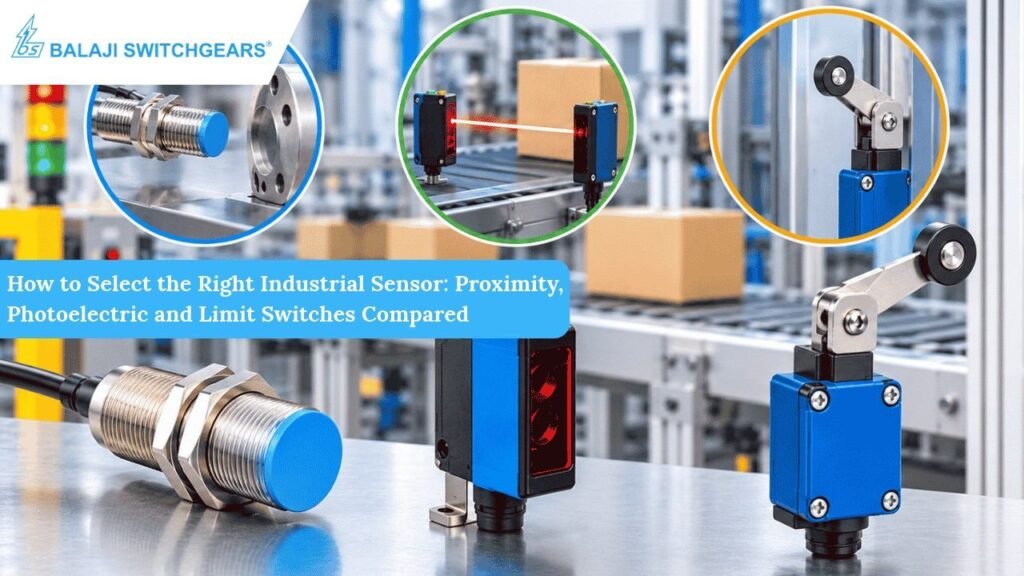
In an automated production line, even a small detection error can create a major operational problem. A machine may fail to identify a moving component, a conveyor may not detect an approaching product, or equipment may continue operating because a moving part has not reached the correct position.
These situations can lead to production delays, material wastage, incorrect machine operations and unnecessary maintenance.
This is why selecting the right industrial sensor is an important part of machine design and automation. Sensors help machines detect objects, monitor movement and communicate information to control systems such as PLCs.
However, not every sensor works in the same way. Some detect objects without physical contact, some use light to identify their presence, while others operate through mechanical contact.
Three commonly used options are proximity sensors, photoelectric sensors and limit switches. Each has a different operating principle and is suited to specific industrial applications.
At Balaji Switchgears, we understand the importance of reliable detection in industrial automation. Through our range of Telemecanique Sensors, we support OEMs, panel builders, system integrators and industrial end users in exploring suitable sensing solutions for their applications.
In this blog, we compare these three sensor types, explain how they work and discuss the important factors to consider before selecting one.
1. Why Is the Right Industrial Sensor Important?
Industrial sensors act as the eyes of an automated machine. They detect changes in the surrounding environment and send electrical signals to a control system, allowing equipment to respond according to programmed instructions.
For example, when a product reaches a particular point on a conveyor, a sensor can detect its presence and send a signal to the PLC. The PLC can then initiate the next operation, such as stopping the conveyor, activating a robotic arm or starting a packaging sequence.
The accuracy and reliability of this detection directly affect machine performance.
An unsuitable sensor may result in:
- Missed detection or incorrect object identification
- Unnecessary machine stoppages
- Inconsistent production cycles
- Mechanical wear due to unsuitable contact-based detection
- Increased maintenance requirements
- Reduced automation efficiency
Choosing the right sensor requires understanding the target object, detection distance, operating environment and machine control requirements.
2. What Is a Proximity Sensor?
A proximity sensor detects the presence of an object without physically touching it. It is commonly used when a machine needs to identify the position or presence of a component during an automated process.
One widely used type is the inductive proximity sensor, which detects metallic objects using an electromagnetic field.
When a metal object enters the sensor’s detection area, it changes the electromagnetic field generated by the sensor. The sensor recognises this change and produces an electrical output signal.
There are different types of proximity sensors:
Inductive proximity sensors: Primarily used to detect metallic objects such as steel components, metal parts and machine elements.
Capacitive proximity sensors: Can detect metallic and non-metallic materials, including plastics, liquids, powders, glass and cardboard, depending on the sensor design and application.
Where Are Proximity Sensors Used?
- Metal component detection on production lines
- Position detection in automated machinery
- Counting metal parts on conveyors
- Monitoring movement of machine components
- Detecting metallic workpieces
- Industrial assembly and material-handling systems
Example: Imagine a manufacturing machine that processes metal components one at a time. An inductive proximity sensor can detect when a metal part reaches the required position and send a signal to the PLC to begin the next operation.
Telemecanique Sensors: XS and XT Ranges
Telemecanique Sensors offers inductive proximity sensors under its XS range and capacitive proximity sensors under its XT range.
The XS range is designed for non-contact detection of metallic objects. Depending on the model, these sensors are available in different shapes, sensing distances, mounting configurations and output types.
The XT capacitive range can detect different types of materials, including non-metallic targets, making it useful for applications involving liquids, plastics, powders and other materials.
These ranges support applications in packaging, material handling, machine tools, robotics and manufacturing.
3. What Is a Photoelectric Sensor?
A photoelectric sensor uses light to detect the presence, absence or position of an object.
It generally consists of a light emitter and a receiver. The emitter sends out a beam of light, and the receiver monitors the light received. When an object interrupts or reflects this light, the sensor detects the change and generates an electrical output.
Unlike standard inductive proximity sensors, photoelectric sensors can detect a wide variety of materials, including plastic, glass, paper, wood and metal.
There are three commonly used photoelectric sensor arrangements:
Through-beam sensors: The emitter and receiver are installed opposite each other. An object is detected when it interrupts the light beam. This arrangement is useful for applications requiring reliable detection over a longer distance.
Retro-reflective sensors: The emitter and receiver are housed in the same unit, while a reflector is installed opposite the sensor. The sensor detects an object when it interrupts the reflected beam.
Diffuse-reflective sensors: The emitter sends light towards the target, and the object reflects some of that light back to the receiver. No separate reflector is required.
Where Are Photoelectric Sensors Used?
- Packaging and bottling lines
- Product counting and detection
- Conveyor-based material handling
- Label and carton detection
- Object positioning and presence detection
- Automated sorting and inspection systems
Example: Consider a packaging line where different boxes move along a conveyor. A photoelectric sensor can detect each box as it passes, allowing the control system to count products or trigger the next packaging operation.
Telemecanique Sensors: XU Range
Telemecanique Sensors offers photoelectric sensors under its XU range, designed for applications such as material handling, packaging, labelling, assembly and food and beverage production.
The range includes different detection configurations to address varying application requirements.
Depending on the selected model, engineers can evaluate sensing distance, detection mode, target characteristics and installation conditions to identify a suitable solution.
Photoelectric sensors are particularly useful when the application involves detecting different materials without physical contact.
4. What Is a Limit Switch?
Unlike proximity and photoelectric sensors, a limit switch operates through physical contact.
It is an electromechanical device containing an actuator connected to electrical contacts. When a moving object touches the actuator, the internal mechanism changes the contact state, opening or closing the electrical circuit.
Limit switches are commonly used to detect the end position or movement limit of a machine component.
Depending on the application, they are available with different actuator arrangements, including:
- Roller lever
- Plunger
- Roller plunger
- Rotary head
- Adjustable lever
The appropriate actuator depends on the direction, force and movement of the object operating the switch.
Where Are Limit Switches Used?
- Conveyor end-position detection
- Hoisting and lifting equipment
- Machine movement control
- Industrial doors and mechanical assemblies
- Position monitoring in automated machinery
- Material-handling equipment
Example: Consider a lifting platform that moves vertically. A limit switch can be installed at a defined travel position. When the platform reaches that point, it physically operates the switch, sending a signal to the control system to stop or control further movement.
Telemecanique Sensors: XC Range
Telemecanique Sensors offers a comprehensive range of mechanical limit switches under its XC range.
The portfolio includes standard, compact, miniature and application-specific limit switches with different actuator configurations.
Certain application-specific designs are intended for demanding applications such as hoisting, material handling and conveyor systems.
These switches are useful when machinery needs dependable physical position detection or travel-limit monitoring.
5. Proximity vs Photoelectric vs Limit Switch: What Is the Difference?
Although all three devices are used for industrial detection, their operating principles and application suitability are different.
| Parameter | Proximity Sensor | Photoelectric Sensor | Limit Switch |
| Detection method | Electromagnetic or capacitive sensing | Light interruption or reflection | Physical contact |
| Contact with object | No | No | Yes |
| Target material | Depends on sensor type | Wide variety of materials | Object must operate actuator |
| Detection distance | Generally short for inductive models | Can offer longer sensing distances | Depends on actuator position |
| Moving parts | No mechanical actuator | No mechanical actuator | Mechanical actuator |
| Common application | Metal part and position detection | Product detection and counting | End-position detection |
| Important selection factor | Target material and sensing distance | Optical conditions and target surface | Actuator type and mechanical movement |
The biggest difference is not simply how these devices look or how they are mounted. It is how they detect an object and the conditions under which they can operate reliably.
6. How to Select the Right Industrial Sensor
Choosing between these three options becomes easier when engineers evaluate the actual application instead of selecting a sensor based only on price or availability.
Here are six important factors to consider:
1. Identify the Target Material
First, determine what needs to be detected.
If the target is metallic, an inductive proximity sensor may be suitable. If the target is plastic, glass, paper or another non-metallic material, a photoelectric sensor or suitable capacitive proximity sensor may be a better option.
If the machine needs to detect a component through physical movement against an actuator, a limit switch may be appropriate.
2. Check the Required Sensing Distance
How far away will the object be from the sensor?
Inductive proximity sensors are generally selected for shorter detection distances. Photoelectric sensors can support longer distances, depending on their configuration and specifications. Limit switches depend on the physical position and movement required to operate their actuators.
Always verify the rated sensing distance in the product datasheet.
3. Evaluate the Operating Environment
Industrial environments can expose sensors to dust, oil, water, vibration, chemicals and temperature variations.
For example, an optical sensor installed in a dusty area may require additional attention to its sensing surface. A proximity sensor may be more suitable for certain applications exposed to oil or water, provided its enclosure and environmental specifications are appropriate.
Similarly, limit switches used in heavy-duty applications should have suitable mechanical construction and protection ratings.
4. Consider Operating Speed and Frequency
For high-speed production lines, sensor response time and switching frequency are important. Non-contact sensors can be useful where objects pass the detection point frequently.
For mechanical end-position detection, a suitably rated limit switch may be sufficient, provided its operating frequency and mechanical life meet the application requirements.
5. Check Electrical and PLC Compatibility
The sensor must be compatible with the machine’s control system.
Check the supply voltage, output type, wiring arrangement, switching capacity and PLC input requirements. Common industrial sensor outputs include PNP and NPN types, while some applications use relay outputs.
Incorrect electrical compatibility can prevent a sensor from communicating properly with the control system, even if its detection performance is suitable.
6. Consider Installation and Maintenance
Check the sensor’s mounting dimensions, available installation space, cable or connector arrangement and accessibility for inspection.
Also consider whether the sensor requires alignment, reflector positioning or mechanical actuator adjustment.
A sensor that is difficult to install or maintain can create unnecessary downtime over the long term.
7. Industrial Sensor Solutions from Telemecanique Sensors
Selecting the right sensor is only one part of building a reliable automation system. The product must also match the machine’s operating conditions and integrate correctly with the control architecture.
Telemecanique Sensors offers a broad portfolio of industrial sensing products designed for different detection and automation requirements.
Its key ranges include:
- XS Range: Inductive proximity sensors for detecting metallic objects without physical contact.
- XT Range: Capacitive proximity sensors for detecting different materials, including non-metallic targets.
- XU Range: Photoelectric sensors for object detection, counting and positioning in industrial applications.
- XC Range: Mechanical limit switches for position detection, machine movement and travel-limit applications.
These products support industries such as manufacturing, packaging, material handling, machine building, robotics and food and beverage processing.
At Balaji Switchgears, we help OEMs, panel builders, contractors, system integrators and industrial end users understand their sensing requirements and explore suitable Telemecanique Sensors products for their applications.
Conclusion
The right industrial sensor can make a significant difference to machine accuracy, production consistency and automation performance. However, proximity sensors, photoelectric sensors and limit switches are not interchangeable in every application.
A proximity sensor is a suitable option for non-contact detection of specific targets, particularly metallic components with inductive models. A photoelectric sensor offers flexibility when detecting different materials or objects over longer distances. A limit switch is useful when physical contact is required to identify a machine’s movement or end position.
The best choice depends on target material, sensing distance, operating environment, machine speed, electrical compatibility and maintenance requirements.
At Balaji Switchgears, we help industrial customers explore suitable sensing and automation solutions from Telemecanique Sensors. Our aim is to support informed product selection that helps machines operate accurately, consistently and efficiently.
Looking for the right industrial sensor for your application? Connect with Balaji Switchgears for product assistance and Telemecanique Sensors solutions.