
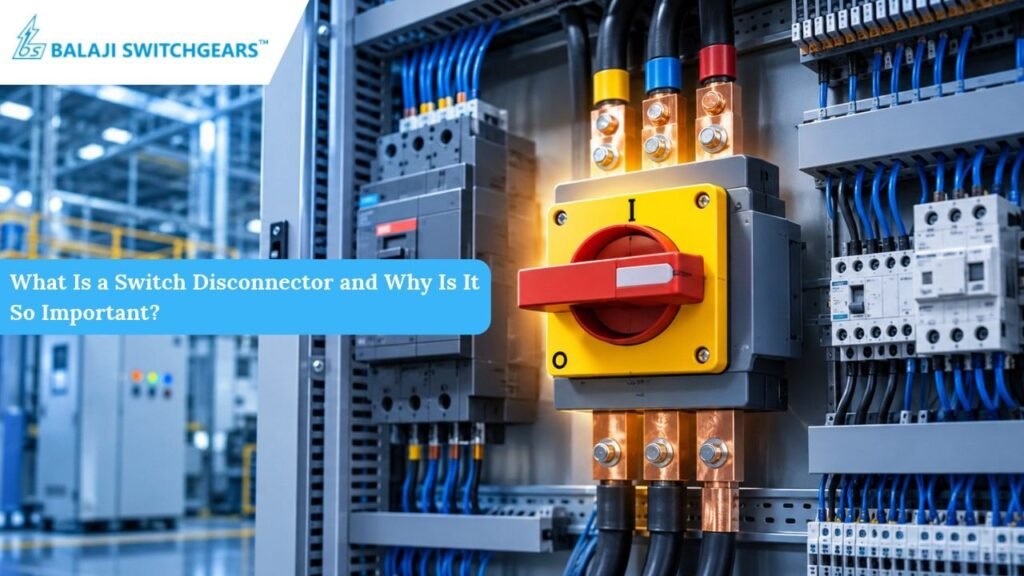
In an industrial electrical system, switching off the power is not always enough. Before maintenance, inspection or equipment replacement, technicians need a reliable way to isolate electrical circuits from their power source. Without proper isolation, electrical equipment may remain exposed to dangerous supply conditions, creating serious risks for personnel and connected machinery.
This is where a switch disconnector becomes important. It combines switching and isolation functions in a single device, allowing electrical circuits to be switched under specified operating conditions and isolated for maintenance.
For industries, panel builders, OEMs and electrical contractors, selecting the right switch disconnector is an important part of designing a safe and dependable electrical distribution system.
At Balaji Switchgears, we help customers evaluate electrical switching and protection requirements with suitable product solutions from leading brands such as ABB. Let’s understand what a switch disconnector does, where it is used and what you should consider before selecting one.
What Is a Switch Disconnector?
A Switch disconnector is an electrical switching device designed to perform two important functions: switching a circuit and providing isolation.
The switching function allows an operator to connect or disconnect an electrical circuit under the operating conditions specified for the device. The isolation function provides a means of separating the circuit from its electrical supply so that maintenance or inspection can be carried out safely, following the required safety procedures.
Unlike a basic switch, a switch disconnector is designed with isolation requirements in mind. Its suitability depends on its rated voltage, current, utilisation category and other specified characteristics.
Switch disconnectors are commonly used in:
- Industrial electrical distribution panels.
- Motor control centres (MCCs).
- Machinery and production equipment.
- Power distribution systems.
- HVAC installations.
- Commercial and infrastructure electrical systems.
They are available in different configurations, current ratings and pole arrangements to suit specific applications.
How Does a Switch Disconnector Work?
A switch disconnector works by opening or closing its electrical contacts through a manual or operating mechanism.
When the device is switched ON, its contacts establish the electrical connection, allowing current to flow through the circuit. When switched OFF, the contacts open and separate the connected circuit from the supply.
A properly designed switch disconnector provides the required isolation characteristics in accordance with its applicable product standards.
However, it is important to understand that a switch disconnector does not automatically provide complete protection against every electrical fault. Its primary function is switching and isolation. Overcurrent and short-circuit protection may need to be provided by appropriately selected protective devices, depending on the system design and device configuration.
For maintenance work, switching OFF alone should not be treated as sufficient. The equipment must be isolated according to the established electrical safety procedure, including lockout/tagout where applicable, verification of absence of voltage and any other required precautions.
Why Is a Switch Disconnector Important?
In industrial environments, electrical systems supply power to motors, machines, control panels and production equipment. Safe isolation is essential whenever these systems require inspection or maintenance.
Here are some of the key reasons switch disconnectors are important.
1. Safe Electrical Isolation
One of the main purposes of a switch disconnector is to provide a means of isolating electrical equipment from its power supply. This is particularly important when technicians need to inspect or maintain a machine, motor or distribution circuit.
2. Convenient Circuit Switching
Switch disconnectors allow operators to switch circuits ON or OFF within the device’s specified operating conditions. This makes them useful for controlling the supply to individual machines, panel sections and electrical loads.
3. Improved Maintenance Planning
Providing suitable isolation points can make maintenance activities more organised. Technicians can identify and isolate the relevant electrical section before beginning work, following the site’s safety procedures.
4. Equipment and System Management
Switch disconnectors help establish clear switching and isolation arrangements across electrical distribution systems. This is particularly useful in facilities with multiple machines, feeders and electrical panels.
5. Integration into Electrical Panels
Their compact configurations and different mounting options make switch disconnectors suitable for integration into a variety of industrial and commercial panel designs.
Switch Disconnector vs Circuit Breaker vs Isolator: What Is the Difference?
These three devices are often discussed together, but they do not perform exactly the same function.
| Device | Primary Function | Important Consideration |
| Switch Disconnector | Switching and isolation | Must be suitable for the intended switching duty |
| Circuit Breaker | Switching and protection against specified electrical faults | Trips under defined fault conditions |
| Isolator | Electrical isolation | Generally intended for operation under no-load conditions, unless specifically rated otherwise |
A circuit breaker is designed to interrupt fault currents within its specified breaking capacity and operating characteristics. It is commonly used for overcurrent and short-circuit protection.
A switch disconnector provides switching and isolation functions but should not be assumed to offer the same fault-interruption protection as a circuit breaker. Any required protective device must be selected separately or as part of an approved device combination.
An isolator is primarily intended to establish an isolated condition. A conventional isolator is generally not designed to interrupt load current unless its design and rating specifically permit it.
The right choice depends on the application, electrical load, fault level and required operating conditions.
Understanding Switch Disconnector Utilisation Categories
When selecting a switch disconnector, one important specification is its utilisation category.
IEC 60947-3 defines requirements for switches, disconnectors, switch-disconnectors and fuse-combination units. The utilisation category indicates the type of load and switching duty for which a device is suitable.
Some commonly referenced AC utilisation categories include:
- AC-20: Connecting and disconnecting under no-load conditions.
- AC-21: Switching resistive loads, including moderate overloads.
- AC-22: Switching mixed resistive and inductive loads.
- AC-23: Switching motor loads or other highly inductive loads.
The selection should always be based on the actual application and the manufacturer’s declared ratings. A device suitable for one utilisation category should not automatically be considered suitable for another.
ABB Switch Disconnector Solutions for Industrial Applications
ABB offers switch-disconnector solutions for different electrical distribution and industrial switching requirements. The appropriate product depends on the application, voltage level, current rating, installation arrangement and required operating mechanism.
Some ABB product families and configurations worth evaluating include:
ABB OT Series
The ABB OT switch-disconnector range offers solutions for low-voltage switching and isolation applications. Depending on the selected model, these devices are available in different current ratings and pole configurations.
They can be considered for applications such as:
- Industrial distribution panels.
- Machine isolation.
- Motor supply circuits.
- Electrical equipment switching.
The exact model should be selected according to the required ratings and installation conditions.
ABB OTM Series
The ABB OTM range includes motorised change-over and transfer switching solutions. These are relevant where a system requires automatic or remote transfer between power sources.
Depending on the configuration, such solutions can be considered for applications involving normal and backup power supplies.
ABB Tmax XT and Emax 2 Switch-Disconnector Configurations
ABB also offers switch-disconnector configurations within its broader low-voltage circuit-breaker product families, including suitable Tmax XT and Emax 2 MS variants.
These should be evaluated according to their specific product designation, ratings and intended switching and isolation functions. Not every circuit breaker in these families is a switch disconnector.
For medium-voltage applications, different product families and technical requirements apply. Solutions such as ABB NAL and GSec should be evaluated against the project’s voltage level, switching duty and installation specifications rather than treated as direct substitutes for low-voltage devices.
Where Are Switch Disconnectors Used?
Switch disconnectors are used across several industries where electrical isolation and switching are essential.
1. Manufacturing Plants: They provide isolation points for machinery, production lines, motors and individual electrical circuits.
2. Motor Control Centres: They can be used in motor feeder arrangements where local switching and isolation are required.
3. HVAC Systems: They are used in suitable supply arrangements for air-handling equipment, ventilation systems, chillers and other electrical loads.
4. Pumping Stations: Water treatment, wastewater treatment and industrial pumping applications may require switching and isolation for individual pump circuits.
5. Power Distribution Panels: They can form part of incoming or outgoing switching arrangements, depending on the system design.
6. Solar and DC Applications: Suitable DC-rated switching and isolation devices are important in photovoltaic systems. The device must be specifically rated for the DC voltage, current and switching conditions involved. An AC-rated switch disconnector should not be assumed suitable for DC applications.
How to Select the Right Switch Disconnector
Choosing a switch disconnector requires more than matching its current rating with the connected load. The following factors should be considered before finalising the product.
1. Rated Current: Select a device with an appropriate rated operational current for the intended application and operating conditions.
2. Rated Voltage: Confirm that the device is suitable for the system’s operating voltage.
3. Number of Poles: Consider whether the application requires a three-pole, four-pole or another suitable configuration.
4. Utilisation Category: Verify that the device supports the intended switching duty, particularly for motor and inductive loads.
5. Short-Circuit Coordination: Check the required short-circuit withstand characteristics and coordination with the upstream protective device.
6. Operating Mechanism: Decide whether a direct handle, door-coupled handle, extended rotary handle or motorised mechanism is required.
7. Mounting Arrangement: Check the available panel space, mounting method, terminal orientation and installation requirements.
8. Accessories: Evaluate auxiliary contacts, handle arrangements, interlocking provisions and other accessories required by the application.
9. Environmental Conditions: Consider ambient temperature, dust, moisture, enclosure protection and other site conditions.
A properly selected device should meet the application’s electrical and mechanical requirements while fitting into the overall panel design.
How Balaji Switchgears Helps with ABB Switch Disconnector Selection
Selecting a switch disconnector is an important decision for electrical panel builders, OEMs, contractors and industrial users. The device must match the connected load, switching duty, isolation requirements and protection arrangement of the electrical system.
Balaji Switchgears is an authorised distributor of ABB, supporting customers in exploring suitable ABB electrical products for industrial and power distribution applications.
Our approach begins with understanding the application rather than recommending a device based on current rating alone. We help customers evaluate relevant product specifications, including voltage, current, pole configuration, utilisation category, mounting requirements and accessories.
Whether the requirement is for a machine isolation point, an industrial distribution panel or a motor control application, identifying the correct ABB product configuration is essential before procurement.
Conclusion
A switch disconnector plays an important role in electrical systems by providing switching and isolation functions. It helps establish suitable isolation points for maintenance, supports organised electrical distribution and allows operators to manage circuits according to their specified operating conditions.
However, selecting the right device requires careful consideration of electrical ratings, utilisation category, load characteristics, short-circuit coordination and installation requirements.
At Balaji Switchgears, an authorised distributor of ABB, we help OEMs, panel builders, contractors and industrial customers explore suitable ABB switch-disconnector solutions for their applications.
Looking for ABB switch disconnectors for your next project? Connect with Balaji Switchgears to discuss your electrical panel, machinery or power distribution requirements and explore suitable ABB product options for your application.