
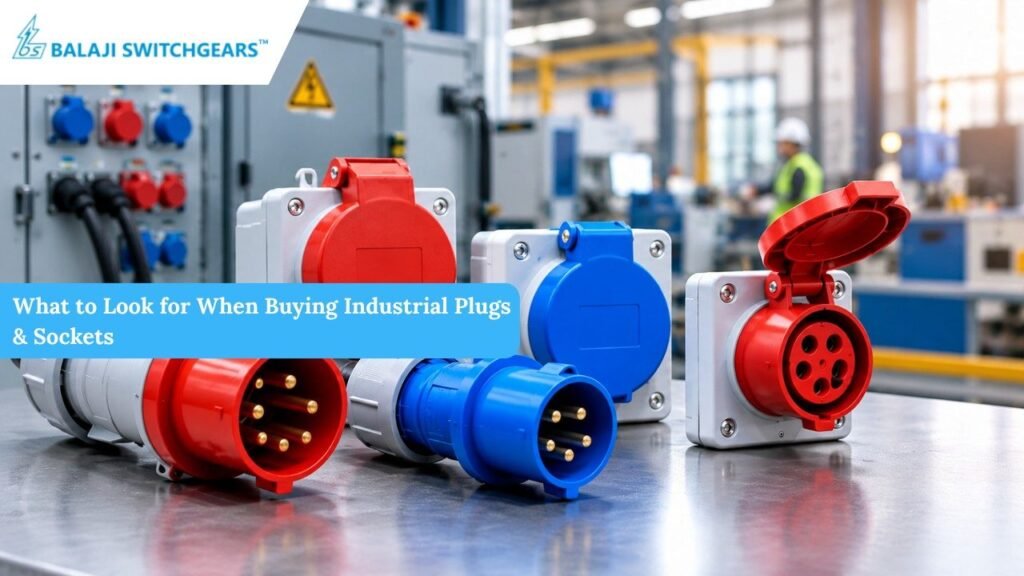
On a busy factory floor, a plug and socket is the part nobody notices until it fails. Then a welding machine stops, a packaging line goes dark, or a cable end turns black from heat. The real cost is not the connector but the lost production and safety risk that follow.
Industrial plugs and sockets are built very differently from the domestic kind. They carry higher currents, face dust, water and vibration, and are plugged and unplugged hundreds of times. This guide explains what to check before you buy, so that you choose a connector that is safe, durable and right for the job.
Why Industrial Connectors Are Not Just Heavy-Duty Home Plugs
A household plug is designed for a clean, dry room and a modest appliance. An industrial plug must handle three phase power, long cable runs, heavy tools and harsh surroundings.
Most industrial connectors follow the IEC 60309 standard, which defines dimensions, colours, voltages and keying so that products from different makers are compatible. The standard also prevents someone from connecting a 110 V tool to a 415 V supply by accident. Buying a product that conforms to it is the foundation of every other decision in this guide.
1. Start With the Current Rating
Every connector has a rated current, and it must comfortably exceed the load it will serve. Common ratings are 16 A, 32 A, 63 A and 125 A.
Work out the full load current of the equipment, then add a safety margin of around 20 percent. A 28 A welder, for example, should not be put on a 32 A connector that is already run hot all day. Moving to the next size costs a little more but extends the life of both the plug and the cable.
Undersized connectors commonly overheat. Pins and sleeves warm up, resistance rises, and the cycle ends in melted housings or fire.
2. Match the Voltage and Read the Colour Code
IEC 60309 uses colour to signal voltage. Remember these basics:
Blue is used for 200 to 250 V single phase supplies.
Red is used for 380 to 480 V three phase supplies.
Yellow is used for 100 to 130 V, often on construction sites.
Keyed designs make it physically impossible to plug a low voltage appliance into a higher voltage socket, so never modify or force a connector. Always confirm the voltage and frequency of your supply before ordering.
3. Choose the Right Number of Poles
The pole configuration must match the system.
2P+E, meaning two poles plus earth, serves single phase equipment.
3P+E suits three phase motors that do not need a neutral.
3P+N+E serves mixed loads, such as machines that also run single phase controls or lighting.
The earth contact is longer than the others so that it connects first and disconnects last. Never buy a connector with a missing or removable earth pin. A mismatch in poles can lead to equipment running in reverse, sensitive electronics being damaged, or the earth protection being lost.
4. Check the Ingress Protection (IP) Rating
The IP rating tells you how well the connector resists dust and water. It is a major reason for premature failure when ignored.
IP44 offers protection against splashing water and small solid objects, which is acceptable for dry indoor locations.
IP54 offers better dust resistance and suits ordinary workshops and factory floors.
IP67 protects against temporary immersion and dust, making it suitable for outdoor sites, washdown areas, food processing plants and wet environments.
Remember that the rating applies only when the plug is correctly fitted into the socket, or when the socket cover is closed. Spring-loaded flaps and screw-down caps help maintain protection when the connector is not in use.
5. Look Closely at Materials and Build Quality
Housing material affects strength, heat resistance and lifespan.
Thermoplastic housings are lightweight and resist corrosion, and good grades handle impact well.
Rubber or reinforced polymers suit mobile equipment that gets dragged, dropped or driven over.
Metal housings give extra strength in the roughest conditions, though they must be properly earthed.
Inside, check the contacts. Good connectors use brass or copper alloy pins with quality plating, which resist oxidation and keep resistance low. Smooth moulding, snug fit and firm closure suggest solid manufacturing, while sharp flash edges and loose pieces point to poor quality.
6. Consider Interlocked and Switched Sockets
For higher currents, an interlocked socket provides extra safety. The plug can only be inserted or withdrawn when the switch is off, which prevents arcing at the contacts. Likewise, the switch cannot be turned on unless the plug is fully engaged.
This feature is particularly valuable for 63 A and 125 A applications, where breaking a loaded connection can cause a damaging arc. Fused versions add overcurrent protection, while ones with mechanical locking can be padlocked off during maintenance. In regulated industries, these features are often a requirement, not an option.
7. Pay Attention to the Cable Connection
Many failures happen where the cable meets the plug, not inside the contacts.
Check that the cable gland suits the cable’s outer diameter and gives proper strain relief. If the cable is pulled, the force should be taken by the clamp and not by the terminals.
Terminals should accommodate the conductor size you plan to use, with screws or screwless clamps that hold firmly under vibration. Loose terminals heat up and eventually burn.
Where flexible cables are subject to repeated bending, a protective bend-limiting sleeve extends cable life significantly.
8. Match the Connector to Its Environment
The best choice depends on where it will live.
Dusty plants, such as cement, textiles and woodworking, call for a high dust rating and a closing cover.
Chemical and oil environments need housings that resist corrosion and swelling.
High temperature zones, such as foundries and bakeries, need materials rated for heat and good ventilation around the connector.
Outdoor and marine locations benefit from UV-stabilised plastics and an IP67 or higher rating.
Hazardous areas with gas or dust need connectors specifically certified for explosive atmospheres. Never improvise with standard products in these zones.
9. Verify Certifications and Compliance
Reliable products carry test marks and comply with relevant standards, such as IEC 60309 and the applicable BIS requirements in India. Ask the supplier for datasheets and test certificates, and compare stated ratings with markings on the product.
Counterfeit and low-grade connectors are widespread, usually with thinner contacts and weaker plastics. They may look identical but behave quite differently under load. Buying from an established supplier is the simplest protection against this.
10. Plan for Maintenance and Spares
A connector is a wear item. Contacts loosen, seals harden and housings crack over time. When buying, consider whether replacement parts, such as gaskets, caps and inserts, are available. Standardising on one range across the plant makes inspection, spare stocking and training much easier.
Build a simple inspection routine: look for discoloration, listen for buzzing, check for warmth, and tighten terminals during shutdowns.
Common Buying Mistakes
Choosing purely on price, while ignoring the real cost of unplanned downtime.
Selecting by amperage without checking voltage and pole count.
Using an IP44 connector in a washdown area.
Ignoring strain relief and cable gland sizing.
Skipping certification checks on bulk orders.
Quick Buying Checklist
- Confirm load current and add a 20 percent margin.
- Check supply voltage and match the colour code.
- Select the correct pole configuration, including neutral and earth.
- Choose an IP rating suited to the location.
- Inspect housing material and contact quality.
- Decide whether interlocked or fused sockets are needed.
- Verify cable gland size and strain relief.
- Request certifications and plan for spares.
Final Thoughts
Industrial plugs and sockets are small, inexpensive parts of a large system, but they decide whether that system runs safely. The right choice comes from understanding current, voltage, poles, protection and environment together, not from one rating alone.
If you want help selecting connectors for your plant, work with a supplier who understands both the product and the application. Balaji Switchgears has supported OEMs, panel builders, contractors and end users across India for over 34 years, offering industrial plugs and sockets alongside a wide range of low voltage switchgear and automation products. Visit Balaji Switchgears to explore the range, or contact the team for expert selection support. For dependable industrial connections, choose Balaji Switchgears.