
Electrical safety at home is often taken for granted. We switch on lights, operate kitchen appliances, charge electronic devices, run air conditioners, washing machines, water heaters, pumps, and numerous other electrical loads every day without thinking about what happens when something goes wrong.
Behind this everyday convenience is an electrical protection system designed to disconnect power when abnormal conditions occur. However, no single protective device is designed to handle every type of electrical fault. This is why a properly designed residential electrical installation uses different protection devices that work together.
One of the most important devices for protecting people against earth leakage and electric shock is a Residual Current Circuit Breaker, commonly known as an RCCB. When combined with appropriate overcurrent protection such as an MCB, it creates a comprehensive protection arrangement for residential electrical circuits.
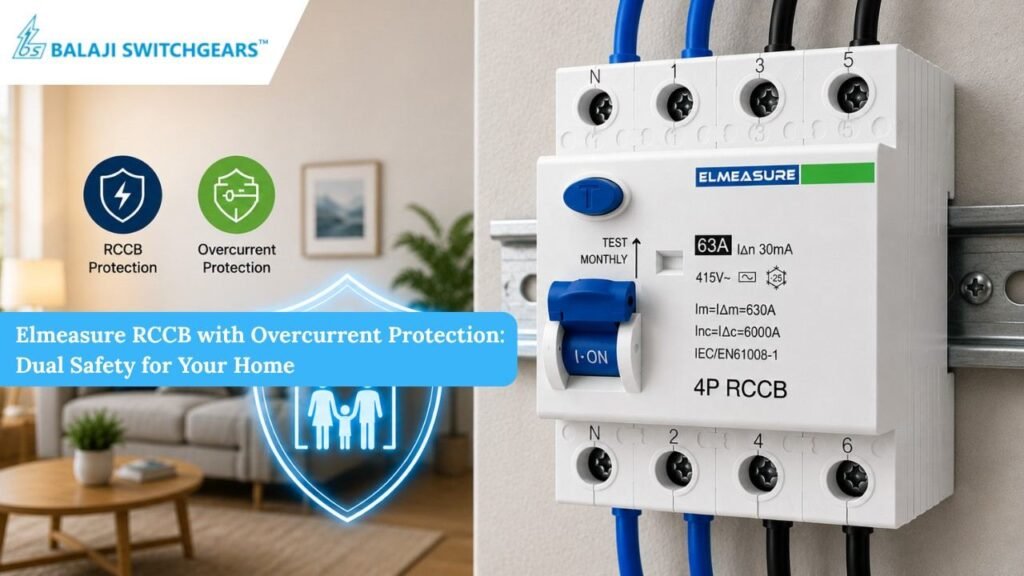
Elmeasure RCCB solutions are designed to detect earth leakage currents and disconnect the affected circuit quickly. Elmeasure’s current RCCB range includes 2 pole and 4 pole configurations, current ratings from 16A to 63A, and residual current sensitivities of 30mA, 100mA, and 300mA. The company states that its RCCBs comply with IS 12640 1 and IEC 61008 1 and offer a tripping time of up to 100 milliseconds.
Understanding how an RCCB works, what it protects against, and why it needs to be coordinated with overcurrent protection is essential for building a safer home electrical system.
What Is an RCCB?
RCCB stands for Residual Current Circuit Breaker.
Its primary function is to detect an imbalance between the current flowing through the live conductor and the current returning through the neutral conductor.
Under normal conditions, these currents should be substantially equal.
If some current escapes from the intended circuit path, such as through damaged insulation, faulty equipment, or a person coming into contact with a live part, the RCCB detects the resulting residual current and disconnects the supply.
This is fundamentally different from the way an MCB operates.
An MCB is primarily designed to protect a circuit from overloads and short circuits. Elmeasure’s MCB range is specified for overload and short circuit protection, while its RCCB range is specifically designed for earth leakage protection.
This difference is important because homeowners sometimes assume that installing an RCCB alone provides complete electrical protection. It does not.
Why Earth Leakage Protection Matters at Home
Electricity normally follows a controlled path through the electrical circuit. When insulation becomes damaged or an appliance develops a fault, some current can take an unintended path to earth.
This condition is known as earth leakage.
Earth leakage can occur because of:
Damaged appliance insulation
Moisture entering electrical equipment
Faulty wiring
Damaged cables
Improper earthing
Ageing electrical components
Faulty heating appliances
Outdoor electrical equipment
If the leakage is large enough, it can create an electric shock hazard or contribute to electrical fire risk.
An RCCB is designed to detect this residual current and disconnect the circuit.
This makes RCCB protection particularly important in residential environments where people regularly interact with electrical appliances.
How an Elmeasure RCCB Works
The working principle of an RCCB is based on current balance.
The device monitors the conductors supplying the protected circuit.
During normal operation, the current going into the circuit and the current returning from it are balanced.
If a portion of the current escapes through an unintended path, an imbalance develops.
The RCCB detects this difference.
When the residual current reaches the device’s specified trip sensitivity, the RCCB disconnects the circuit.
Elmeasure currently offers RCCBs with 30mA, 100mA, and 300mA residual current settings. The 30mA option is particularly relevant to applications where additional protection against electric shock is required, while higher residual current settings can be used according to the application and electrical design.
The correct sensitivity should always be selected by a qualified electrical professional based on the installation requirements.
What Does an RCCB Protect Against?
The main purpose of an RCCB is protection against residual current and earth leakage.
This means it can help protect against hazards associated with:
Insulation breakdown
Leakage through appliance bodies
Accidental contact situations
Earth faults
Leakage caused by moisture
Electrical fire risks associated with persistent leakage
However, an RCCB should not be considered a replacement for every other protective device in the electrical installation.
This is where the concept of dual protection becomes important.
Why an RCCB Alone Is Not Enough
An RCCB is designed to detect residual current. It is not primarily designed to provide overload and short circuit protection.
Imagine a circuit supplying several appliances. If the circuit draws excessive current because too many loads are connected, an RCCB may not operate simply because the current is excessive.
Similarly, an RCCB is not intended to replace the short circuit protection provided by an appropriate circuit breaker.
This is why an RCCB with overcurrent protection should be understood as a coordinated protection arrangement rather than assuming that the RCCB itself performs both functions.
In a typical residential distribution board, an RCCB can work alongside MCBs.
The MCB protects individual circuits against overload and short circuit conditions.
The RCCB provides residual current protection.
Together, they provide two different layers of electrical protection.
Understanding Overcurrent Protection
Overcurrent occurs when more current flows through a circuit than the wiring or equipment is designed to safely carry.
There are two common forms.
Overload
An overload occurs when electrical equipment or circuits draw more current than their intended operating capacity for a sustained period.
For example, connecting too many high power appliances to a circuit can cause excessive current.
The resulting heat can damage cable insulation and electrical components if the condition continues.
Short Circuit
A short circuit occurs when conductors come into an unintended low resistance connection, allowing a very large current to flow.
Short circuits can generate intense heat and electrical forces within a very short time.
An MCB or another suitable overcurrent protective device is designed to interrupt such conditions.
Elmeasure’s MCB range provides protection against overload and short circuit faults, with models available in different pole configurations and tripping characteristics.
The Dual Safety Approach
The real advantage comes from combining different protection functions.
Consider a residential distribution board supplying several circuits.
The MCBs protect the individual circuits against overload and short circuit faults.
The RCCB monitors for residual current and earth leakage.
If an appliance develops an insulation fault that causes current to leak toward earth, the RCCB can disconnect the circuit.
If a circuit becomes overloaded or experiences a short circuit, the appropriate MCB can trip.
This creates complementary protection.
One device monitors for one category of electrical problem while another addresses a different category.
That is why coordinated protection is much more effective than relying on one device for every possible fault.
Why 30mA RCCB Protection Is Commonly Associated With Homes
Residential electrical installations involve direct human interaction with electrical equipment.
People operate switches, connect appliances, handle portable equipment, and may use electrical devices in locations where moisture is present.
A sensitive RCCB can provide an additional layer of protection when a leakage current occurs.
Elmeasure offers 30mA RCCB variants within its product range. The company states that its RCCBs are designed to detect earth leakage and disconnect the circuit quickly, with a specified tripping time of up to 100 milliseconds.
The actual RCCB rating and sensitivity should always be selected according to the installation design and applicable electrical requirements.
Choosing the Right Elmeasure RCCB
Selecting an Elmeasure RCCB requires consideration of several factors.
Rated Current
Elmeasure’s current RCCB range covers rated currents from 16A to 63A.
The selected current rating must be appropriate for the circuit and coordinated with the upstream and downstream protection.
Number of Poles
Elmeasure provides 2 pole and 4 pole RCCB configurations.
A 2 pole RCCB can be appropriate for relevant single phase applications, while a 4 pole device can be used for suitable three phase installations where the neutral also needs to be switched.
The configuration must match the electrical system.
Residual Current Sensitivity
Elmeasure offers 30mA, 100mA, and 300mA variants.
The correct sensitivity depends on the purpose of the protection and the electrical installation.
System Voltage
The RCCB must be suitable for the operating voltage of the circuit.
Elmeasure specifies 240V for its 2 pole variants and 415V for its 4 pole variants within the listed technical specifications.
Installation Method
Elmeasure’s RCCBs are designed for DIN rail mounting, making them suitable for modern residential distribution boards and electrical panels.
RCCB for Home: Where Can It Be Used?
An RCCB for home applications can be used to protect residential electrical circuits against earth leakage.
Typical applications include:
Residential distribution boards
Lighting circuits
Socket circuits
Kitchen circuits
Water heater circuits
Air conditioning circuits
Outdoor electrical circuits
Pump circuits
Other residential loads
The actual circuit arrangement should be designed according to the home’s electrical architecture and applicable local requirements.
RCCB and Appliances
Modern homes contain many appliances with electronic circuits.
Refrigerators, washing machines, air conditioners, induction cookers, computers, televisions, water heaters, and other devices can all develop insulation faults or leakage conditions.
An RCCB provides an additional safety layer by monitoring the electrical circuit for residual current.
However, an RCCB cannot compensate for poor wiring practices.
Proper cable selection, earthing, circuit protection, installation quality, and appliance maintenance remain essential.
RCCB and Earthing Work Together
An important point is that an RCCB does not make a poor earthing system acceptable.
A safe electrical installation requires proper earthing, suitable conductors, appropriate protective devices, and correct installation practices.
Elmeasure’s own installation guidance recommends ensuring that healthy earthing is installed at the premises and that appropriate earth leakage, overload, and short circuit protection is provided near the point of supply.
This demonstrates why electrical safety should be approached as a complete system rather than relying on a single protective device.
Testing and Maintenance
An RCCB should be tested periodically according to the manufacturer’s instructions and applicable electrical safety practices.
The test function provided on an RCCB is intended to verify that the device’s tripping mechanism operates.
Testing is important because an electrical protection device must be functional when a fault occurs.
Maintenance teams or homeowners should also watch for unusual or repeated tripping.
Frequent RCCB trips should not simply be ignored or bypassed.
Repeated tripping can indicate:
An appliance insulation fault
Moisture
Damaged wiring
Earth leakage
A wiring problem
An incorrectly designed circuit
The cause should be investigated by a qualified electrician.
What Happens When an RCCB Keeps Tripping?
An RCCB that trips repeatedly is providing useful information.
It may be detecting a genuine leakage condition.
For example, a damaged appliance may be allowing current to escape to earth.
Disconnecting appliances one by one can sometimes help identify the source, but electrical troubleshooting should be performed safely and by a qualified professional where required.
An RCCB should never be permanently bypassed simply because it trips frequently.
Doing so removes an important layer of protection.
RCCB Versus RCBO
Another useful distinction is between an RCCB and an RCBO.
An RCCB provides residual current protection but normally requires separate overcurrent protection.
An RCBO combines residual current protection and overcurrent protection within one device.
The choice between these arrangements depends on the electrical system, distribution board design, circuit configuration, available space, and project requirements.
For larger installations, using separate RCCBs and MCBs can provide a flexible distribution arrangement.
Why Product Quality Matters
Electrical protection devices are expected to operate correctly during abnormal conditions.
For that reason, product quality, certification, correct ratings, and proper installation are extremely important.
Elmeasure states that its RCCBs comply with IS 12640 1 and IEC 61008 1. Its published specifications also include fast tripping, multiple sensitivity options, and an electrical and mechanical life of up to 4,000 operations.
These specifications make it important to select the product based on the actual electrical application rather than simply choosing a device based on price.
Building a Complete Home Electrical Protection System
A safe residential electrical system typically requires several layers of protection.
The incoming supply needs appropriate protection.
Individual circuits need suitable overcurrent protection.
Residual current protection should be provided where required.
The electrical installation needs effective earthing.
Cables must be correctly sized and installed.
Appliances should be maintained and used according to their specifications.
Surge protection may also be considered where the installation requires protection from transient overvoltages.
Each component has a specific role.
When these elements are correctly coordinated, the electrical system becomes significantly safer and more reliable.
Conclusion
Electrical safety at home requires protection against more than one type of fault. Overloads and short circuits can damage wiring and equipment, while earth leakage can create electric shock and fire risks. This is why a properly designed electrical installation uses complementary protective devices.
An Elmeasure RCCB provides an important layer of protection by detecting residual current and disconnecting the circuit when leakage exceeds its specified sensitivity. Elmeasure’s current RCCB range offers 2 pole and 4 pole configurations, 16A to 63A rated currents, and 30mA, 100mA, and 300mA residual current options.
When an RCCB is correctly coordinated with MCBs or other suitable overcurrent protection, homeowners can benefit from dual protection. The RCCB addresses earth leakage, while the overcurrent protective device addresses overload and short circuit conditions.
For anyone looking for an RCCB for home applications, the most important consideration is not simply choosing a device with the right ampere rating. The complete electrical installation, earthing arrangement, circuit design, sensitivity, coordination, and applicable standards must all be considered.
For residential, commercial, and industrial customers seeking dependable RCCB electrical protection, Balaji Switchgears provides access to Elmeasure electrical protection solutions and other trusted electrical products. With expertise in power distribution, protection, automation, and electrical infrastructure, Balaji Switchgears helps customers select appropriate protection solutions for safer, more reliable, and efficiently designed electrical systems.