
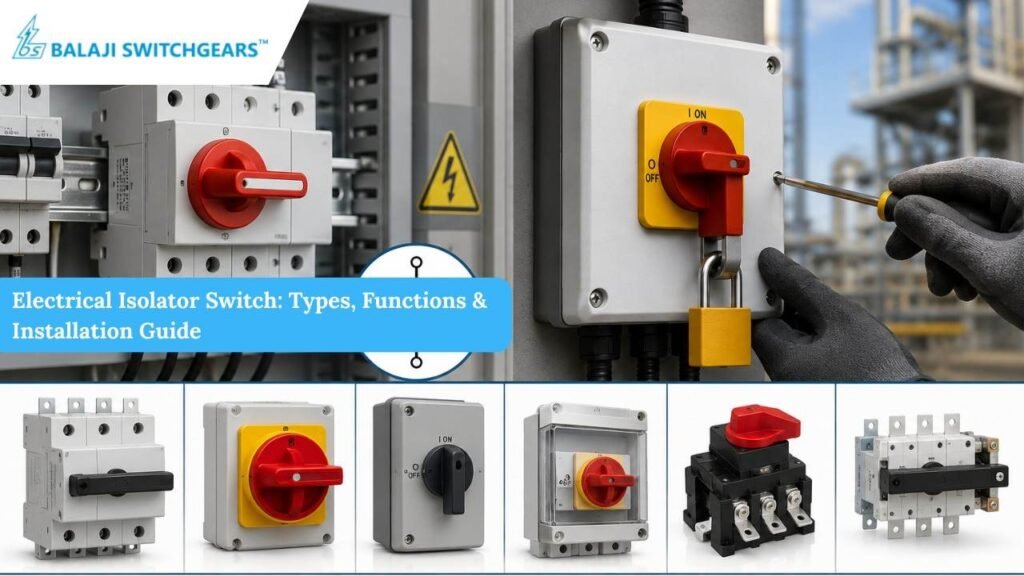
Electrical systems are designed to deliver reliable power, but they also need to be designed with safety and maintenance in mind. Whenever electrical equipment needs to be inspected, repaired, cleaned, replaced, or serviced, technicians need a reliable way to disconnect it from its power source. This is where an Electrical Isolator Switch becomes an important part of an electrical installation.
An isolator provides a means of physically separating an electrical circuit or equipment from its source of supply. It is primarily used to create a safe condition for maintenance and servicing. Unlike a circuit breaker, an isolator is generally not intended to interrupt fault current or routinely break a loaded circuit. Instead, it is used after the appropriate switching or protective device has disconnected the load, providing a clear means of isolation.
From industrial machinery and distribution panels to commercial buildings and electrical substations, isolators are available in different configurations to suit different voltage levels, current ratings, pole arrangements, and installation environments.
Understanding the different types, functions, selection criteria, and installation requirements is therefore important for electrical engineers, panel builders, OEMs, maintenance teams, and facility managers.
What Is an Electrical Isolator Switch?
An Electrical Isolator Switch is a mechanical switching device used to disconnect an electrical circuit or equipment from its power supply.
The basic purpose is straightforward. When equipment needs to be worked on, the relevant supply is disconnected and the isolator provides a defined point of separation between the equipment and the source.
In many applications, the isolator is installed alongside or in coordination with circuit breakers and other protective devices. The circuit breaker handles functions such as overload and short circuit protection, while the isolator provides a means of safe electrical separation for maintenance.
A key characteristic of an isolator is that it is generally operated when the circuit is not carrying load current. The appropriate operating procedure depends on the specific equipment and installation design, so the manufacturer’s instructions and applicable electrical safety procedures should always be followed.
Why Is an Isolator Switch Important?
Electrical maintenance involves significant risks if equipment is accidentally energised while technicians are working on it.
An isolator helps create a controlled point at which electrical equipment can be separated from the supply.
This is particularly important in industrial environments where electrical panels may feed motors, pumps, compressors, production machines, HVAC equipment, or automation systems.
A properly selected and installed isolator can help maintenance teams:
Safely disconnect equipment before servicing
Clearly identify the isolated section of a system
Prevent unintended energisation
Simplify maintenance procedures
Separate equipment from the electrical supply
Improve operational control of electrical systems
Some switch disconnectors also provide positive or visible indication of the isolation condition, depending on their design. Schneider Electric, for example, distinguishes products that provide positive contact indication from products that additionally provide a visible break.
Electrical Isolator Switch vs Circuit Breaker
One of the most common misunderstandings is that an isolator and circuit breaker perform the same function.
They do not.
A circuit breaker is a protective switching device. It can automatically interrupt current when conditions such as overload or short circuit occur, subject to its ratings and design.
An isolator is primarily intended to provide safe electrical isolation.
In a typical installation, a circuit breaker may first disconnect the circuit under fault or operating conditions. Once the circuit is safely de-energised, the isolator can be opened to provide physical separation for maintenance.
This distinction is extremely important when designing an electrical system because an isolator should not automatically be treated as a substitute for a protective device.
Main Functions of an Electrical Isolator Switch
The primary function is electrical isolation, but isolators provide several practical benefits within electrical installations.
Safe Disconnection
The most important purpose is to separate equipment from its electrical supply before maintenance or inspection.
Maintenance Safety
An isolator provides a clearly defined point of disconnection, helping maintenance personnel establish a safe working condition.
Equipment Isolation
Individual machines or sections of a distribution system can be isolated without necessarily shutting down an entire facility.
Operational Control
Local isolation allows operators and maintenance teams to control specific sections of electrical infrastructure.
Improved Visibility
Depending on the design, the open position or contact status may provide clear confirmation that the equipment has been isolated.
Understanding Different Isolator Switch Types
There is no single isolator suitable for every application. Isolator switch types vary according to the electrical system, number of poles, current rating, voltage, construction, and installation environment.
For low voltage installations, common configurations include single pole, double pole, three pole, and four pole isolators.
In medium and high voltage installations, isolators can have different mechanical arrangements and may be classified by their physical construction and position within the power system.
Choosing the right configuration is essential for achieving the required level of isolation.
Single Pole Isolator
A single pole isolator disconnects one conductor or pole of a circuit.
It can be used in applications where the electrical system design requires isolation of a single live conductor.
The exact suitability depends on the circuit configuration and applicable electrical requirements.
Double Pole Isolator
A double pole isolator disconnects two conductors simultaneously.
In appropriate single phase applications, this may allow both the live and neutral conductors to be disconnected.
Double pole configurations are commonly encountered in residential, commercial, and smaller electrical installations where complete isolation of the relevant conductors is required.
Three Pole Isolator
Three pole isolators are commonly associated with three phase electrical systems.
They disconnect the three phase conductors and are frequently used for industrial equipment and three phase distribution circuits.
Applications can include motors, machinery, HVAC equipment, and industrial panels.
Four Pole Isolator
A four pole isolator is commonly used in three phase systems where the neutral also needs to be switched.
This configuration disconnects all three phases together with the neutral.
Four pole isolators can be particularly useful where complete isolation of a three phase circuit and neutral is required by the system design.
Fused Isolator
A fused isolator combines isolation with fuse based overcurrent protection.
The fuse provides protection against excessive current, while the isolating mechanism provides a means of disconnecting the circuit for maintenance.
This type of solution can be useful in applications where both switching isolation and fuse protection are required in a compact arrangement.
Switch Disconnector
A switch disconnector combines switching and isolation functions within a device designed for the relevant operating conditions.
Unlike a basic isolator intended for no load isolation, an appropriately rated switch disconnector can be designed to switch specified load currents.
This distinction is important because the correct device depends on whether the circuit needs simple isolation or controlled switching under load.
Switch disconnectors are widely used in industrial and commercial applications, including distribution systems, machinery, motor control centres, and photovoltaic installations.
Indoor and Outdoor Isolators
The installation environment is another important consideration.
An indoor isolator installed inside a protected electrical panel does not face the same environmental conditions as a device installed outside a factory or near industrial machinery.
Outdoor installations may be exposed to:
Rain
Dust
Humidity
Temperature fluctuations
UV radiation
Corrosive conditions
For these applications, the isolator and its enclosure must provide appropriate protection against the surrounding environment.
The enclosure rating and construction should be selected according to the actual installation conditions rather than simply choosing a visually suitable product.
How to Select the Right Electrical Isolator Switch
Selecting an Electrical Isolator Switch requires more than choosing a switch based on physical size.
Several electrical and mechanical parameters should be evaluated.
Current Rating
The isolator should have an appropriate current rating for the intended circuit and application.
The expected continuous operating current, installation conditions, and applicable derating requirements should be considered.
Voltage Rating
The switch must be suitable for the system voltage.
Using a device outside its rated electrical characteristics can compromise safety and performance.
Number of Poles
The required pole configuration depends on the electrical system and the conductors that need to be isolated.
Single phase and three phase systems may require different arrangements.
Application Category
If the switch needs to interrupt a load current, the device must be specifically rated for that duty.
A basic isolator intended for isolation should not be treated as a load switching device.
Installation Environment
Indoor, outdoor, dusty, humid, corrosive, and high temperature environments may require different enclosure and product specifications.
Short Circuit Conditions
The overall installation must also consider the available fault current and coordination with protective devices.
Standards and Compliance
The selected product should comply with the relevant standards for its application.
For low voltage switch disconnectors and related switching equipment, IEC 60947 standards are commonly referenced. Schneider Electric’s Interpact INS and INV switch disconnector ranges, for example, specify compliance with IEC 60947-1 and IEC 60947-3 among other standards.
Electrical Isolator Installation
Correct electrical isolator installation is just as important as product selection.
An isolator should be installed by a qualified electrical professional following the manufacturer’s instructions, applicable standards, and site safety procedures.
Before installation, the electrical system should be properly assessed to determine the correct location, rating, pole configuration, cable size, enclosure requirements, and coordination with upstream and downstream equipment.
The isolator should be mounted securely and positioned so that it can be accessed safely.
Cable connections should be made according to the manufacturer’s specified terminal arrangements and tightening requirements.
Incorrect connections or inadequate tightening can lead to excessive resistance, heating, and eventual equipment failure.
Positioning the Isolator Correctly
The isolator should be located where it can be operated and identified safely.
For machinery, a local isolation point can be particularly useful because maintenance personnel can disconnect the specific equipment they are working on.
For larger electrical installations, isolators may be positioned at strategic points within distribution systems.
The exact location depends on the electrical architecture and the safety requirements of the installation.
Safe Operating Procedure
An isolator should not simply be operated whenever someone wants to turn equipment off.
The correct switching sequence depends on the system.
In an installation where a circuit breaker is provided upstream, the breaker may first be used to interrupt the load or fault current. The isolator can then be opened to establish the required isolation.
Before maintenance begins, the appropriate safety procedure should include verification that the equipment is de-energised. Lockout and tagout procedures should be applied wherever required by site safety rules.
Electrical isolation should always be treated as a controlled safety procedure rather than merely switching a handle to the OFF position.
Maintenance of Isolator Switches
Although isolators are relatively simple mechanical devices, regular inspection is important.
Maintenance teams should check for:
Signs of overheating
Loose connections
Mechanical damage
Corrosion
Dust accumulation
Abnormal operation
Damaged handles or enclosures
Unusual noise during operation
The manufacturer’s maintenance instructions should always take priority.
For larger installations, planned inspection and testing can help identify deterioration before it becomes a serious operational problem.
Common Mistakes to Avoid
Several mistakes can reduce the effectiveness of an isolation system.
One common mistake is selecting an isolator solely according to current rating while ignoring voltage, pole configuration, application category, or environmental conditions.
Another mistake is using a basic isolator to interrupt a load when the device is not rated for that duty.
Poor installation is another concern. Loose terminals, incorrect cable sizing, inadequate enclosure protection, or improper mounting can create unnecessary electrical and mechanical risks.
It is also important not to confuse isolation with protection. An isolator does not automatically provide overload or short circuit protection. Appropriate protective devices must be included as part of the overall electrical system.
Applications of Electrical Isolator Switches
Electrical isolators are used across a wide range of applications.
In industrial plants, they can be installed for machinery, motors, pumps, compressors, control panels, and distribution equipment.
In commercial buildings, isolators are commonly used with HVAC systems, electrical distribution equipment, and other building services.
In renewable energy systems, isolation devices can be used to separate photovoltaic equipment and associated electrical circuits.
In substations and power systems, larger isolators and disconnectors are used to separate equipment such as transformers, feeders, and busbar sections for maintenance.
The appropriate device and operating procedure depend heavily on the voltage level and system architecture.
Why Proper Isolation Supports Plant Reliability
Electrical safety and plant reliability are closely connected.
When equipment can be isolated efficiently, maintenance teams can work on individual systems without unnecessarily affecting other parts of a facility.
This can reduce maintenance-related downtime and make troubleshooting more efficient.
For example, isolating one motor or machine before servicing may allow other production equipment to continue operating.
A well planned isolation strategy therefore contributes not only to personnel safety but also to operational continuity.
Conclusion
An Electrical Isolator Switch is a fundamental component of safe and reliable electrical infrastructure. Its primary purpose is to provide a controlled means of separating electrical equipment from its power source, particularly during maintenance and servicing.
Understanding different isolator switch types, including single pole, double pole, three pole, four pole, fused isolators, and switch disconnectors, helps engineers and electrical professionals select the appropriate solution for each application.
Equally important is correct electrical isolator installation. The selected device must have suitable electrical ratings, pole configuration, environmental protection, and application characteristics. Installation should always be carried out by qualified personnel in accordance with the manufacturer’s instructions and applicable electrical safety requirements.
For industries, OEMs, panel builders, and commercial facilities looking for dependable electrical distribution and isolation solutions, Balaji Switchgears provides a wide range of industrial electrical products and technical solutions from trusted manufacturers. With experience in power distribution, industrial automation, switchgear, and electrical control systems, Balaji Switchgears helps customers select the right isolation and switching solutions for safe, reliable, and efficient electrical installations.