
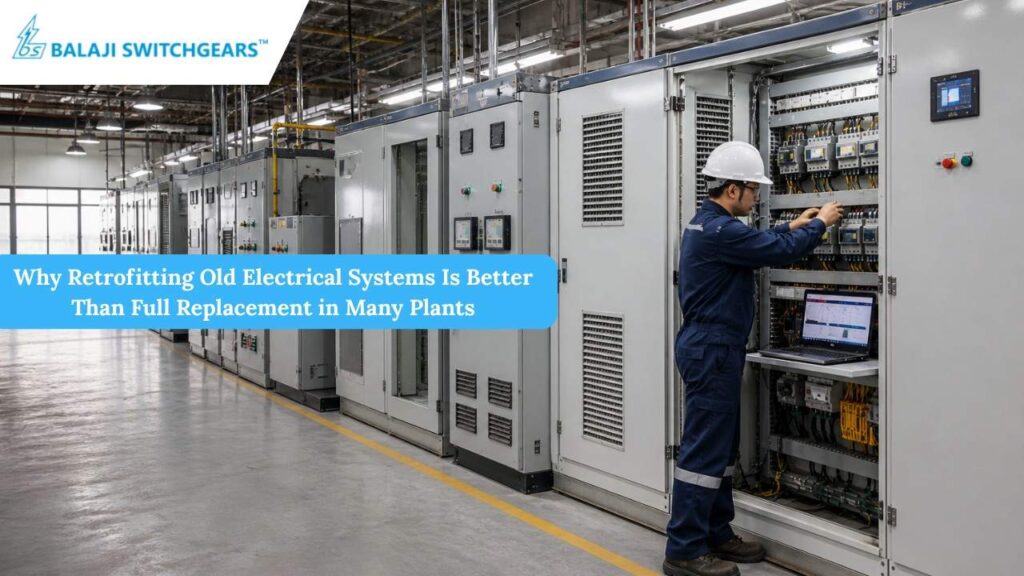
In industrial environments, electrical systems are the backbone of daily operations. From powering machinery to supporting automation and control systems, their reliability directly impacts productivity. However, as plants age, these systems often become outdated, less efficient, and increasingly difficult to maintain.
At this stage, industries face a critical decision: should they replace the entire system or upgrade what already exists?
While full replacement may appear to be the most advanced solution, in many real-world scenarios, retrofitting old electrical systems proves to be far more practical. It allows industries to enhance performance, improve safety, and modernize operations without the heavy cost and disruption associated with complete replacement. For companies working with experienced solution providers like Balaji Switchgears, retrofitting becomes a strategic approach rather than just a technical fix.
Understanding Retrofitting in Electrical Systems
Retrofitting is the process of upgrading existing electrical systems by replacing selected components, improving configurations, and integrating modern technologies into the current setup.
Instead of dismantling the entire infrastructure, retrofitting builds on what is already in place. This may involve upgrading switchgear, improving protection systems, enhancing wiring quality, and introducing better monitoring or control mechanisms.
The objective is simply to improve system performance and safety while minimizing cost and operational disruption.
The Challenge with Full System Replacement
Although replacing an entire electrical system may seem like a long-term solution, it often brings significant challenges, especially in active industrial plants.
Full replacement typically requires extended shutdowns. In industries where production runs continuously, even a short interruption can lead to major financial losses. The process also demands high capital investment, detailed planning, and complex execution.
Additionally, existing layouts may need to be redesigned, and compatibility with current machinery must be carefully managed. These factors make full replacement not only expensive but also operationally risky.
This is why many industries today prefer retrofitting as a smarter and more controlled approach to modernization.
Cost Efficiency and Better Investment Planning
One of the strongest advantages of retrofitting is its cost efficiency.
Instead of replacing everything, industries can focus only on components that need improvement. This targeted upgrade approach significantly reduces capital expenditure while still delivering noticeable performance gains.
It also allows better financial planning. Businesses can prioritize critical upgrades first and gradually improve the rest of the system over time.
For industries looking to optimize budgets without compromising on performance, retrofitting offers a balanced and practical solution.
Reduced Downtime and Continuous Operations
In industrial settings, downtime is one of the most critical concerns.
Full system replacement often requires long shutdown periods, which can disrupt production schedules and impact delivery timelines. Retrofitting, on the other hand, allows upgrades to be carried out in phases.
This means work can be done during planned maintenance windows, ensuring minimal disruption to operations.
By maintaining continuity, industries can avoid production losses while still improving their systems, a key advantage that makes retrofitting highly valuable.
Extending the Life of Existing Infrastructure
Many older electrical systems are built with strong and durable designs. While some components may become outdated, the overall infrastructure often remains reliable.
Retrofitting allows industries to extend the life of these systems by upgrading only what is necessary.
Instead of discarding functional setups, retrofitting enhances their performance and aligns them with modern requirements. This approach not only saves cost but also maximizes the value of previous investments.
Improved Safety and Compliance
Safety standards continue to evolve, and older systems may not always meet current requirements.
Retrofitting provides an opportunity to upgrade protection mechanisms, improve insulation, and enhance fault detection systems.
By integrating modern safety features, industries can reduce risks and ensure compliance with updated regulations.
This not only protects equipment but also creates a safer working environment for operators and maintenance teams.
Integration of Modern Technologies
Industrial automation has advanced rapidly, and modern systems offer better control, monitoring, and efficiency.
Retrofitting makes it possible to integrate these technologies into existing systems without complete replacement.
Real-time monitoring, improved control devices, and better communication systems can be added to enhance overall performance. This combination of existing infrastructure and modern technology creates a more efficient and intelligent system.
Flexibility for Future Expansion
One of the major advantages of retrofitting is flexibility.
Industries can upgrade systems based on current needs while keeping room for future expansion. As production demands increase, additional improvements can be implemented without major structural changes.
This adaptability is difficult to achieve with full replacement, where systems are often designed for fixed capacities.
Retrofitting allows businesses to grow and evolve without major disruptions.
Environmental and Sustainability Benefits
Sustainability is becoming a key focus for industries worldwide.
Full system replacement often generates significant waste, as large portions of existing infrastructure are discarded.
Retrofitting reduces this impact by reusing and upgrading existing systems. This minimizes material waste and lowers the overall environmental footprint.
By choosing retrofitting, industries not only improve performance but also contribute to more sustainable operations.
Simplified Maintenance and Better Reliability
Modernized systems created through retrofitting are easier to maintain.
Updated components offer better reliability and often include improved diagnostic features. This allows maintenance teams to identify and resolve issues more quickly.
Standardized systems and improved documentation further simplify troubleshooting.
Over time, this leads to reduced maintenance effort and more consistent system performance.
Solving Obsolescence Challenges
One of the biggest issues in older systems is the unavailability of spare parts.
Retrofitting addresses this by replacing obsolete components with modern alternatives. This ensures that the system remains serviceable and reliable.
Instead of struggling with outdated parts, industries can upgrade critical components and maintain smooth operations without a complete overhaul.
A Smarter Approach to Modernization
Retrofitting is not just a technical upgrade, it is a strategic decision.
It allows industries to modernize gradually, balancing cost, performance, and operational continuity. Instead of making large investments all at once, businesses can improve systems step by step.
This reduces risk and provides better control over the entire upgrade process.
The Balaji Switchgears Approach
In industrial environments, every decision related to electrical systems impacts long-term performance.
Balaji Switchgears understands that modernization is not always about replacing everything, it is about making the right improvements at the right time.
With a focus on reliability, safety, and efficiency, Balaji Switchgears supports industries in upgrading their electrical systems through practical and well-planned retrofitting solutions.
By combining technical expertise with application understanding, industries can achieve improved performance without unnecessary disruption.
Conclusion
Retrofitting old electrical systems offers a practical and efficient alternative to full replacement in many industrial plants.
It reduces costs, minimizes downtime, extends the life of existing infrastructure, and enables the integration of modern technologies. At the same time, it supports sustainability and improves safety standards.
For industries aiming to modernize without affecting ongoing operations, retrofitting provides a balanced and future-ready solution.
With the right approach and guidance from experienced partners like Balaji Switchgears, businesses can achieve reliable, efficient, and scalable electrical systems that meet both current and future demands.