
Electrical safety begins with protection, and protection begins with proper grounding and earthing. In modern power distribution networks, especially in low voltage switchgear, grounding and earthing are not optional design elements. They are fundamental safety mechanisms that protect equipment, personnel, and infrastructure from electrical faults.
Yet, many professionals use the terms “grounding” and “earthing” interchangeably without fully understanding their distinct roles.
This blog explains the difference between grounding in switchgear systems and earthing in switchgear system design, why they matter, and how they ensure reliable and safe power distribution.
What Is Grounding in Switchgear Systems?
Grounding in switchgear systems refers to the intentional connection of electrical system components to ground (earth potential) to stabilize voltage levels and provide a reference point for fault currents.
In practical terms, grounding:
- Protects equipment from voltage surges
- Stabilizes system voltage
- Ensures proper operation of protection devices
- Provides a safe path for fault current
Grounding plays a critical role in ensuring that during a fault condition, excessive current flows safely to the ground instead of through sensitive components or personnel.
What Is Earthing in Switchgear System Design?
Earthing in switchgear system installations focuses on connecting non-current-carrying metallic parts – such as panel enclosures, frames, doors, and support structures – to the earth.
The primary purpose of earthing is human safety.
If a fault causes a live conductor to touch the metallic enclosure of a panel, earthing ensures that the fault current flows directly to earth. This triggers protective devices like breakers to trip quickly, preventing electric shock.
In simple terms:
- Grounding protects the system
- Earthing protects people
Both are essential in low voltage switchgear installations.
Why Grounding and Earthing Are Critical in Low Voltage Switchgear
Low voltage switchgear systems are widely used in:
- Industrial facilities
- Commercial buildings
- Residential complexes
- Renewable energy installations
- Power distribution networks
Although voltage levels are lower compared to high-voltage systems, the fault current potential can still be extremely dangerous.
Improper grounding or earthing can result in:
- Electric shock hazards
- Equipment damage
- Arc flash incidents
- Fire risks
- Frequent breaker malfunctions
- Unstable system voltage
Therefore, grounding in switchgear systems must be carefully engineered and verified during installation.
How Grounding Works in Switchgear
Grounding creates a low-impedance path for fault currents.
When a fault occurs – such as insulation breakdown – current flows through the grounding conductor instead of through unintended paths.
The relationship between voltage, current, and resistance explains this clearly
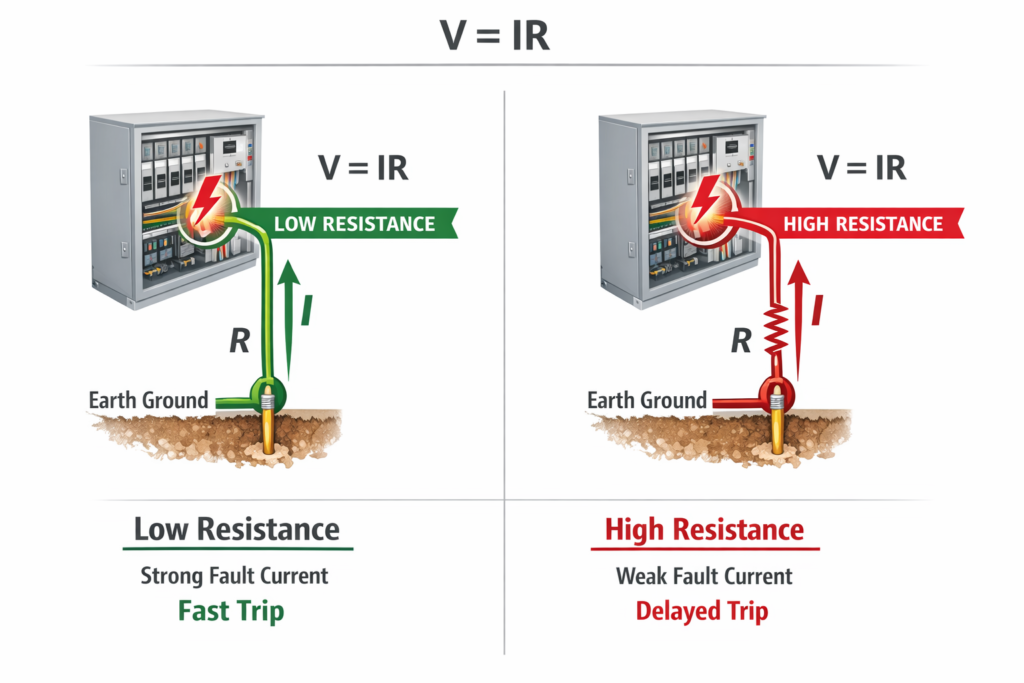
V = IR
If grounding resistance is high, fault current flow reduces. This may prevent protective devices from detecting the fault quickly, increasing hazard duration.
Low grounding resistance ensures:
- Rapid breaker tripping
- Reduced fault duration
- Lower arc flash risk
- Minimized equipment damage
This is why proper grounding design and testing are critical in switchgear systems.
Types of Grounding in Switchgear Systems
Grounding methods vary depending on application and system design.
1. Solid Grounding
In solid grounding, the neutral point of the transformer or generator is directly connected to earth.
Advantages:
- Fast fault clearing
- Simple design
- Widely used in low voltage switchgear
2. Resistance Grounding
A resistor is inserted between the neutral and earth to limit fault current.
This method:
- Reduces arc flash energy
- Controls fault current magnitude
- Protects sensitive equipment
Often used in industrial facilities where continuity is important.
3. Reactance Grounding
A reactor limits fault current instead of a resistor.
Used primarily in higher voltage applications but sometimes integrated in specialized systems.
Earthing Components in Switchgear Panels
Earthing in switchgear system design includes several critical components:
- Earth busbar
- Earth continuity conductor
- Panel bonding connections
- Earth pits
- Ground rods or plates
All metallic parts inside a switchgear panel must be bonded to the main earth bar to ensure continuity.
This includes:
- Doors
- Hinges
- Removable covers
- Instrument panels
Proper bonding prevents floating voltages on panel surfaces.
Importance of Earth Resistance Values
The effectiveness of earthing depends heavily on earth resistance.
Lower resistance values ensure:
- Faster fault current dissipation
- Improved protection performance
- Reduced touch voltage
Typical recommended earth resistance values vary depending on standards and applications, but maintaining minimal resistance is always preferred for safety.
Regular earth resistance testing is essential for maintaining reliable grounding in switchgear systems.
Role of Grounding in Arc Flash Protection
Arc flash incidents are among the most dangerous hazards in switchgear systems.
Effective grounding helps:
- Reduce fault clearing time
- Limit arc energy
- Protect maintenance personnel
In low voltage switchgear, rapid fault isolation is critical to minimizing arc flash intensity.
Grounding ensures that protective relays and breakers detect faults immediately and disconnect the circuit safely.
Grounding and Equipment Performance
Grounding does more than ensure safety – it also enhances equipment performance.
Benefits include:
- Stable reference voltage
- Reduced electrical noise
- Improved relay coordination
- Better power quality
Sensitive automation systems and digital relays require stable grounding to function correctly.
Poor grounding may lead to nuisance tripping or erratic operation.
Common Mistakes in Grounding and Earthing
Improper implementation can compromise system safety.
Common issues include:
- Loose earth connections
- Corroded grounding conductors
- Inadequate bonding of panel parts
- High earth resistance
- Incorrect conductor sizing
- Improper neutral-ground bonding
These mistakes increase risk and reduce protection reliability.
Grounding Conductor Sizing
Grounding conductors must be sized appropriately to carry potential fault currents.
Undersized conductors may:
- Overheat during fault
- Melt insulation
- Fail to carry current safely
Correct sizing ensures durability during short-circuit conditions.
Maintenance and Inspection Practices
Grounding and earthing systems must be inspected regularly.
Maintenance procedures include:
- Checking connection tightness
- Measuring earth resistance
- Inspecting corrosion
- Verifying bonding continuity
- Testing protective device coordination
Routine inspection ensures that grounding in switchgear systems remains effective over time.
Grounding in Renewable and Modern Installations
With the rise of renewable energy and automation, grounding requirements have become more complex.
Battery storage systems, solar inverters, and digital controllers require:
- Clean grounding
- Noise suppression
- Surge protection integration
Modern low voltage switchgear designs must accommodate both safety grounding and functional grounding for sensitive electronics.
International Standards and Compliance
Grounding and earthing in switchgear systems must comply with national and international standards such as:
- IEC guidelines
- IS standards
- IEEE recommendations
Compliance ensures:
- System safety
- Inspection approval
- Insurance validation
- Long-term reliability
Ignoring grounding standards can lead to legal and operational consequences.
The Future of Grounding in Switchgear Systems
As electrical systems become more digitized, grounding strategies are evolving.
Emerging developments include:
- Intelligent grounding monitors
- Real-time fault detection systems
- Advanced surge protection integration
- Improved earthing materials
These innovations enhance both safety and system intelligence.
Conclusion
Grounding in switchgear systems and earthing in switchgear system design form the foundation of electrical safety.
In low voltage switchgear installations, proper grounding:
- Stabilizes voltage
- Ensures rapid fault clearing
- Protects equipment
- Reduces arc flash risk
Proper earthing:
- Protects personnel
- Prevents electric shock
- Maintains safe panel enclosures
Together, they create a reliable, safe, and efficient electrical distribution system.
Ignoring these principles can result in equipment damage, operational downtime, and serious safety hazards.
For organizations designing and installing low voltage switchgear, working with experienced electrical solution providers like Balaji Switchgears ensures that grounding and earthing systems are engineered correctly, tested thoroughly, and maintained for long-term performance.
In electrical infrastructure, safety begins at the ground level, and grounding done right makes all the difference.