
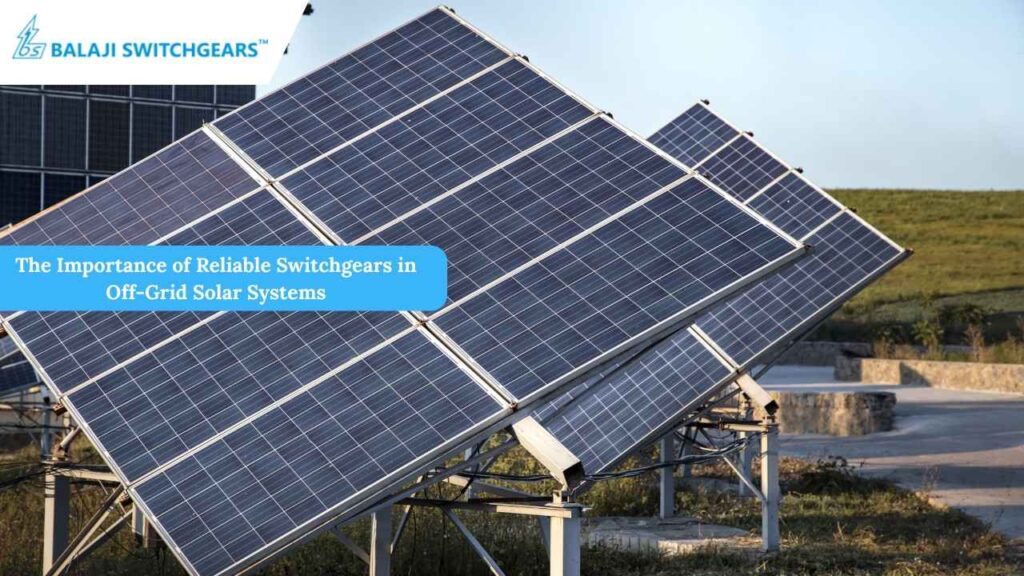
Off-grid solar systems have transformed how remote communities, industrial sites, farms and eco-friendly homes access electricity. Instead of depending on the main grid, these locations generate and store their own power—often using solar panels paired with batteries. While investing in solar modules and inverters is essential, many owners overlook the component that keeps the entire system safe, stable and long-lasting: reliable switchgear.
Switchgears may not be the most visible part of an off-grid system, but they are certainly among the most important. They manage fault protection, load control, isolation, monitoring and safe power distribution. In a setup where every watt counts and every failure has immediate consequences, having dependable switchgear is not optional—it is critical. Companies like Balaji Switchgears, known for offering carefully engineered electrical distribution solutions, emphasize this need across modern solar installations.
This blog explores why high-quality switchgear is essential in off-grid solar systems, how it protects equipment and users, and what makes certain switchgear designs more suitable for solar applications than others.
Why Switchgear Matters More in Off-Grid Systems Than Grid-Tied Ones
In grid-connected solar setups, the national grid acts as a stabilizing backbone. It absorbs excess energy, supports load variations and balances power flow. But in an off-grid system, there is no external support. The entire operation depends on the quality of internal components.
That is precisely where reliable switchgear becomes invaluable.
1. Every fault affects the entire system
A minor short circuit in any part of an off-grid system can instantly disrupt the inverter, drain the battery or damage connected appliances. Without strong protection, even small issues escalate quickly.
2. Backup power is limited
Off-grid setups rely on batteries or diesel generators. Any electrical failure reduces available backup and impacts essential functions like communication systems, refrigeration or water pumps.
3. Sensitive electronics require stable flow
Modern inverters, MPPT controllers and lithium-ion batteries operate within strict voltage limits. High-quality switchgear helps maintain this stability.
4. Maintenance is harder and more expensive
Remote locations often face challenges like slow repair times, lack of spare parts or extreme weather. Reliable switchgear reduces dependency on frequent servicing.
In short, well-designed switchgear is the safety shield that stands between your system and costly downtime.
What Switchgear Does Inside an Off-Grid Solar System
In a typical off-grid facility—whether residential, industrial or agricultural—switchgear performs several essential roles:
Circuit protection
Protective devices prevent equipment damage caused by overloads, short circuits or sudden surges from batteries and inverters.
System isolation
During maintenance or emergencies, switchgear allows isolating panels, inverters or battery banks safely.
Load management
Switchgear ensures that critical loads get priority supply while non-essential loads remain controlled.
Battery and inverter coordination
Reliable switchgear supports proper charging, discharging and energy transfer, which is essential for battery longevity.
Monitoring and fault detection
Modern switchgear integrates metering, indicators and alarms that help users identify faults early.
In off-grid systems, these functions are not just helpful—they are essential for daily operation.
Why Quality Matters: Risks of Using Poor Switchgear
Using substandard or incompatible switchgear is a common mistake in solar projects. Many installations cut costs on distribution equipment, yet this leads to much bigger expenses later.
Here are the most common risks:
Fire hazards
Unreliable breakers or loose connections can cause overheating, leading to insulation failure or fires—especially in systems where high DC currents are involved.
Damage to inverters
Inverters are sensitive and expensive. Switchgear that fails to interrupt faults quickly can destroy inverter modules.
Reduced battery life
Irregular current flow or undervoltage/overvoltage conditions gradually degrade battery cells.
Downtime and service delays
If switchgear breaks down in a remote area, system downtime increases dramatically.
Loss of load prioritization
Essential equipment like refrigeration, water supply or medical devices may lose power unexpectedly.
Reliable switchgear is not just an upgrade—it is a necessity to ensure safety and continuity.
Why Low-Voltage Switchgear Is Crucial for Off-Grid Solar
Most off-grid systems operate in the low-voltage category, meaning the equipment used must handle large current flows at comparatively lower voltages. This makes low voltage switchgear a key component in ensuring efficient and protected power distribution.
Here’s what makes low voltage switchgear important:
Compatibility with inverters and batteries
Off-grid inverters and battery banks usually operate between 12V and 480V AC/DC. Purpose-built switchgear ensures stable control within this range.
High current handling
Even low-voltage systems generate high currents, especially from battery discharges. Switchgear built for such scenarios prevents overheating and arcing.
Enhanced protection logic
Off-grid setups often need special protection rules, like backfeed prevention or overload control, which are supported by well-designed LV switchgear.
Reliability under harsh conditions
Off-grid environments often include heat, dust, humidity or vibrations. Quality switchgear is engineered to withstand such challenges.
For any off-grid installation, using properly rated Low voltage switchgear ensures reliability and operational safety.
Core Components of Off-Grid Solar Switchgear
A high-quality switchgear assembly for an off-grid solar installation usually includes:
MCCBs and MCBs
Handle overload and short-circuit protection for AC loads, inverter outputs and generator inputs.
DC circuit breakers
Designed specifically to interrupt DC faults, crucial for solar arrays and battery connections.
Contactors
Help automate switching between sources or loads.
Surge Protection Devices (SPD)
Protect the system from lightning-induced surges or inverter switching transients.
Busbars and Interconnects
Provide safe and efficient current distribution.
Auto Transfer Switches (ATS)
Switch between solar battery power and generator backup.
Monitoring and meter modules
Allow tracking of voltage, current, power consumption and fault conditions.
Enclosures
Provide environmental protection, preventing damage from dust, moisture and heat.
Each part plays a critical role in ensuring that the off-grid system operates smoothly and safely.
How Reliable Switchgear Improves Performance in Off-Grid Systems
Reduces system losses
High-quality switchgear minimizes resistive losses and heat buildup, improving overall system efficiency.
Protects sensitive electronics
Consistent voltage and current flow preserve inverter and battery health.
Enables smart energy management
Modern switchgear integrates with controllers and monitoring systems, helping users make informed decisions.
Makes maintenance safer and easier
Clear isolation points and labeling ensure technicians can work safely.
Supports load prioritization
Switchgear allows separating essential and non-essential loads for better energy management.
Enhances lifespan of the entire system
Reliable components reduce wear and tear on connected equipment, extending overall system life.
Switchgear Requirements for Different Off-Grid Applications
Rural Homes and Homesteads
Require compact, affordable switchgear with basic protection and load control features.
Remote Industrial Sites
Need strong, durable switchgear capable of handling large motors, pumps or compressors.
Agricultural Farms
Often include irrigation pumps, cold storage and processing machinery—requiring robust load management.
Resorts, Lodges and Eco-Spaces
Need silent, reliable power and seamless switching between solar and batteries.
Telecom Towers
Demand high reliability and long service life due to 24/7 operation.
Each application has its own challenges, but the solution remains the same: invest in high-quality LV switchgear with appropriate ratings.
What to Consider When Choosing Switchgear for Off-Grid Systems
1. System voltage and current
The switchgear must be correctly rated for inverter output, battery discharge current and solar array ratings.
2. DC vs AC protection
Solar panels and batteries require DC protection, while appliances use AC protection.
3. Scalability
Choose modular designs that allow future expansion.
4. Environmental conditions
Enclosures should be dustproof, weatherproof or corrosion-resistant if required.
5. Quality and certification
Look for equipment built to standard protection and performance guidelines.
6. Integration needs
Some off-grid sites require remote monitoring or automation integration.
Why Professional Solar Integrators Prefer Reliable Switchgear
Professional installers understand the real-world risks of poor electrical distribution equipment. This is why they often choose switchgear with proven reliability, long-term durability and strong safety features.
Benefits to integrators:
• Fewer service calls
• Reduced warranty claims
• Better customer satisfaction
• Higher system uptime
• Smooth commissioning and testing
A well-installed switchgear panel often determines whether an off-grid system runs successfully for 10 years—or struggles from day one.
Final Thoughts
Off-grid solar systems are the future for remote communities, sustainable businesses and energy-independent homes. But no matter how advanced the panels, batteries or inverters may be, the heart of the system’s safety and reliability lies in its switchgear. Using high-quality low voltage switchgear ensures stable performance, safer operation, reduced maintenance and longer equipment life. For organizations seeking dependable switchgear solutions for off-grid solar applications, Balaji Switchgears offers professional-grade products and engineering support designed to meet modern energy needs.