
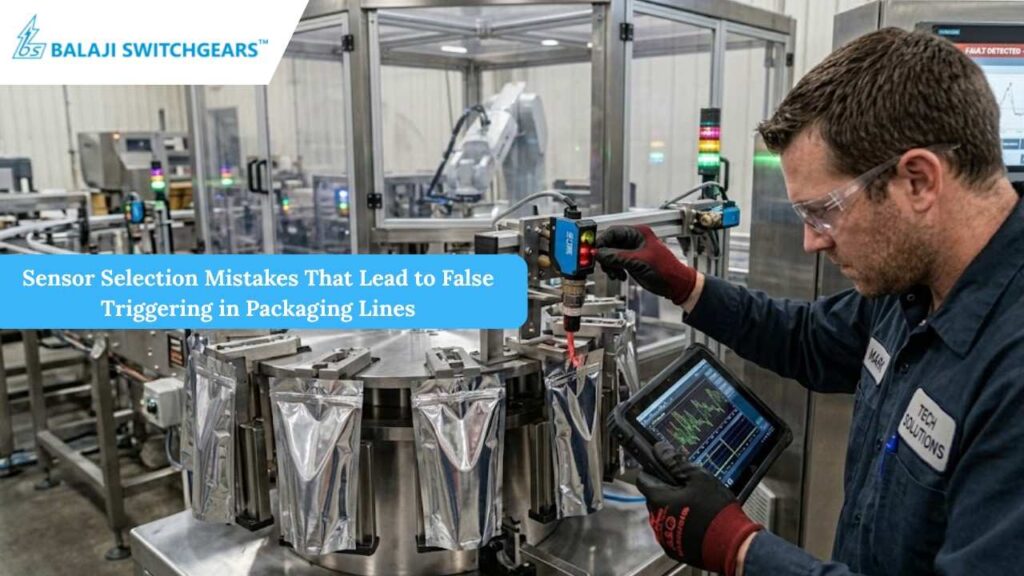
In today’s fast-moving industrial landscape, packaging lines are designed for speed, precision, and consistency. From food and beverage to pharmaceuticals and consumer goods, automated packaging systems rely heavily on sensors to detect, count, position, and control products throughout the process.
However, one of the most common and frustrating issues faced in these systems is false triggering. Machines stop unexpectedly, counts go wrong, or products get misaligned all because sensors are not performing as expected.
In many cases, the root cause is not sensor failure, but incorrect sensor selection.
Choosing the wrong type of sensor, or failing to consider environmental and application-specific factors, can lead to unreliable signals and inconsistent machine behavior. Understanding these mistakes is essential for improving efficiency and ensuring smooth operations in packaging lines.
The Critical Role of Sensors in Packaging Lines
Sensors act as the “eyes and ears” of automated systems. They detect the presence, absence, position, or movement of products and send signals to control systems such as programmable controllers.
In packaging lines, sensors are used for tasks such as:
- Detecting product presence on conveyors
- Counting items before packaging
- Ensuring proper alignment
- Triggering filling, sealing, or labeling operations
Because these processes are interconnected, even a small error in sensing can disrupt the entire line.
False triggering occurs when a sensor sends a signal at the wrong time either detecting something that is not there or missing something that is. This leads to incorrect machine actions and operational inefficiencies.
What is False Triggering and Why Does It Happen?
False triggering refers to incorrect or unintended sensor activation. It may appear as random faults, inconsistent counting, or irregular machine behavior.
This issue is often intermittent, making it difficult to diagnose. Machines may work perfectly at one moment and fail the next, creating confusion for maintenance teams.
The primary reason behind such issues is not always a faulty sensor, but rather mismatched sensor selection for the application.
Sensors are highly sensitive devices, and their performance depends on factors such as material type, environmental conditions, installation position, and operating speed. Ignoring these factors leads to unreliable detection.
Choosing the Wrong Type of Sensor
One of the most common mistakes is selecting a sensor that is not suitable for the application.
Different types of sensors such as inductive, capacitive, photoelectric, and ultrasonic are designed for specific purposes. For example, an inductive sensor works well for detecting metal objects but will fail to detect plastic or glass products.
In packaging lines where products vary in material, shape, or transparency, using the wrong sensor type can result in missed detections or false signals.
Photoelectric sensors, for instance, are widely used in packaging, but even within this category, there are variations such as diffuse, retro-reflective, and through-beam sensors. Each has its own strengths and limitations.
Selecting the correct type requires a clear understanding of the product characteristics and application requirements.
Ignoring Product Material and Surface Properties
Packaging lines often deal with a wide range of materials: transparent bottles, shiny metal cans, printed cartons, or flexible plastic packaging.
Sensors respond differently to these surfaces. Reflective or glossy surfaces can cause light-based sensors to misread signals, while transparent objects may pass undetected if the sensor is not designed for such applications.
When material properties are not considered during selection, sensors may generate inconsistent outputs, leading to false triggering.
Overlooking Environmental Conditions
Industrial environments are rarely ideal. Dust, moisture, vibration, temperature variations, and ambient light all affect sensor performance.
For example, dust accumulation on a sensor lens can block signals, while high humidity can interfere with certain detection methods. Strong ambient lighting may disrupt photoelectric sensors, causing incorrect readings.
In packaging lines, especially in food or pharmaceutical industries, washdown conditions are common. Sensors not designed for such environments may fail or behave unpredictably.
Ignoring environmental conditions during sensor selection is a major cause of unreliable operation.
Improper Sensor Placement and Alignment
Even the right sensor can perform poorly if it is not installed correctly.
Incorrect positioning can cause the sensor to detect unintended objects or miss the target entirely. Misalignment is especially critical in high-speed packaging lines where timing is precise.
If the sensing range is not properly adjusted, the sensor may pick up background objects or reflections, leading to false signals.
Proper mounting, alignment, and calibration are essential to ensure accurate detection.
Not Considering Line Speed and Response Time
Packaging lines often operate at high speeds, where products move rapidly along conveyors.
Sensors must be able to respond quickly enough to detect each product accurately. If the sensor’s response time is too slow, it may miss detections or generate delayed signals.
This mismatch between sensor capability and line speed is a common reason for inconsistent performance.
Selecting sensors with appropriate switching frequency and response time is crucial for high-speed applications.
Electrical Noise and Signal Interference
Industrial environments are filled with electrical equipment such as motors, drives, and switching devices. These can generate electromagnetic interference that affects sensor signals.
If sensors and cables are not properly shielded or routed, noise can cause false triggering. Signals may fluctuate, leading to incorrect inputs in the control system.
Proper wiring practices and the use of high-quality components help reduce such issues.
Lack of Sensitivity Adjustment
Many sensors come with adjustable sensitivity settings. However, improper configuration can lead to unstable performance.
If sensitivity is set too high, the sensor may detect unintended objects or background noise. If it is too low, it may fail to detect the actual target.
Fine-tuning sensitivity based on the application is essential for reliable operation.
Real Impact on Packaging Line Performance
False triggering may seem like a minor issue, but its impact on packaging lines can be significant.
Production efficiency drops when machines stop unexpectedly or operate incorrectly. Incorrect counting leads to packaging errors, affecting product quality and customer satisfaction.
Frequent troubleshooting increases maintenance workload and operational costs. In some cases, repeated faults can even damage equipment due to improper machine actions.
Over time, these issues reduce overall productivity and reliability.
The Importance of Application-Based Sensor Selection
Avoiding false triggering starts with selecting sensors based on actual application requirements rather than general assumptions.
This involves understanding:
- Product type and material
- Environmental conditions
- Required sensing distance
- Speed of operation
- Mounting constraints
A well-matched sensor not only improves accuracy but also reduces the need for frequent adjustments and maintenance.
Moving Towards Reliable Automation
Modern packaging lines demand consistency and precision. As automation becomes more advanced, the role of sensors becomes even more critical.
Selecting the right sensor is not just about functionality it is about ensuring stability in the entire system.
With the right approach, false triggering can be minimized, leading to smoother operations, reduced downtime, and improved output quality.
The Balaji Switchgears Perspective
In industrial automation, success lies in the details. Components like sensors may seem small, but their impact on system performance is significant.
At Balaji Switchgears, the focus is on helping industries choose the right electrical and automation solutions based on real application needs. This includes understanding system requirements, environmental challenges, and operational goals.
By prioritizing correct selection and proper implementation, industries can avoid common mistakes that lead to false triggering and unreliable performance.
Conclusion
False triggering in packaging lines is often not a result of faulty equipment but a consequence of incorrect sensor selection and application mismatch.
From choosing the wrong sensor type to ignoring environmental factors and installation practices, small mistakes can lead to major operational issues.
By understanding these challenges and adopting a thoughtful, application-driven approach, industries can improve system reliability and efficiency.
In high-speed packaging environments, where precision is critical, the right sensor selection makes all the difference. It ensures that machines respond accurately, processes run smoothly, and production goals are consistently achieved.
For businesses looking to build dependable and efficient systems, focusing on the fundamentals like proper sensor selection is a step toward long-term success.