
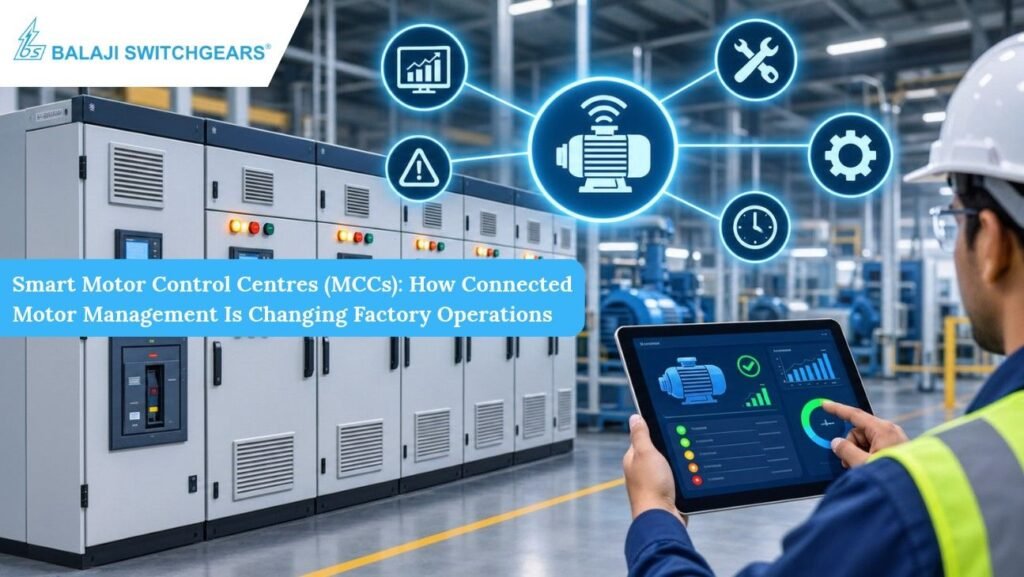
In a manufacturing plant, a single motor failure can interrupt an entire production process. A pump may stop supplying water, a conveyor may halt material movement, or a compressor may fail to maintain the required pressure. In many cases, the biggest challenge is not just the equipment failure but identifying what caused it and how quickly operations can resume.
Traditional Motor Control Centres (MCCs) provide centralised control and protection for industrial motors. However, as factories become more automated and production requirements become increasingly demanding, simply starting and stopping motors is no longer enough. Industrial teams also need visibility into motor performance, electrical conditions, energy consumption and developing faults.
This is where Smart Motor Control Centres (Smart MCCs) are changing factory operations. By connecting intelligent motor control and protection devices with industrial communication networks, Smart MCCs help transform conventional motor management into a more connected, data-driven process.
At Balaji Switchgears, we understand the importance of reliable motor control and protection in industrial applications. Let’s explore how connected motor management works and why it is becoming important for modern factories.
1. What Is a Smart Motor Control Centres?
A Motor Control Centre is an assembly that brings together electrical equipment used to control and protect multiple motors from a central location.
A conventional MCC typically contains components such as:
- Circuit breakers or fuse-based protection devices
- Contactors for motor switching
- Overload relays for motor protection
- Motor starters
- Variable Frequency Drives (VFDs)
- Soft starters
- Control and monitoring accessories
A Smart MCC builds on this conventional arrangement by incorporating intelligent, communication-enabled devices. These devices can collect operating information and share it with PLCs, SCADA systems, Human Machine Interfaces (HMIs) or other industrial monitoring platforms.
For example, instead of only knowing that a motor has stopped, an operator may be able to view its operating status, current, overload condition, trip history or communication status through a monitoring interface.
The main difference is that a conventional MCC primarily provides control and protection, whereas a Smart MCC adds connected monitoring, diagnostics and access to operating data.
2. How Connected Motor Management Works
The working of a Smart MCC depends on communication between motor control devices, automation controllers and monitoring systems.
Let’s understand the process step by step.
Step 1: Motor control devices collect information
Intelligent motor protection relays, motor controllers and connected drives monitor relevant operating parameters. Depending on the device, these may include current, voltage, power, motor status, temperature-related information and fault conditions.
Step 2: Data is communicated through an industrial network
The connected devices transmit available information using industrial communication protocols. Common examples include Modbus TCP, Modbus RTU, EtherNet/IP and PROFINET.
The communication architecture depends on the selected devices and the plant’s automation requirements.
Step 3: PLC or monitoring systems process the information
The collected data can be integrated into a PLC, SCADA system or industrial monitoring platform. This allows operators and maintenance teams to view motor conditions without depending entirely on physical inspection.
Step 4: Teams respond using operating insights
When a device reports an overload, fault or abnormal operating condition, the relevant team can investigate the issue using available diagnostic information.
This makes motor management more informed and helps reduce the time spent identifying problems.
3. Why Are Factories Moving Towards Smart MCCs?
Modern manufacturing facilities operate multiple motors across different production stages. Managing each motor individually can become difficult, particularly when equipment operates continuously or is spread across a large facility.
Connected motor management helps address this challenge in several ways.
Real-Time Motor Monitoring
One of the biggest advantages of a Smart MCC is improved visibility into motor operating conditions.
Operators can monitor information such as running status, current, voltage, power consumption, alarms and fault conditions, depending on the connected device’s capabilities.
For example, in a water treatment plant, several pumps may operate across different treatment stages. With connected motor management, the operations team can view the status of individual motor feeders through a central monitoring system.
This makes it easier to identify which motor is operating, which one has stopped and whether a reported fault requires attention.
Faster Fault Identification
When a motor trips in a conventional setup, maintenance personnel may need to inspect the equipment and its associated protection devices to identify the cause.
A connected motor management system can provide additional diagnostic information, such as overload events, trip records and available electrical measurements.
This helps technicians narrow down possible causes before beginning physical troubleshooting.
For example, if a conveyor motor trips because of an overload condition, the available trip information can help the maintenance team investigate whether the problem is related to excessive mechanical load, a process issue or another electrical condition.
The actual cause still needs to be verified, but access to relevant information can make troubleshooting more efficient.
Improved Maintenance Planning
Traditional maintenance often depends on fixed schedules or action taken after equipment failure.
Smart MCCs can support a more condition-based maintenance approach by making operating trends, alarms and fault history available to maintenance teams.
For instance, repeated overload warnings on a motor may indicate that the connected equipment needs inspection. Similarly, changes in electrical measurements may highlight conditions that require further investigation.
This information helps maintenance teams prioritise inspections based on actual equipment conditions rather than relying only on calendar-based maintenance.
It is important to understand that connected monitoring does not automatically guarantee predictive maintenance. Effective prediction requires suitable sensors or intelligent devices, reliable data, appropriate analysis and a defined maintenance response.
4. The Role of Intelligent Motor Protection Devices
Intelligent motor protection devices are central to the functioning of a Smart MCC.
Conventional overload relays provide essential protection against motor overload conditions. However, electronic motor management devices can offer additional monitoring, communication and diagnostic capabilities.
Depending on the device and configuration, these capabilities may include:
- Overload and phase-loss protection
- Current and voltage monitoring
- Phase imbalance detection
- Ground-fault protection
- Motor operating status
- Trip and alarm history
- Communication with automation systems
For example, an electronic motor management relay connected to a motor feeder can communicate its operating status and protection events to a PLC or SCADA system.
This allows the plant team to monitor multiple motor circuits from a central location.
The selection of a protection device should still be based on motor rating, starting characteristics, load type, protection requirements and the manufacturer’s technical specifications.
5. How Smart MCCs Help Improve Energy Management
Electric motors are widely used in pumps, compressors, conveyors, fans, mixers and production machinery. Their energy consumption can have a significant impact on industrial operating costs.
However, knowing how much electricity an entire facility consumes does not always explain how efficiently individual motor-driven processes are operating.
Connected motor management can provide motor-level electrical information, depending on the devices and metering architecture used.
Important parameters may include:
- Active power
- Reactive power
- Energy consumption
- Power factor
- Current and voltage
- Operating hours
Consider a factory operating multiple pumping systems. By monitoring the electrical consumption and operating conditions of individual motor feeders, the engineering team can identify areas that may require further investigation.
A pump operating under unsuitable conditions, an unnecessarily running motor or an inefficient process may create opportunities for improvement.
This information can support better energy-management decisions. However, energy savings depend on the corrective actions taken, such as improving process control, optimising motor loading or selecting suitable speed-control solutions.
6. The Importance of VFDs and Soft Starters in Smart MCCs
Variable Frequency Drives and soft starters play an important role in modern motor control systems.
Variable Frequency Drives (VFDs) control motor speed by adjusting the frequency and voltage supplied to the motor. They are particularly useful in applications where the required speed changes according to process demand.
For example, a pump does not always need to operate at full speed. A suitable VFD-based arrangement can adjust its speed according to system requirements.
Connected VFDs can also provide useful operating information, such as speed, current, drive status, alarms and fault conditions, depending on their communication capabilities.
Soft starters control motor starting by gradually increasing the voltage supplied to the motor. They help reduce starting current and mechanical stress during startup in suitable applications.
When integrated into a Smart MCC, connected drives and soft starters can share operating information with the plant’s automation system.
The choice between a direct-on-line starter, soft starter or VFD depends on the application, motor characteristics, starting requirements and process-control needs. Not every motor requires a VFD, and selecting the correct starting method is important for overall system performance.
7. Smart MCC Applications Across Industries
Connected motor management is useful wherever industrial processes depend on multiple motors operating together.
Water and Wastewater Treatment: Pumps, blowers and mixers can be monitored to improve visibility into equipment status and respond to faults across different treatment stages.
Food and Beverage Manufacturing: Motors used in conveyors, mixers, packaging machines and processing equipment can be monitored through connected control systems.
Cement and Mining: Crushers, conveyors, fans and material-handling equipment often operate under demanding conditions. Connected motor information can help maintenance teams investigate faults and monitor equipment performance.
Pharmaceutical Manufacturing: Motors used in pumps, HVAC systems, mixing equipment and utilities can be integrated into central monitoring architectures, subject to the facility’s operational and compliance requirements.
Chemical and Petrochemical Plants: Connected motor management can support monitoring of pumps, compressors, agitators and other critical motor-driven equipment.
HVAC and Building Infrastructure: Fans, chillers and pumps can be monitored to improve operational visibility and support more effective maintenance planning.
In each application, the MCC architecture must be designed according to the motor load, electrical protection requirements, operating environment and automation system.
8. Smart MCC vs Conventional MCC: What Is the Difference?
Both conventional and smart MCCs perform essential motor control and protection functions. The difference lies in their monitoring and communication capabilities.
| Parameter | Conventional MCC | Smart MCC |
| Motor starting and stopping | Yes | Yes |
| Electrical protection | Yes | Yes |
| Connected device monitoring | Limited, depending on design | Available through intelligent devices |
| Remote status visibility | Requires additional arrangements | Supported through network integration |
| Fault information | Basic indication or local records | Detailed device diagnostics, where supported |
| Energy monitoring | Requires suitable meters | Can be integrated at motor or feeder level |
| Maintenance approach | Often time-based or reactive | Can support condition-based maintenance |
A Smart MCC is not automatically the right choice for every installation. The investment should be evaluated according to the number of motors, operational criticality, monitoring requirements and expected benefits.
9. What to Consider Before Selecting a Smart MCC
Choosing a Smart MCC requires a clear understanding of the plant’s electrical and automation requirements.
Motor ratings and load requirements: Identify the number of motors, their power ratings, full-load currents, starting methods and operating conditions.
Protection and switching devices: Select suitable circuit breakers, contactors, overload relays, motor protection devices and drives according to the application.
Communication compatibility: Check whether the selected devices support the communication protocols used by the plant’s PLC, SCADA or automation system.
Monitoring requirements: Decide which parameters need to be monitored, such as current, voltage, power, motor status, alarms and fault history.
Panel design and safety: Consider short-circuit withstand requirements, segregation, heat dissipation, enclosure protection, accessibility and applicable assembly standards.
Future expansion: Allow for additional motor feeders, network capacity and monitoring points if the plant is expected to expand.
Cybersecurity: Connected devices introduce additional network considerations. Plan access controls, network segmentation, secure configuration and appropriate maintenance practices.
A properly selected Smart MCC should meet present operating requirements while allowing practical integration with the plant’s future automation needs.
How Balaji Supports Motor Management
At Balaji Switchgears, we understand that reliable motor management is essential for maintaining industrial productivity. Our focus is on helping OEMs, panel builders, system integrators and industrial customers explore suitable electrical and automation components for their applications.
From motor protection and switching devices to contactors, overload relays, VFDs, soft starters, controlgear and monitoring solutions, we help customers evaluate component options based on their technical requirements.
We also recognise that a connected MCC requires more than individual smart devices. Compatibility between protection equipment, communication networks, controllers and monitoring systems is essential for achieving a reliable solution.
Whether you are planning a new MCC installation or upgrading an existing motor control system, the right component selection and system architecture can make a meaningful difference to operational visibility and maintenance efficiency.
Get in touch with Balaji Switchgears to explore electrical and motor management solutions for your industrial applications.