
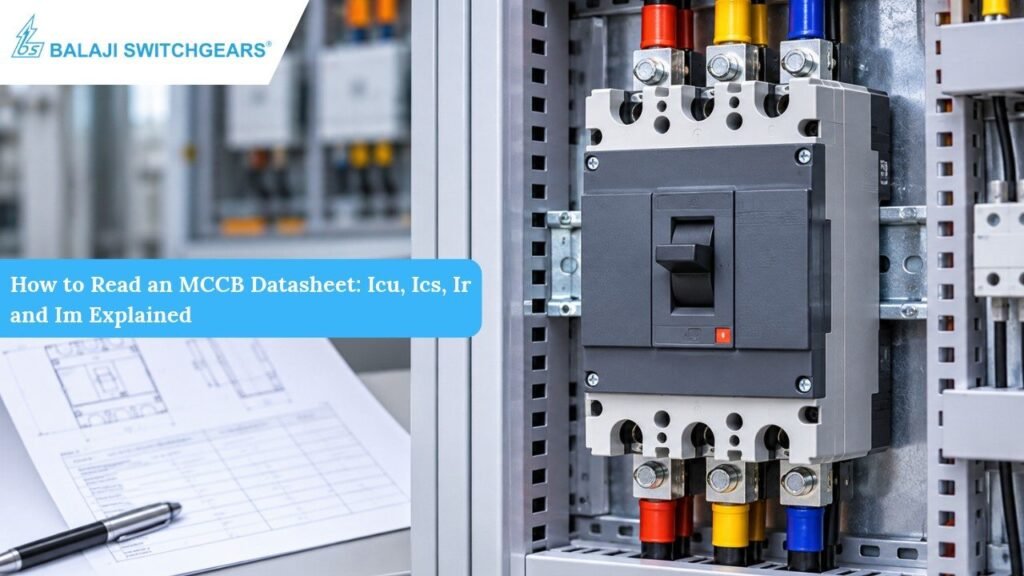
Selecting the right MCCB (Moulded Case Circuit Breaker) involves much more than matching its ampere rating with the connected load. The breaker must also be capable of interrupting the prospective short-circuit current at the installation point and providing suitable protection against overloads and electrical faults.
When panel builders and electrical engineers review an MCCB datasheet, they often come across technical terms such as Icu, Ics, Ir and Im. Although these parameters may appear together, each describes a different aspect of circuit breaker performance.
Understanding these ratings helps engineers make informed selection decisions, avoid incorrect protection settings and improve the reliability of electrical distribution systems.
At Balaji Switchgears, we believe that understanding product specifications is an important part of selecting the right switchgear. In this guide, we explain these four key MCCB parameters using Schneider Electric product ranges and practical industrial examples.
What Is an MCCB Datasheet?
An MCCB datasheet is a technical document that provides the electrical, mechanical and operational specifications of a moulded case circuit breaker.
For engineers and panel builders, it acts as a reference for checking whether a particular breaker is suitable for the electrical installation.
A Schneider Electric MCCB datasheet or product specification may include:
- Rated current and frame size
- Rated operational voltage
- Number of poles
- Ultimate breaking capacity (Icu)
- Service breaking capacity (Ics)
- Long-time overload protection setting (Ir)
- Magnetic or instantaneous short-circuit pickup setting
- Trip-unit characteristics
- Insulation and impulse withstand ratings
- Mounting requirements and compatible accessories
Among these specifications, Icu, Ics, Ir and Im deserve particular attention because they relate to fault interruption and protection performance.
1. Icu – Rated Ultimate Short-Circuit Breaking Capacity
Icu stands for Rated Ultimate Short-Circuit Breaking Capacity.
It indicates the maximum prospective short-circuit current that an MCCB can interrupt under specified test conditions at a particular rated operational voltage.
It is generally expressed in kiloamperes (kA).
For example, if an MCCB datasheet specifies:
Icu = 36 kA at 415V AC
This means the breaker has a rated ultimate short-circuit breaking capacity of 36 kA at 415V AC under the applicable test conditions.
Why does Icu matter?
During a short circuit, fault current can rise to extremely high levels within a very short time. If the prospective fault current at the installation point exceeds the breaker’s rated breaking capacity, the breaker may not be suitable for safely interrupting that fault.
Consider an industrial distribution panel where the calculated prospective short-circuit current is 25 kA. Selecting an MCCB with an Icu of only 18 kA would be inadequate for that fault level.
The engineer must select a breaker with a suitable breaking capacity for the actual installation conditions.
Schneider Electric selection consideration: Schneider Electric MCCB ranges such as ComPacT NSX and EasyPact CVS offer different breaking-capacity levels depending on the model, current rating and operating voltage. The exact Icu value must always be verified against the relevant product reference and datasheet.
Remember: Icu is voltage-dependent. Never assume that the highest kA value mentioned in a product catalogue applies at every operating voltage.
2. Ics – Rated Service Short-Circuit Breaking Capacity
Ics stands for Rated Service Short-Circuit Breaking Capacity.
While Icu indicates the ultimate short-circuit breaking capacity, Ics indicates the breaker’s rated ability to interrupt a short-circuit current and remain capable of further service after the specified test sequence.
It is also expressed in kA and is often represented as a percentage of Icu.
For example:
- Icu = 36 kA
- Ics = 75% of Icu
- Ics = 27 kA
This means the MCCB has a rated service breaking capacity of 27 kA.
Why is Ics important?
In industrial facilities, a short-circuit event can interrupt production and affect connected equipment. The service breaking capacity helps engineers assess the breaker’s expected post-fault service capability.
A higher Ics relative to Icu can provide greater assurance of continued service after the specified fault-interruption tests, subject to inspection and the manufacturer’s instructions.
For example, consider two MCCBs with the same Icu rating of 36 kA:
- MCCB A: Ics = 18 kA
- MCCB B: Ics = 36 kA
Both have the same ultimate breaking capacity, but their service breaking capacities are different.
This is why checking Icu alone is not enough. Engineers should also review Ics, particularly for critical industrial applications where continuity of operation is important.
Schneider Electric selection consideration: Certain Schneider Electric MCCB ranges offer Ics equal to 100% of Icu, while other ranges have different Ics-to-Icu relationships. For example, Schneider Electric’s ComPacT NSX documentation specifies 100% Ics relative to Icu for the applicable range and performance configurations. Always check the exact model and voltage rating rather than assuming the same relationship across every MCCB.
3. Ir – Long-Time Overload Protection Setting
Ir refers to the long-time overload protection pickup setting of an MCCB.
Unlike Icu and Ics, which describe short-circuit breaking capacities, Ir relates to the current threshold at which the overload protection function operates.
In simple terms, it determines the current level at which the breaker identifies a sustained overload condition and initiates tripping according to its time-current characteristics.
In many adjustable MCCBs, Ir can be set as a proportion of the trip unit’s rated current (In). The available adjustment range depends on the specific model and trip unit.
For example, consider an MCCB with a trip-unit rated current of 250A and an adjustable Ir range of 0.4 to 1 times In.
If the selected setting is 0.8:
Ir = 250 × 0.8
Ir = 200A
The long-time overload protection pickup is therefore set at 200A.
Why does Ir matter?
Electrical cables and equipment are designed to operate within specified current limits. If a circuit carries excessive current for an extended period, it can lead to overheating, insulation damage and premature equipment failure.
The Ir setting helps protect against these sustained overload conditions.
For example, consider an industrial motor feeder. The engineer must account for the motor’s operating current, cable current-carrying capacity, starting characteristics and applicable protection requirements before finalising the overload setting.
Setting Ir too high can reduce the effectiveness of overload protection. Setting it too low can result in unwanted tripping during normal operation.
Therefore, Ir should be selected through proper load assessment and protection coordination rather than simply matching it to the MCCB’s maximum current rating.
Schneider Electric selection consideration: Schneider Electric MCCBs, including applicable ComPacT NSX and EasyPact CVS models, offer different trip-unit configurations and adjustment options. The available Ir range must be checked against the selected breaker and trip-unit documentation.
4. Im – Magnetic Short-Circuit Protection Setting
Im refers to the magnetic short-circuit pickup setting in MCCBs that use this designation.
It represents the current threshold at which the magnetic protection mechanism responds to a short circuit. This protection is intended to operate rapidly when current reaches the specified pickup level.
Unlike overload protection, which generally operates with an inverse-time characteristic, magnetic protection responds to high fault currents.
For example, consider a hypothetical MCCB with an Ir setting of 200A and a magnetic pickup set at 10 times Ir.
Im = 200 × 10
Im = 2,000A
This represents a magnetic pickup threshold of 2,000A. The multiplier is illustrative; actual adjustment ranges depend on the breaker and trip-unit design.
Why does Im matter?
Short circuits can produce extremely high currents that may damage cables, equipment and electrical components. Magnetic protection helps the MCCB respond quickly when the current reaches its specified pickup threshold.
In an industrial motor circuit, starting current can be considerably higher than normal operating current. If the magnetic pickup is selected without considering starting characteristics and fault protection requirements, unwanted tripping may occur.
The magnetic pickup must therefore be coordinated with the load characteristics, expected fault current and downstream protection devices.
Important Schneider Electric terminology note: Do not assume that every Schneider Electric MCCB uses the symbol Im. The terminology depends on the trip-unit design. Some Schneider Electric thermal-magnetic models and documentation specify Im, while ComPacT NSX documentation for certain trip units uses Ii for instantaneous pickup. Electronic trip units may also use settings such as Isd for short-time protection. Always refer to the specific Schneider Electric product datasheet and trip-unit guide.
Icu, Ics, Ir and Im: Understanding the Difference
Although these parameters appear together in MCCB specifications, they perform different roles.
| Parameter | Meaning | What It Tells You |
| Icu | Ultimate Breaking Capacity | Maximum rated short-circuit current the MCCB can interrupt under specified conditions |
| Ics | Service Breaking Capacity | Rated short-circuit interruption capability associated with continued service after the specified test sequence |
| Ir | Long-Time Overload Setting | Current threshold for overload protection |
| Im | Magnetic Short-Circuit Setting | Pickup threshold for magnetic short-circuit protection, where this designation is used |
The easiest way to remember these parameters is:
- Icu and Ics relate to the MCCB’s short-circuit breaking performance.
- Ir relates to long-time overload protection.
- Im relates to magnetic short-circuit pickup where that terminology is used.
How to Read a Schneider Electric MCCB Datasheet: A Practical Checklist
Understanding individual ratings is useful, but selecting an MCCB requires reviewing the complete product datasheet.
Here are some important points engineers and panel builders should verify before finalising their selection.
1. Check the Rated Operational Voltage
Confirm that the MCCB is suitable for the installation’s operating voltage. Breaking-capacity ratings can vary at different voltage levels.
2. Verify the Prospective Short-Circuit Current
Determine the expected fault current at the installation point. Select an MCCB with a suitable Icu rating and review Ics according to the required service performance.
3. Understand the Rated Current and Trip Unit
Do not confuse the MCCB frame size with the rated current of its trip unit. Check the selected Schneider Electric model’s current rating and trip-unit specifications.
4. Select the Correct Ir Setting
Consider the connected load, cable capacity, operating conditions and applicable protection requirements before setting the overload threshold.
5. Check the Magnetic or Instantaneous Pickup
Review the relevant protection setting, whether identified as Im, Ii or another designation in the selected trip unit. Consider load starting currents, fault levels and coordination requirements.
6. Review the Number of Poles and Installation Requirements
Check whether the application requires a 3-pole or 4-pole MCCB. Also verify terminal arrangements, mounting requirements, accessories and environmental conditions.
7. Review the Manufacturer’s Time-Current Curves
Datasheet values alone do not provide the complete picture. Time-current characteristics help engineers understand how the MCCB responds to different current levels and whether it can coordinate properly with other protective devices.
Common Mistakes to Avoid When Selecting an MCCB
Even when the datasheet is available, incorrect interpretation of specifications can lead to unsuitable breaker selection.
Some common mistakes include:
- Selecting an MCCB based only on its ampere rating.
- Checking Icu but ignoring Ics.
- Assuming the highest kA rating applies at every operating voltage.
- Confusing the MCCB frame rating with the actual trip-unit rating.
- Setting Ir without considering cable and load requirements.
- Treating Im and Ii as interchangeable across all trip-unit designs.
- Ignoring motor starting current when reviewing magnetic pickup settings.
- Overlooking coordination with upstream and downstream protective devices.
Avoiding these mistakes helps improve protection design and supports safer, more reliable electrical distribution.
How Balaji Switchgears Helps with Schneider Electric MCCB Selection
Selecting an MCCB requires more than comparing product ratings. Engineers and panel builders need to consider the connected load, operating voltage, prospective fault current, protection settings and installation requirements together.
At Balaji Switchgears, we support OEMs, panel builders, system integrators and industrial end users with electrical switchgear and automation product solutions.
Our Schneider Electric portfolio includes MCCB options such as ComPacT NSX and EasyPact CVS, with different current ratings, breaking capacities and trip-unit configurations for varied electrical distribution requirements.
Whether you are selecting an MCCB for a new control panel, upgrading an existing distribution system or reviewing protection requirements for an industrial application, our team can help you explore suitable Schneider Electric options based on your technical and application requirements.
Conclusion
Reading an MCCB datasheet correctly is an important step towards selecting suitable circuit protection for an electrical installation.
Icu and Ics help assess short-circuit breaking performance, while Ir and the relevant magnetic or instantaneous pickup settings define how the breaker responds to overload and short-circuit conditions.
With Schneider Electric MCCB ranges such as ComPacT NSX and EasyPact CVS, engineers and panel builders can evaluate different options according to their application requirements. The final selection should always be based on the exact product reference, manufacturer’s documentation, fault-level calculations and protection coordination.
Balaji Switchgears is an Authorised Distributor of Schneider Electric, offering a range of Schneider Electric MCCBs, including ComPacT NSX and EasyPact CVS. We help OEMs, panel builders, system integrators and industrial customers explore the right MCCB solutions based on their electrical protection and application requirements.
Looking for Schneider Electric MCCBs for your project? Get in touch with Balaji Switchgears for product selection assistance.