
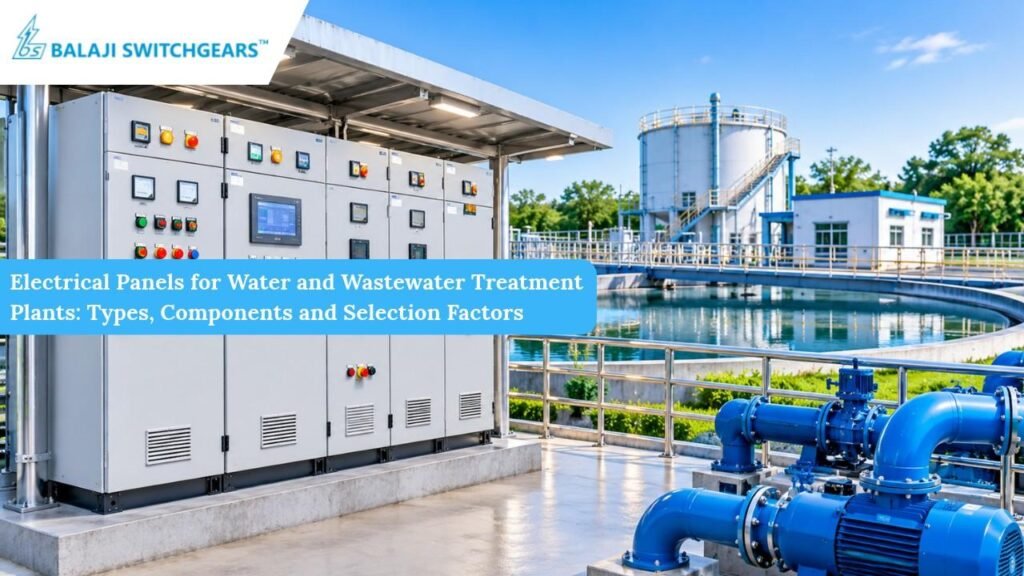
Water and wastewater treatment plants depend on several electrical and mechanical systems working together. From raw water pumping and filtration to chemical dosing, aeration and sludge handling, every stage requires reliable power distribution and control. A failure in one critical electrical system can interrupt operations, affect treatment processes and increase maintenance requirements.
This is where electrical panels for water and wastewater treatment plants become essential. They distribute electrical power, control motors, manage automation functions and provide protection to critical equipment. The right panel configuration helps operators maintain process continuity while making plant operation safer and more manageable.
For EPC contractors, panel builders, system integrators and industrial project teams, selecting electrical panels requires an understanding of the treatment process, connected loads, operating environment and level of automation.
At Balaji Switchgears, we understand the importance of selecting suitable electrical and automation components for demanding industrial applications. This guide explores the types of electrical panels used in water and wastewater treatment plants, their key components and the factors to consider before finalising a panel requirement.
1. Why Are Electrical Panels Important in Water and Wastewater Treatment Plants?
A treatment plant operates through multiple processes, many of which depend on electrically driven equipment. Pumps transfer water between different treatment stages, motors operate mechanical equipment, and control systems coordinate process operations.
Electrical panels bring these functions together by providing a structured arrangement for power distribution, motor control, protection and automation.
Their importance can be understood through the following functions:
Power distribution: Panels distribute incoming electrical power to pumps, motors, blowers, dosing systems and other connected equipment.
Motor control: They provide the necessary control arrangements for starting, stopping and operating motors according to process requirements.
Equipment protection: Protective devices help safeguard electrical circuits and connected equipment against conditions such as overloads and short circuits.
Process automation: Control panels can integrate PLCs, HMIs, sensors and other devices to support automatic operation and monitoring.
Operational management: Centralised control arrangements make it easier for operators to monitor equipment status, respond to alarms and manage plant operations.
Without properly selected electrical panels, coordinating multiple treatment processes becomes more difficult and can increase the risk of operational interruptions.
2. Types of Electrical Panels Used in Water and Wastewater Treatment Plants
Different stages of a treatment plant have different electrical requirements. Consequently, a project may require several types of panels working together.
A. Power Control Centre (PCC) Panels
A Power Control Centre (PCC) panel is used for the distribution of electrical power to different sections of a plant. It receives power from the incoming supply and distributes it to downstream distribution and motor control systems.
In a water treatment facility, PCC panels may supply power to pumping stations, filtration sections, treatment equipment and other major electrical loads.
Key considerations include:
- Incoming and outgoing feeder requirements.
- Rated current and voltage.
- Short-circuit withstand capacity.
- Busbar sizing and configuration.
- Circuit protection and isolation.
- Future feeder expansion requirements.
The PCC configuration should be planned according to the plant’s overall electrical load and distribution architecture.
B. Motor Control Centre (MCC) Panels
Motors are among the most important electrical loads in water and wastewater treatment facilities. They operate raw water pumps, transfer pumps, aeration blowers, agitators, mixers and sludge-handling equipment.
Motor Control Centre (MCC) panels provide centralised motor control and protection arrangements.
Depending on the application, an MCC may include:
- Motor starters.
- Motor protection circuit breakers.
- Contactors.
- Overload relays.
- Control relays.
- Variable Frequency Drives (VFDs).
- Indication and control devices.
For example, a wastewater treatment plant may use several pumps and blowers that operate according to process demand. An appropriately configured MCC helps organise their control and protection requirements.
C. PLC and Automation Control Panels
Modern treatment plants often require coordinated control of multiple processes. PLC-based automation panels help manage these operations through programmed control logic.
A Programmable Logic Controller (PLC) receives signals from field devices such as level sensors, pressure transmitters, flow meters and other instruments. It processes the information and controls connected equipment according to the programmed sequence.
PLC panels may support:
- Automatic pump operation.
- Tank-level-based control.
- Sequential motor operation.
- Alarm generation.
- Equipment interlocking.
- Communication with supervisory systems.
These panels are particularly useful where operators need centralised monitoring and automated process control.
D. VFD Control Panels
Water treatment operations frequently involve changing flow rates and pressure requirements. Running every motor continuously at full speed may not always be suitable for the process.
Variable Frequency Drives (VFDs) control motor speed by adjusting the frequency and voltage supplied to the motor, within the drive’s operating limits.
VFD-based panels can be used for:
- Raw water pumping.
- Treated water distribution.
- Pressure boosting systems.
- Aeration blowers.
- Transfer pumps.
When correctly selected and configured, VFDs can help match motor operation to changing process demand. They may also support smoother starting and reduce unnecessary mechanical stress, depending on the application.
3. Key Electrical Components Used in Treatment Plant Panels
The reliability of an electrical panel depends on the suitability of its components and how they work together.
Some important components include:
Moulded Case Circuit Breakers (MCCBs): MCCBs provide circuit protection and isolation for suitable incoming and outgoing feeders. Their selection depends on rated current, voltage, breaking capacity and coordination requirements.
Miniature Circuit Breakers (MCBs): MCBs are commonly used for protection of suitable lower-current auxiliary and control circuits.
Air Circuit Breakers (ACBs): ACBs may be used in main distribution applications where higher current ratings and appropriate protection arrangements are required.
Contactors: Contactors provide electrical switching for motors and other loads as part of the control circuit.
Overload Relays: These help protect motors against sustained overload conditions when correctly selected and coordinated with the motor starter.
Variable Frequency Drives: VFDs regulate the speed of compatible motors according to application requirements.
Control Relays and Timers: These support control logic, interlocking and sequencing functions.
PLC and HMI Devices: PLCs execute automation logic, while Human Machine Interfaces allow operators to view process information and interact with the control system.
The components must be selected as part of a coordinated system. Choosing individual devices without considering their electrical ratings, protection characteristics and application requirements can create problems during commissioning and operation.
4. Electrical Challenges in Water and Wastewater Treatment Plants
Treatment plants operate in environments that can be demanding for electrical equipment. Moisture, humidity, corrosive substances and continuous equipment operation all influence panel selection.
Moisture and Water Exposure
Panels installed near pumping stations, tanks and treatment equipment may be exposed to moisture or water splashes. The enclosure’s protection level should match the actual installation conditions.
The required IP rating should be evaluated according to the location, exposure and applicable project specifications. An IP rating should never be selected simply because it is higher; it must be appropriate for the expected environment.
Corrosion and Chemical Exposure
Wastewater treatment facilities may contain corrosive gases and chemicals. These conditions can affect enclosure materials, terminals, cable connections and other electrical components.
Suitable enclosure materials, protective finishes and installation arrangements should be considered based on the site’s environmental conditions.
Continuous Motor Operation
Pumps and blowers may operate for extended periods, depending on the treatment process. Incorrect motor protection, poor ventilation or unsuitable component ratings can contribute to overheating and equipment problems.
Proper motor sizing, protection coordination and thermal management are therefore important.
Electrical Faults and Supply Variations
Voltage fluctuations, phase imbalance, overloads and short circuits can affect connected equipment. Suitable protective devices and properly designed distribution arrangements help manage these risks.
Maintenance Accessibility
Treatment plants often need equipment to remain operational while maintenance activities are performed on other sections. Clear panel layouts, proper circuit identification and accessible components can make inspection and maintenance more manageable.
5. How Automation Improves Treatment Plant Operations
Automation plays an important role in managing water and wastewater treatment processes. Instead of depending entirely on manual switching, operators can use PLC-based systems to coordinate equipment according to process conditions.
For example, a tank-level sensor can provide information to a PLC. Based on the programmed logic, the controller can initiate or stop a pump when the specified level conditions are reached.
Similarly, pressure transmitters and flow meters can provide inputs for monitoring pumping operations, while motor status signals help operators identify equipment conditions.
When connected to a suitable supervisory system, automation can support:
- Centralised equipment monitoring.
- Process alarms and fault indications.
- Automatic pump sequencing.
- Runtime and operating-status monitoring.
- Better visibility of process conditions.
- More organised plant operation.
However, the automation architecture should be planned according to the plant’s actual requirements. PLCs, HMIs, communication networks, sensors and control devices must be compatible with one another.
6. Important Factors to Consider When Selecting Electrical Panels
Selecting electrical panels for a water or wastewater treatment plant requires more than checking the total connected load. The following factors should be reviewed before finalising the panel configuration.
1. Total Connected Load: Identify all pumps, motors, blowers, mixers, dosing equipment and auxiliary loads. Consider their ratings and operating requirements.
2. Motor Starting Requirements: Evaluate whether the application requires direct-on-line starters, star-delta starters, soft starters or VFD-based control.
3. Protection and Coordination: Select suitable circuit breakers, overload protection and other protective devices. Protection settings and coordination should be evaluated against the system design.
4. Short-Circuit Rating: Confirm the prospective fault level at the installation point and ensure that the selected panel assembly and components have appropriate ratings.
5. Enclosure and IP Protection: Consider humidity, dust, water exposure, chemical conditions and the panel’s installation location.
6. Automation Requirements: Determine whether the plant needs manual control, automatic operation, PLC integration, HMI monitoring or SCADA connectivity.
7. Power Quality: Assess the impact of VFDs and other non-linear loads on the electrical system. Harmonic considerations and any required mitigation should be evaluated during system design.
8. Future Expansion: Treatment plants may be upgraded as capacity requirements change. Allowing for suitable spare feeders, space and expansion provisions can simplify future modifications.
9. Applicable Standards: Panel assemblies and components should meet the applicable project specifications and relevant standards. IEC 61439 is an important reference for low-voltage switchgear and controlgear assemblies, while IEC 60947 covers relevant low-voltage switchgear and controlgear devices. The required compliance and verification should be confirmed for the specific project.
7. How Balaji Switchgears Supports Electrical Panel Requirements
Choosing the right electrical and automation components is an important step in planning a reliable water or wastewater treatment facility. The requirements of a pumping station can differ considerably from those of a filtration unit, aeration system or sludge-handling section.
At Balaji Switchgears, we work with OEMs, panel builders, system integrators, contractors and industrial customers to help them evaluate electrical and automation product requirements for their applications.
Our focus is on understanding the operating conditions, connected loads and control requirements before identifying suitable product options.
For treatment plant projects, this involves considering requirements such as:
- Circuit protection and switching devices for power distribution.
- Motor control and protection components for pumps and blowers.
- Contactors, overload relays and control accessories.
- VFDs and motor control solutions.
- PLC and HMI requirements for automation.
- Electrical components suitable for the specified panel configuration.
By helping customers evaluate these requirements, Balaji Switchgears supports a more application-focused approach to product selection and procurement.
Whether the requirement involves a new treatment plant, an expansion project or an upgrade to an existing electrical system, selecting the right components is an important part of preparing the panel for its intended operating conditions.
Conclusion
Electrical panels are central to the operation of water and wastewater treatment plants. From distributing power and controlling motors to managing automation and protecting equipment, they support several essential functions across the treatment process.
The right selection depends on connected loads, motor starting methods, protection requirements, environmental conditions, automation needs and future expansion plans. A properly evaluated panel configuration helps create a safer, more organised and maintainable electrical system.
At Balaji Switchgears, we help OEMs, panel builders, contractors and industrial customers explore suitable electrical and automation components for their panel requirements.
Planning an electrical panel for a water or wastewater treatment project? Connect with Balaji Switchgears to discuss your application requirements and explore suitable products for power distribution, motor control, circuit protection and automation. Our team can help you evaluate the relevant component specifications before moving ahead with procurement.