
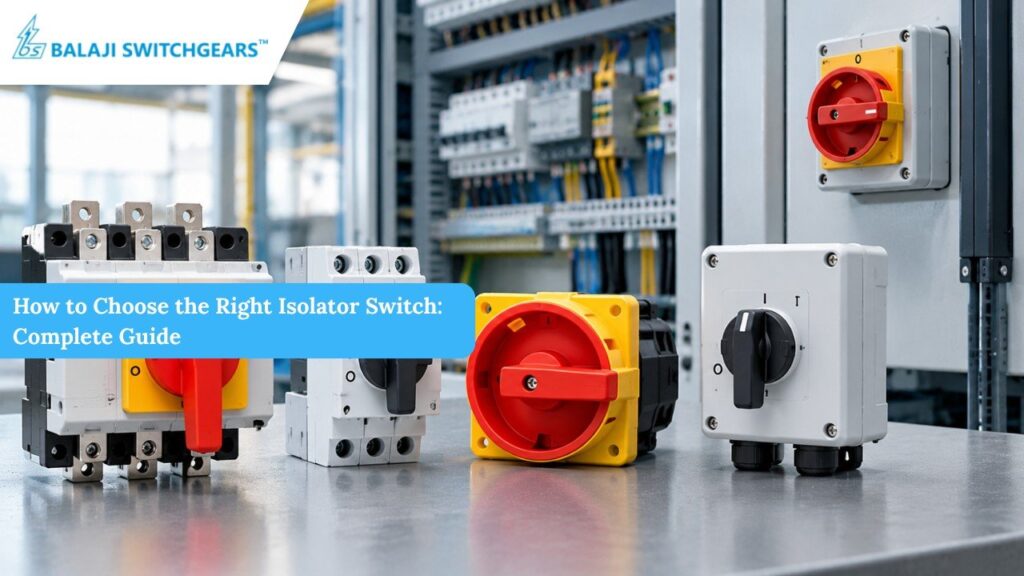
Ask any maintenance engineer about the most nerve-racking part of the job and many will say the same thing: working on equipment they cannot be sure is dead. An Isolator switch exists to remove that doubt. It gives a clear, deliberate way to separate a circuit from its power source so that people can work safely.
Yet isolators are often picked in a hurry, by price or availability. A wrongly chosen unit can overheat, weld shut or fail to protect the person holding the spanner. This guide walks through what an isolator does, the ratings that matter, and a practical way to choose the right one for your installation.
What Is an Isolator Switch?
An isolator, also called a disconnector, is a mechanical switching device that provides a visible or reliably indicated gap in a circuit. Once open, downstream equipment is electrically separated and can be serviced.
Its main job is isolation, not protection. A circuit breaker trips on faults. An isolator does not. It simply offers a safe, lockable point of disconnection.
Many modern products are switch disconnectors, which can also make and break normal load current. Pure isolators may only be operated when the circuit is already de-energised. Knowing which one you have, and which one you need, is the first decision.
Isolator, Switch Disconnector and MCB: Know the Difference
A pure isolator has no meaningful breaking capacity. Opening it under load can produce a dangerous arc.
A switch disconnector combines isolation with load breaking, so it can be operated while the equipment is running.
An MCB or MCCB adds overload and short circuit protection, but its isolating function depends on the design and marking of the specific device.
In most industrial panels, a load-breaking switch disconnector is installed ahead of a motor or machine so that the operator can shut it down quickly and then lock it out for maintenance.
Step 1: Match the Rated Operational Current
Start by calculating the circuit’s expected operating current. Select an isolator with a rated operational current (Ie) suitable for the connected load, supply voltage and switching duty.
Common current ratings vary by product range and application. Always check the manufacturer’s catalogue to confirm the appropriate rating for your installation.
Also consider the operating environment. High ambient temperatures and installation inside an enclosure can affect thermal performance. Check the manufacturer’s specified operating conditions and apply any required derating before finalising your selection.
Step 2: Check the Utilization Category
This is the specification many buyers miss. IEC 60947-3 classifies switching duty through utilization categories, and the right one tells you what the device can safely handle.
AC-21 covers resistive loads with little or no inductance, which is the lightest duty.
AC-22 covers mixed resistive and inductive loads, including moderate overloads.
AC-23 covers motors and other highly inductive loads, where the device must break heavy currents.
For motor circuits, choose AC-23, since motors draw several times their rated current during starting and produce strong arcs on opening. For direct current systems, such as solar arrays and battery banks, look for DC-21 or DC-22 categories, because direct current arcs are far harder to extinguish than alternating ones.
Step 3: Decide the Number of Poles
The pole count depends on the supply system.
Single phase circuits typically need two poles, switching phase and neutral.
Three phase three wire systems need three poles.
Three phase four wire systems may need four poles when the neutral must also be isolated, which is common where multiple sources, generators or sensitive electronics are involved.
Switching the neutral matters. A technician who assumes it is safe because it sits near earth potential can be proved wrong by a fault elsewhere.
Step 4: Verify Fault Withstand Ratings
Even though an isolator is not a protective device, it must survive a fault current until the upstream device clears it. Check two figures:
Rated short time withstand current, or Icw, shows how much current the isolator can carry for a set period without damage.
Rated short circuit making capacity, or Icm, shows whether it can safely close onto an existing fault.
If the prospective fault level at your point of installation is high, as it often is near transformers, a modest isolator may not be enough. Combining the isolator with fuses, in a fuse switch disconnector, is a common way to deliver both isolation and short circuit protection.
Step 5: Consider Voltage and Insulation Ratings
Look at the rated insulation voltage, Ui, and the rated impulse withstand voltage, Uimp. The isolator must comfortably exceed your system voltage and handle transient surges without flashover. Standard low voltage industrial systems in India run at 415 V three phase, but some applications, such as mining, cement and solar, work at higher voltages.
Step 6: Choose the Right Enclosure and IP Rating
The same isolator behaves very differently depending on where it is installed. Dust, moisture, oil mist and washdown all attack contacts and insulation.
An IP54 or IP55 enclosure is a sensible baseline for indoor industrial floors.
IP65 or higher suits outdoor locations, food processing areas and any place that is regularly hosed down.
Corrosive settings, such as chemical plants and coastal sites, call for stainless steel or polycarbonate housings in place of mild steel.
Gasket quality matters too; a strong enclosure with a poor seal is no better than a weak one.
Step 7: Pay Attention to Handle, Interlock and Lockout Features
Safety features are what separate a good isolator from an ordinary switch.
A clear ON and OFF indication, preferably red and yellow for emergency use, tells operators the true state of the circuit.
Padlocking provisions allow several workers to apply their own locks, which is the foundation of any lockout tagout procedure.
Door interlocking prevents the panel from being opened while the isolator is live, and prevents closing the isolator with the door open.
A positive contact indication, where the handle can only show OFF when the contacts are truly open, guards against welded contacts giving a false reading.
Step 8: Select the Mounting Style
Isolators are available as base mounted, door mounted with an external rotary handle, DIN rail mounted, and in standalone enclosed versions. For machine panels, a door mounted rotary handle is usually the best choice, since it keeps the operator outside the enclosure while switching. For main distribution boards, larger base mounted units with extended shafts are more common.
Special Case: Solar and DC Applications
Solar installations deserve separate mention. Direct current has no natural zero crossing, so arcs persist. A solar isolator needs to be specifically rated for DC at the correct voltage and current, with series connected contacts to share the arc. Using an alternating current isolator on a photovoltaic string is a serious fire risk.
Common Mistakes to Avoid
Choosing by amperage alone while ignoring the utilization category.
Using a pure isolator to switch a running motor.
Forgetting to derate for panel temperature.
Ignoring the neutral in four wire systems.
Installing a low IP enclosure in a dusty or wet location.
Skipping lockout provisions to save a little cost.
Quick Selection Checklist
Before placing an order, confirm these points:
- Calculate full-load current and verify the isolator rating.
- Pick the utilization category: AC-21, AC-22, AC-23 or DC.
- Decide the number of poles, including neutral if needed.
- Check Icw, Icm and the prospective fault level.
- Confirm Ui, Uimp and system voltage.
- Select the IP rating and enclosure material.
- Specify padlocking, door interlock and positive indication.
- Choose the correct mounting style.
Final Thoughts
A good isolator is a small purchase that protects very expensive equipment and, more importantly, people. Treat it as a safety-critical component, not a commodity, and review the selection whenever loads or environments change.
If you want guidance on matching an isolator to your motor, panel or plant, speak to a supplier who works with these products every day. Balaji Switchgears has served OEMs, panel builders, contractors and end users across India for over 34 years, supplying low voltage switchgear and industrial automation products with PAN India service support. Explore the isolator range at Balaji Switchgears, or contact the team for expert selection help. For safe, dependable isolation, choose Balaji Switchgears.