
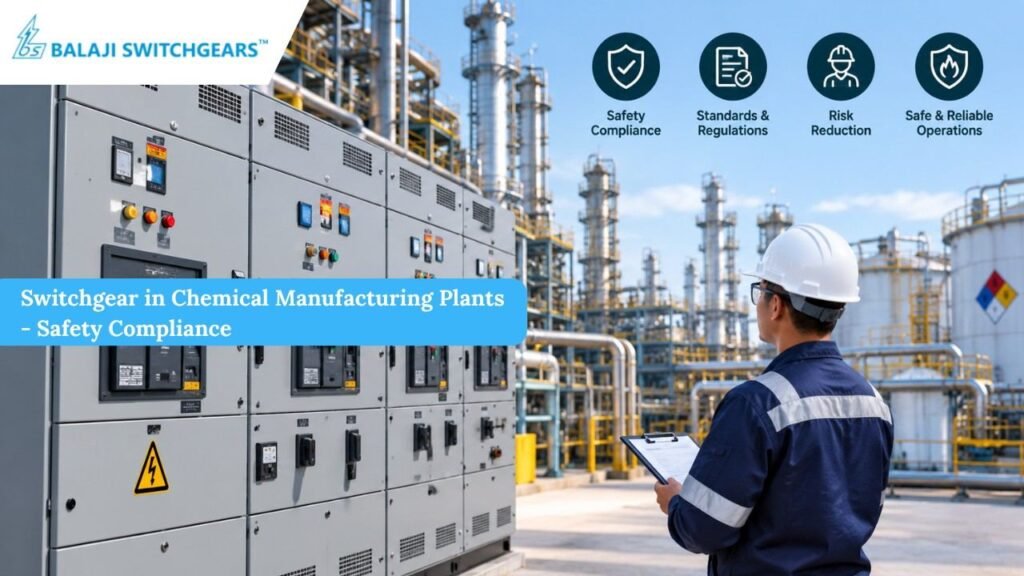
Chemical manufacturing plants don’t get a second chance on electrical safety. Walk through a solvent handling area, a reactor bay, or a bulk storage yard, and you’re standing in a space where flammable vapours, combustible dust, and corrosive atmospheres are simply part of daily operation. In that environment, a switchgear panel isn’t just distributing power, it’s one of the barriers standing between normal production and a fire or explosion incident. Get the selection wrong, and the very equipment meant to protect the plant becomes the ignition source everyone was trying to avoid.
This is why switchgear compliance in chemical plants is treated so differently from a typical factory or commercial installation. It isn’t only about IP ratings and short-circuit ratings anymore. It’s about zone classification, certified protection types, and a documented, auditable compliance trail that regulators, insurers, and safety auditors will eventually come asking for. At Balaji Switchgears, a large part of the work we do with process industry customers isn’t just supplying switchgear, it’s helping them understand which switchgear actually belongs in which part of the plant, and why.
Start With the Zone, Not the Catalogue
The single biggest mistake in chemical plant electrical design is picking switchgear first and figuring out where it’s installed later. It has to work the other way round.
Every area of a chemical plant needs to go through hazardous area classification before anyone specifies a panel. This process identifies where flammable gases, vapours, or combustible dust could realistically be present, and how often continuously, occasionally, or only under fault conditions. In India, this is guided by IS 5572 for classifying areas with flammable gases and vapours, and IS 5571 for selecting and installing equipment in those zones, alongside the international IEC 60079 series that most global chemical companies design against.
Once an area is classified broadly, Zone 0, Zone 1, or Zone 2 for gases and vapours, with equivalent dust classifications for powder and granular chemical handling the switchgear selection almost designs itself. A control panel that’s perfectly acceptable in a non-hazardous utility room can be a genuine ignition risk if it’s installed a few metres away, inside a reactor bay where solvent vapours occasionally accumulate.
Protection Types That Actually Matter on a Chemical Floor
Once the zone is known, the switchgear has to be built or certified to a matching protection concept. A few of these come up constantly in chemical plant projects:
- Flameproof enclosures (Ex d) – built to contain an internal arc or explosion so it can’t ignite the surrounding atmosphere, commonly used for switchgear installed directly in Zone 1 areas.
- Increased safety (Ex e) – eliminates sparking and hot surfaces under normal operation through tighter design and clearance standards, often used for terminal boxes and junction enclosures.
- Intrinsic safety (Ex i) – limits electrical energy in the circuit so it’s physically incapable of causing ignition, typically applied to instrumentation and low-power control circuits rather than main switchgear.
- Purged and pressurised enclosures (Ex p) – keep an internal protective gas pressure that prevents the hazardous atmosphere from entering the enclosure at all.
None of these are interchangeable, and none of them are a matter of preference. The zone classification dictates which protection concept is acceptable, and mixing this up installing a standard IP-rated panel where an Ex-rated flameproof enclosure was required is exactly the kind of gap that surfaces during a statutory inspection or, worse, after an incident.
Compliance Is a Paper Trail as Much as a Physical One
Chemical plants operate under the Factories Act, environmental clearances, and, depending on the process, additional oversight tied to hazardous chemical handling. Auditors and inspecting authorities don’t just want to see the right switchgear installed, they want documentation proving it’s certified for the zone it sits in, that it’s been tested, and that it’s maintained on a defined schedule.
That means every panel supplied for a hazardous area needs to carry its test certificates, Ex-marking, and compliance documentation in order, and this paperwork needs to travel with the equipment through its entire life in the plant, not just at the point of commissioning. We’ve seen plants get pulled up during audits not because the switchgear itself was wrong, but because the certification records had gone missing over the years, or because a panel was modified on-site without anyone updating the compliance file. Good switchgear selection has to come bundled with good documentation discipline, or the compliance story falls apart the moment someone asks for proof.
Corrosion, Dust, and Ambient Conditions Deserve Just as Much Attention
Explosion protection tends to dominate the conversation, but chemical plants are also brutal on switchgear in more mundane ways. Corrosive vapours attack terminals and busbars over time. Fine chemical dust settles into enclosures and compromises insulation. High ambient temperatures near process equipment push switchgear closer to its thermal limits than the datasheet ever anticipated.
This is where enclosure material and IP rating selection become part of the safety conversation, not just a mechanical detail. Stainless steel or GRP enclosures, properly gasketed doors, adequate IP66 sealing against dust and washdown, and correctly rated ventilation or cooling all extend the working life of switchgear that’s already carrying the burden of hazardous area certification. A panel that’s Ex-certified but corroding from the inside out because the wrong enclosure material was chosen isn’t actually a compliant, safe installation; it’s a slow-motion failure waiting to happen.
Maintenance and Periodic Inspection Are Not Optional Extras
Hazardous area switchgear compliance doesn’t end at commissioning. Gaskets degrade, enclosure seals loosen, cable glands work themselves free from vibration, and flameproof joint clearances can be compromised by improper reassembly after maintenance work. Periodic inspection checking enclosure integrity, joint clearances, cable entries, and earthing continuity is what keeps a Zone 1 rated panel actually behaving like a Zone 1 rated panel five or ten years after installation.
Plants that treat this as a scheduled, documented activity tend to sail through audits. Plants that treat switchgear as install-and-forget infrastructure tend to discover problems only when an inspector or worse, an incident forces the issue.
Getting the Selection Right From the Start
The practical takeaway for anyone specifying or upgrading switchgear in a chemical manufacturing environment comes down to a short list:
- Get hazardous area classification done properly and documented before any switchgear is chosen.
- Match protection type flameproof, increased safety, intrinsic safety, or purged enclosures to the actual zone, not to habit or convenience.
- Choose enclosure materials and IP ratings that account for corrosive, dusty, or high-temperature conditions, not just the electrical load.
- Keep certification, test reports, and Ex-marking documentation current and easily accessible for audits.
- Build periodic inspection and maintenance into the plant’s safety calendar, not just its electrical maintenance calendar.
This is the kind of detail we work through with process industry customers at Balaji Switchgears reviewing zone classification, matching the right protection concept and enclosure specification, and sourcing genuine, properly certified switchgear and control gear from established partners like Schneider Electric, ABB, and Rittal, rather than leaving compliance to chance. In a chemical plant, switchgear selection isn’t a line item, it’s a safety decision, and it deserves to be treated like one from day one.
If you’re reviewing switchgear compliance for an existing chemical facility, or specifying panels for a new plant, our team at Balaji Switchgears can help you work through the zone classification, protection type, and documentation requirements together. You can reach us or browse our range of low voltage switchgear and automation products at balajiswitchgears.com.