
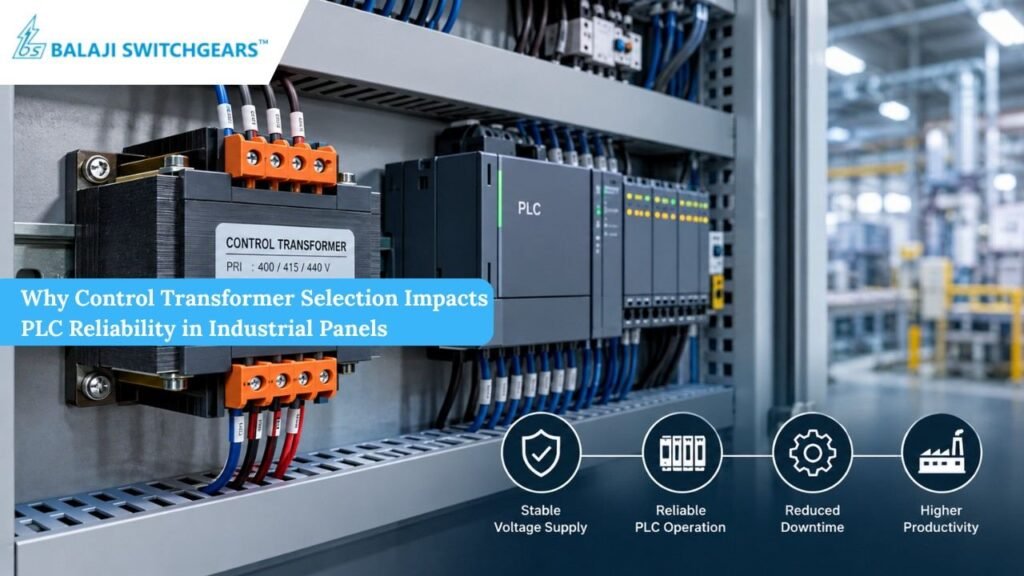
Walk into almost any control room after a nuisance PLC trip, and you’ll hear the same conversation. Someone blames the driver. Someone else blames the PLC firmware. Someone checks the earthing. And nine times out of ten, nobody even glances at the control transformer sitting quietly in the corner of the panel, the one component that’s actually feeding clean, stable power to the very brain of the machine.
That’s the irony of control transformer selection. It’s one of the least glamorous decisions in panel design, and yet it has an outsized influence on whether your PLC, HMI, relays, and I/O modules run for years without a hiccup or become a source of recurring, unexplained downtime. At Balaji Switchgears, we’ve spent decades building and supplying panels for industries ranging from manufacturing to infrastructure, and if there’s one pattern we keep seeing, it’s this: panels that fail early almost always have a control transformer that was undersized, misapplied, or simply an afterthought during design.
This blog is about why that small transformer deserves far more attention than it usually gets and how getting it right protects the reliability of your entire automation system.
The PLC Doesn’t Run on Raw Power — It Runs on Clean, Regulated Power
A PLC is a precision electronic device. Its processor, memory, and communication modules are designed to work within a narrow voltage tolerance band, typically plus or minus 10% of rated voltage. Anything outside that window sags, surges, harmonics, or noise doesn’t just cause a shutdown. It can cause something worse: intermittent, unpredictable behavior that’s incredibly hard to diagnose.
The control transformer is the component standing between your incoming three-phase supply and the low-voltage control circuit that powers the PLC, its I/O, contactors, and indicator lights. It steps down voltage to a safe, usable level and, just as importantly, it’s meant to isolate the control circuit from the disturbances happening on the power side of the panel motor starts, VFD switching noise, contactor coil transients, and so on.
If that transformer is undersized, incorrectly rated, or poorly matched to the actual load it needs to support, none of that protection holds up. The PLC ends up exposed to voltage dips every time a contactor pulls in, or worse, it runs continuously on a slightly sagging supply that never quite recovers. Over months of operation, this kind of chronic stress shows up as random resets, corrupted memory, communication faults on the network, or premature failure of the power supply module.
Undersizing: The Most Common — and Most Costly — Mistake
Here’s something we see constantly when reviewing panels brought in for troubleshooting or retrofitting: the control transformer was sized to handle the PLC and HMI load alone, without accounting for the inrush current of contactors, solenoids, and relays that switch on simultaneously during startup.
A contactor coil can draw six to ten times its steady-state current for a few milliseconds when it energizes. If several contactors energize together which happens routinely during machine start sequences the transformer needs enough headroom to absorb that inrush without the secondary voltage collapsing. When it can’t, the PLC’s power supply sees a momentary brownout. Sometimes that’s enough to trigger a watchdog reset. Sometimes it’s subtler: a corrupted scan cycle, a missed input, a communication timeout that looks like a network problem but isn’t.
The fix isn’t complicated in principle: calculate the continuous VA load, add the inrush VA of everything that can switch simultaneously, and size the transformer with a reasonable safety margin typically 20 to 25% above the calculated peak. What’s complicated is that this calculation gets skipped far too often, either because the panel is being built to a tight budget or because the transformer is treated as a standard, interchangeable part rather than something that needs to be engineered for the specific panel.
Voltage Regulation and Isolation Matter as Much as VA Rating
VA capacity gets most of the attention, but two other transformer characteristics matter just as much for PLC reliability.
Voltage regulation describes how much the secondary voltage droops under load. A transformer with poor regulation might deliver rated voltage at no load but sag noticeably once real loads relay coils, indicator lamps, PLC output loads are connected. For control circuits feeding sensitive electronics, low-regulation, well-built transformers are worth the marginal extra cost because they keep the PLC’s supply voltage stable across the full range of operating conditions.
Isolation is the other piece. A proper control transformer isn’t just a voltage step-down device, it’s an electrical firewall between the noisy power side of the panel and the sensitive control side. Industrial environments are full of electrical noise: VFD switching frequencies, welding equipment, large motor starts. A transformer with good isolation characteristics, ideally paired with proper shielding and grounding practice, keeps that noise from riding through to the PLC’s power input. Skip this, and you’ll see the PLC or its communication modules behaving erratically in ways that have nothing to do with the code running inside them.
Thermal Life and Duty Cycle: The Slow Failure Nobody Notices
There’s a quieter form of failure that doesn’t show up as a dramatic trip, it shows up as a transformer that runs a little hotter than it should, year after year, slowly cooking its own insulation. Every 10°C rise above a transformer’s rated operating temperature roughly halves its insulation life. A transformer that’s marginally undersized for its actual continuous load might work fine for the first year or two, then start failing intermittently as insulation breaks down, windings develop micro-shorts, and output voltage becomes less stable.
This is exactly the kind of failure that gets misdiagnosed. The panel starts throwing sporadic PLC faults eighteen months into operation, and the maintenance team starts chasing software bugs or sensor issues, when the real story is a transformer that was never given enough thermal margin for the panel’s actual duty cycle and ambient conditions.
What Good Control Transformer Selection Actually Looks Like
Getting this right isn’t about buying the most expensive transformer available, it’s about matching the transformer to the real electrical behavior of the panel. In practice, that means:
- Calculating total connected VA load accurately, including every relay, contactor, solenoid, PLC power supply, and HMI.
- Accounting for simultaneous inrush from contactors and solenoids, not just steady-state draw.
- Choosing a transformer with solid voltage regulation so the PLC sees stable voltage under real operating conditions, not just on a datasheet.
- Selecting appropriate insulation class and thermal rating for the panel’s ambient temperature and enclosure ventilation.
- Using proper fusing and secondary protection so a downstream fault doesn’t take out the transformer or worse, doesn’t clear fast enough and lets a fault condition damage the PLC.
- Grounding and shielding the control circuit correctly so the isolation the transformer provides actually translates into a clean supply at the PLC terminals.
This is the level of detail we bring into every panel that goes through Balaji Switchgears. Since 1990, our engineering team has worked alongside panel builders and industrial customers across India, and control circuit design transformer sizing included is one of the areas where we spend real time getting the specification right before a panel is even built, rather than firefighting after it’s commissioned.
Why This Matters More as Panels Get Smarter
As more panels move toward integrated automation PLCs talking to VFDs, HMIs, remote I/O, and sometimes SCADA systems over industrial networks the tolerance for electrical noise and voltage instability keeps shrinking. A panel built ten years ago with a basic relay logic scheme could absorb a certain amount of electrical sloppiness. A modern panel built around a networked PLC architecture cannot. One unstable control transformer can cascade into communication dropouts across an entire automation network, not just a single faulted device.
That’s why control transformer selection isn’t a line item to be finalized in five minutes while sourcing the rest of the panel’s components. It deserves the same engineering attention as the PLC selection itself, because in a very real sense, it determines whether that PLC gets to perform the way it was designed to.
Getting It Right the First Time
If you’re specifying a new panel, retrofitting an existing one, or troubleshooting recurring PLC faults that never quite make sense, it’s worth going back to basics and checking the control transformer first. It’s cheap insurance against expensive, hard-to-trace downtime.
Balaji Switchgears works with panel builders, OEMs, and industrial customers across India to get this right from VA calculations and voltage regulation to sourcing genuine, correctly rated transformers and control gear from partners like Schneider Electric, Omron, and Elmeasure. If your panel is showing unexplained PLC faults, or you’re designing a new control panel and want the electrical fundamentals right from day one, our engineering team at Balaji Switchgears is happy to review the specification with you.
You can explore our full range of low voltage switchgear and automation products, or get in touch with our team directly, at balajiswitchgears. A panel is only as reliable as its weakest electrical link and with the right control transformer selection, that link doesn’t have to be the one holding your automation system back.