
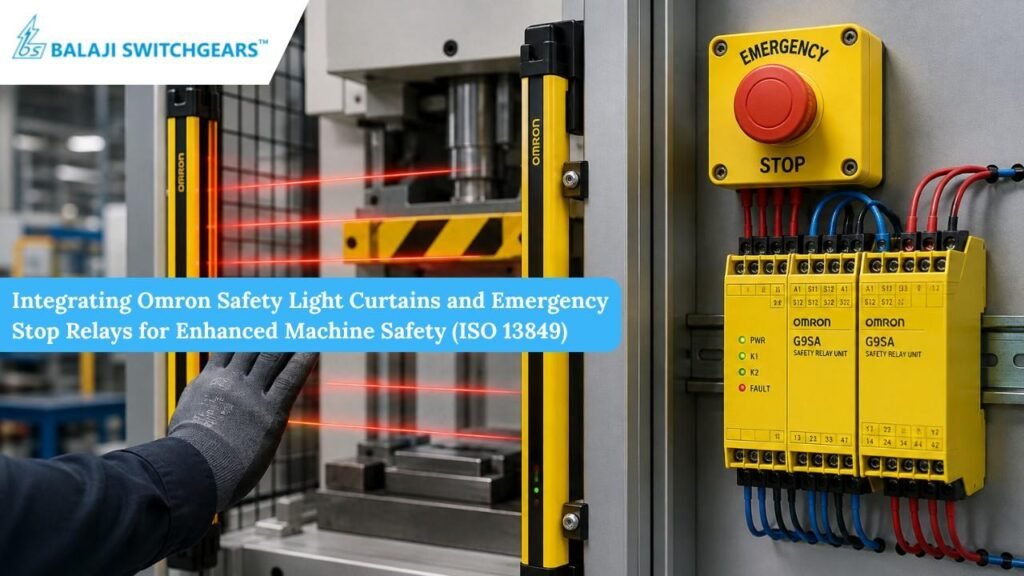
Modern industrial machines are designed to deliver higher speed, greater productivity, and increasingly automated operations. However, as machines become faster and more complex, the importance of protecting operators and maintenance personnel also increases. A machine safety system must be capable of detecting hazardous situations quickly and ensuring that dangerous machine movements are stopped in a controlled and reliable manner.
This is where safety components such as Omron safety light curtains, emergency stop devices, and safety relays become important. When these components are correctly integrated, they can create a coordinated safety function that detects access to hazardous areas, responds to emergency conditions, and removes the necessary machine energy through the appropriate output devices.
For machine builders and system integrators, simply installing individual safety components is not enough. The complete safety function must be designed, validated, and assessed according to the applicable requirements. ISO 13849 provides a framework for designing and evaluating safety related parts of control systems, including the required Performance Level for individual safety functions. The current edition is ISO 13849 1:2023, while many product certifications and technical documents still reference the earlier 2015 edition.
Understanding Machine Safety and ISO 13849
ISO 13849 1 focuses on the safety related parts of control systems, commonly referred to as SRP/CS. These can include safety sensors, control units, relays, contactors, valves, and other components that participate in a safety function.
The standard does not simply say that every machine must use a particular Performance Level. Instead, the required Performance Level, or PLr, is determined based on the risk associated with each safety function. The designer then evaluates whether the implemented safety related control system achieves a Performance Level equal to or greater than the required level.
This distinction is important because machine safety should always begin with risk assessment. A light curtain, emergency stop switch, or safety relay should not be selected merely because it carries a particular safety rating. The complete architecture, component reliability, diagnostic coverage, common cause failure considerations, and actual application must be evaluated.
What Are Omron Safety Light Curtains?
Omron safety light curtains are electro sensitive protective devices designed to detect the presence of an object or person within a defined hazardous area.
A typical safety light curtain consists of an emitter and receiver that create a protective field of light beams. When an operator enters the protected zone and interrupts the appropriate beams, the safety system changes its output state and initiates the defined safety response.
This makes safety light curtains particularly useful around machinery where physical guarding alone would restrict necessary access to the production process.
They are commonly used around:
Press machines
Robotic cells
Assembly machines
Packaging equipment
Material handling systems
Machine tools
Automated production lines
The Omron F3SJ series, for example, is a Type 4 safety light curtain family with models designed to meet PLe and Safety Category 4 requirements under EN ISO 13849 1:2015, along with IEC 61496 and IEC 61508 requirements.
The F3SG family also includes Type 4 models with PLe and Category 4 characteristics, depending on the specific model selected.
Why Light Curtains Are Important for Modern Machines
Traditional fixed guards physically prevent operators from reaching hazardous machine areas. While effective, they can make frequent access difficult.
Light curtains provide an alternative where operators need regular access for loading, unloading, inspection, or material transfer.
For example, consider an automated press where an operator places a component into the machine. A properly designed safety light curtain can create a protective zone at the access point. If the operator enters the hazardous area during a condition in which access must cause a stop, the safety function can command the machine to stop.
This creates a balance between operator protection and machine productivity.
However, a light curtain should never be considered a standalone safety solution. Its signals must be processed through an appropriately designed safety control system and connected to suitable final switching elements.
The Role of a Safety Relay
A safety relay acts as the logic and monitoring element between safety input devices and the machine’s safety outputs.
Inputs can include:
Safety light curtains
Emergency stop switches
Safety door switches
Two hand control devices
Other compatible safety sensors
The safety relay evaluates these signals according to its designed safety logic and controls the safety outputs.
An Omron safety relay can therefore serve as an important link between the protective device and the machine’s stopping mechanism.
Omron’s G9SE safety relay series, for example, is designed for simple safety applications and supports safety input devices including emergency stop switches, door switches, and light curtains. The G9SE family is specified by Omron for applications up to PLe and Safety Category 4 under EN ISO 13849 1 and SIL3 under IEC 62061, depending on the application and configuration.
This type of architecture allows several safety inputs to be connected to a dedicated safety control system instead of relying solely on a standard PLC.
Understanding the Role of an Emergency Stop
A safety light curtain and an emergency stop serve different purposes.
A light curtain automatically detects a defined intrusion into a protected area.
An emergency stop is manually activated when a person identifies an emergency situation and needs the machine to stop.
Emergency stop devices are therefore an important part of many machine safety systems.
For example, an operator may notice a mechanical problem, unexpected movement, material jam, or another hazardous condition. Pressing the emergency stop device initiates the machine’s emergency stop safety function.
Omron provides emergency stop switches as part of its safety component portfolio. The company’s documentation also identifies emergency stop switches as safety input devices that can be connected to safety relay systems.
In practical discussions, the term Omron emergency stop relay is sometimes used to describe the safety relay arrangement used to process an emergency stop signal. Technically, it is useful to distinguish the emergency stop switch from the safety relay. The switch provides the manual safety input, while the safety relay processes the signal and controls the safety outputs.
How Light Curtains and Emergency Stops Work Together
The real value comes from integrating these devices into one properly engineered safety architecture.
Consider an automated manufacturing machine with a hazardous processing area.
During normal operation, the safety light curtain confirms that the protected access area is clear.
The machine’s safety control system receives the valid safety input and permits operation.
If an operator enters the protected area and interrupts the light curtain, the safety output changes state.
The safety relay then removes the safety enable signal from the appropriate machine control elements.
The machine enters its defined safe stop condition.
If the operator presses the emergency stop switch, the same safety architecture responds to that separate safety input and initiates the required emergency stop function.
This means the machine has multiple independent ways of initiating a safety response.
Omron application documentation demonstrates configurations in which emergency stop switches and safety light curtains are connected to safety control systems, with the safety outputs controlling machine stopping functions.
Why the Safety Relay Should Not Be Treated as a Standard Control Relay
A conventional control relay is generally designed to perform switching functions. A safety relay is designed specifically for safety related applications and incorporates appropriate monitoring and fault detection characteristics.
This distinction is extremely important.
A machine safety function may need to detect certain faults rather than simply react to an input signal.
Depending on the architecture, safety systems can use redundant channels and monitoring to improve fault detection and reduce the possibility that a single component failure prevents the safety function from operating correctly.
ISO 13849 considers factors such as architecture, component reliability, diagnostic coverage, and measures against common cause failures when evaluating the achieved Performance Level.
Selecting the Right Safety Light Curtain
Selecting a safety light curtain requires more than measuring the width of the machine opening.
Engineers should consider the type of hazard, required detection capability, protective height, sensing distance, response time, environmental conditions, and required Performance Level.
For example, different applications may require detection of a finger, hand, arm, or full body.
Omron’s safety light curtain portfolio includes solutions for different protection requirements. The F3SJ family, for example, offers different configurations and detection capabilities, while F3SG models provide additional options for industrial environments.
The required stopping distance must also be considered. A safety light curtain must be positioned far enough from the hazard to allow the machine to reach a safe state after the protective field is interrupted.
This is an engineering calculation and should be completed according to the applicable machinery safety requirements.
Selecting the Appropriate Safety Relay
The safety relay should be selected according to the safety functions that it needs to process.
Important considerations include:
Number of safety inputs
Required safety outputs
Emergency stop requirements
Light curtain compatibility
Reset requirements
Monitoring requirements
Response time
Required Performance Level
Required safety category
Expansion requirements
The selected relay must be appropriate for the complete safety architecture rather than being selected independently.
Omron offers different safety control solutions, including the G9SE safety relay series and G9SX safety controller family. The G9SX range supports flexible safety configurations and applications involving emergency stops, safety light curtains, doors, and multiple machine zones.
Reset and Restart Considerations
One of the most important aspects of machine safety is preventing unexpected restart.
Suppose an operator interrupts a light curtain and the machine stops. Simply clearing the light curtain should not automatically restart hazardous machine movement if the risk assessment and safety design require a deliberate restart action.
A suitable reset arrangement should be designed according to the machine’s safety requirements.
The reset device should also be positioned so that the person resetting the machine can appropriately verify the hazardous area before initiating a restart.
This is an important part of designing practical and reliable machine safety systems.
Diagnostic Monitoring Improves Maintenance
Modern safety systems can provide useful diagnostic information that helps maintenance teams identify faults.
Instead of simply showing that a machine has stopped, diagnostic indicators can help identify whether the problem is associated with:
A safety light curtain
Emergency stop circuit
Door switch
Safety relay input
Output circuit
External contactor
Reset condition
Omron’s G9SE series, for example, incorporates diagnostic indicators intended to support installation and maintenance.
Better diagnostics can reduce troubleshooting time and help maintenance teams restore equipment more efficiently.
Common Design Mistakes to Avoid
Several mistakes can reduce the effectiveness of a machine safety system.
One common mistake is selecting a safety light curtain without properly calculating the required stopping distance.
Another is connecting a safety device to a standard PLC input and assuming that the PLC alone provides the required safety function.
Poor reset positioning is another issue. A reset button should not allow an operator to restart a machine without appropriate visibility or control of the hazardous area.
Engineers should also avoid mixing safety and standard control functions without understanding how the architecture affects the required Performance Level.
Finally, the entire safety function must be validated after installation.
Validation Is as Important as Component Selection
Using certified safety components does not automatically mean that the complete machine complies with ISO 13849.
The complete safety function needs to be designed and evaluated.
This includes the input device, safety logic, output devices, wiring, architecture, diagnostics, and relevant fault conditions.
For example, a typical safety function may consist of:
Safety light curtain as the input
Safety relay as the logic element
Contactors or safety rated drive functions as the output
Machine actuator as the final energy control element
The complete chain must be considered when determining whether the required Performance Level has been achieved. ISO 13849 specifically addresses the safety related parts of control systems rather than treating individual components as the entire safety function.
Building a More Reliable Machine Safety System
Effective machine safety is ultimately about designing a system where different components work together rather than treating each device independently.
Omron safety light curtains provide reliable presence detection.
Emergency stop devices provide manual emergency intervention.
An Omron safety relay processes safety inputs and controls safety outputs.
Appropriate contactors, drives, or other final control elements bring the machine to its defined safe state.
When these components are selected and integrated correctly, the result is a more structured and dependable safety architecture.
This approach also makes maintenance easier because each part of the safety function can be identified, tested, and documented.
Conclusion
Machine safety is an essential part of modern industrial automation. As machinery becomes faster and more automated, safety systems must provide reliable protection without unnecessarily reducing productivity.
Omron safety light curtains provide an effective way to detect access to hazardous areas, while emergency stop devices allow operators to initiate an immediate safety response when a dangerous situation occurs. An Omron safety relay provides the safety logic needed to process these inputs and control the appropriate safety outputs.
When designed as part of properly engineered machine safety systems, these technologies can contribute significantly to risk reduction and support the achievement of the required Performance Level under ISO 13849.
The key is not simply choosing individual safety components. The complete safety function must be risk assessed, correctly designed, appropriately connected, and validated for the specific machine and application.
For OEMs, panel builders, machine manufacturers, and industrial users looking to strengthen their machine safety infrastructure, Balaji Switchgears provides access to advanced Omron safety solutions, including safety light curtains, safety relays, and related machine safety components. With expertise in industrial automation and electrical control solutions, Balaji Switchgears helps customers select and integrate the right technologies for safer, more reliable, and future ready machine applications.