
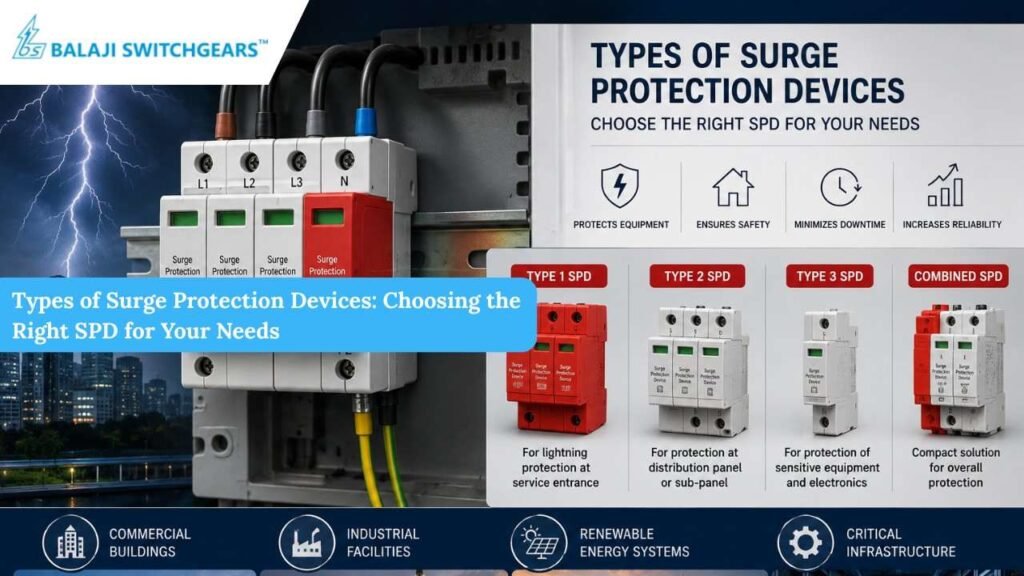
Modern electrical systems are becoming increasingly dependent on sensitive electronic equipment. Industrial control panels, PLCs, automation systems, computers, communication equipment, HVAC controllers, measuring instruments, and other electronic devices all require a stable electrical supply to operate reliably. However, electrical networks are not always exposed to steady voltage conditions. Lightning, utility switching, capacitor switching, motor operations, and other electrical events can create short duration voltage surges that may damage connected equipment.
These transient overvoltages may last for only a fraction of a second, but they can be powerful enough to damage electronic components, interrupt industrial processes, and shorten the operating life of electrical equipment. This is why surge protection has become an important part of modern electrical system design.
A Surge Protection Device, commonly called an SPD, is designed to limit transient overvoltage and divert surge energy away from protected equipment. Depending on its type and application, an SPD can be installed at the main distribution point, a sub distribution board, or close to sensitive equipment.
Understanding the different types of surge protection devices is essential because no single SPD provides the same level of protection in every location. A properly designed system may use multiple stages of protection to reduce the impact of high energy surges as they move through an electrical installation.
What Is a Surge Protection Device?
A Surge Protection Device is an electrical protection device designed to limit temporary high voltage events and divert surge current to an appropriate discharge path, normally the protective earth system.
Surges can originate from external sources such as lightning or from internal electrical operations such as switching large inductive loads. Schneider Electric explains that SPDs are designed to limit transient overvoltages originating from atmospheric events or network switching operations and discharge the resulting surge energy to earth.
The purpose of an SPD is therefore not the same as that of a conventional circuit breaker.
A circuit breaker primarily protects against sustained overcurrent conditions such as overloads and short circuits.
An SPD responds to transient overvoltage events.
Both devices can be part of the same electrical protection strategy, but they perform different functions.
Why Surge Protection Is Important
Industrial and commercial electrical systems contain increasingly sensitive electronics.
A voltage surge can affect:
PLC systems
Variable frequency drives
Industrial computers
Control systems
Communication equipment
Energy meters
Sensors
HVAC controllers
Security systems
Data networking equipment
Even when a surge does not immediately destroy a device, repeated exposure can gradually degrade sensitive components.
This can lead to unexplained failures, reduced equipment life, communication problems, and unexpected maintenance costs.
For industries, the consequences can extend beyond equipment replacement.
A damaged PLC or automation controller can stop a production line. A failed communication device can interrupt data exchange between machines. Damage to a control panel can result in extended troubleshooting and downtime.
A properly designed surge protection system helps reduce these risks.
What Causes Electrical Surges?
Electrical surges can have several causes.
Lightning
Lightning is one of the most powerful natural sources of transient overvoltage. A direct or nearby lightning event can introduce very high energy into an electrical installation.
Utility Switching
Operations on the electrical distribution network can create transient disturbances.
Switching of Motors
Large motors and other inductive loads can generate switching transients when they are started, stopped, or disconnected.
Capacitor Switching
Power factor correction equipment can also create transient conditions during switching.
Internal Electrical Events
Industrial facilities contain numerous switching devices, drives, transformers, contactors, and other equipment that can generate electrical disturbances.
Because surge sources vary, protection must be designed according to the electrical environment and the location of the equipment being protected.
Understanding SPD Types
The main SPD types used for low voltage power systems are Type 1, Type 2, and Type 3.
These types are associated with different locations and levels of protection within an electrical installation.
The IEC based approach uses a coordinated protection concept in which different SPD types are used at different points of an electrical system. Phoenix Contact describes Type 1 protection at the boundary of the external lightning environment, Type 2 protection further downstream, and Type 3 protection close to sensitive equipment.
Understanding this layered approach is important because Type 1, Type 2, and Type 3 devices are not simply three versions of the same product.
They perform different roles.
Type 1 Surge Protection Device
Type 1 SPDs are designed to handle high energy surge currents associated with direct or nearby lightning events.
They are typically installed at the origin of an electrical installation or at the main distribution board, particularly where the building has an external lightning protection system or where there is a significant risk of high energy lightning currents entering the installation.
Type 1 SPDs are designed for high discharge capability. ABB describes Type 1 devices as being designed to discharge high current surges and notes their use at the entrance point of an installation.
The primary purpose of Type 1 protection is to reduce the amount of high energy surge entering the downstream electrical system.
However, Type 1 protection does not necessarily provide the final level of voltage protection required by sensitive electronic equipment.
This is why Type 2 and, where necessary, Type 3 protection may be used downstream.
Type 2 Surge Protection Device
Type 2 SPDs are commonly installed in main distribution boards and sub distribution panels.
They provide protection against residual lightning related surges and transient overvoltages generated within the electrical installation.
Internal switching operations are an important source of these disturbances.
For many industrial and commercial installations, Type 2 protection forms the main layer of surge protection for distribution systems.
Schneider Electric describes Type 2 SPDs as devices installed on the load side of the main service overcurrent protection and explains that they provide protection against internally generated switching surges as well as residual external surge energy.
A Type 2 surge protection device for electrical panels is therefore particularly relevant for industrial distribution boards and control panel applications.
Type 3 Surge Protection Device
Type 3 SPDs provide an additional level of protection close to sensitive equipment.
They are designed to handle lower energy residual surges while providing a lower voltage protection level at the equipment.
Type 3 devices may be installed near:
Computers
PLCs
Electronic controllers
Communication equipment
Sensitive instrumentation
Office electronics
Other critical electronic loads
Because Type 3 SPDs have lower surge discharge capability than Type 1 and Type 2 devices, they are generally used as part of a coordinated protection system rather than as the only SPD in an installation. Schneider Electric similarly describes Type 3 SPDs as supplementary protection installed close to sensitive loads.
Type 1 and Type 2 Combined SPDs
Modern installations can also use combined Type 1 plus Type 2 SPDs.
These devices combine the functions of the first two protection stages in a single product.
Combined solutions can be useful where panel space is limited or where a simplified installation is preferred.
ABB’s SPD documentation identifies Type 1 plus Type 2 devices as solutions capable of handling high energy lightning currents while also providing downstream voltage protection.
However, product selection should always be based on the actual electrical installation, protection requirements, and manufacturer’s technical specifications.
How Layered Surge Protection Works
The most effective approach is often to think of surge protection as a series of protective barriers.
The first barrier reduces the highest energy surge entering the facility.
The second barrier provides additional protection at distribution levels.
The final barrier protects particularly sensitive equipment.
This creates a coordinated system.
For example, an industrial facility may have a Type 1 or Type 1 plus Type 2 SPD at the main distribution board, Type 2 SPDs at downstream distribution panels, and Type 3 protection close to particularly sensitive electronic equipment.
Phoenix Contact describes this as a multi level protection concept based on lightning protection zones.
Choosing the Right Surge Protection Device
Selecting an SPD should never be based only on the label Type 1, Type 2, or Type 3.
Several technical parameters must be evaluated.
System Voltage
The SPD must be suitable for the nominal voltage and earthing arrangement of the electrical system.
Different systems may require different SPD configurations.
Maximum Continuous Operating Voltage
The maximum continuous operating voltage, commonly designated Uc, should be appropriate for the system.
If the device is exposed to a voltage above its continuous operating capability, unnecessary degradation or failure may occur.
Nominal Discharge Current
Nominal discharge current, or In, indicates the discharge current associated with the SPD’s test conditions.
This parameter is important when selecting Type 2 protection.
Maximum Discharge Current
Imax indicates the maximum discharge current the SPD can withstand under specified test conditions.
Higher values may be required in environments with greater surge exposure.
Voltage Protection Level
The voltage protection level, commonly designated Up, is particularly important when protecting sensitive electronic equipment.
The SPD should limit the voltage to a level compatible with the withstand capability of the equipment being protected.
Schneider Electric identifies Uc, In, Imax, Up, and SPD type among the important characteristics to consider during selection.
Selecting an SPD for Electrical Panels
When choosing a surge protection device for electrical panels, the position of the panel within the electrical distribution network should be considered first.
A main distribution panel may require a different SPD from a downstream control panel.
For example, a main incoming panel exposed to significant external surge energy may require Type 1 or Type 1 plus Type 2 protection.
A secondary distribution panel may use Type 2 protection.
A panel supplying sensitive automation equipment may require additional downstream protection.
The length of the cable between protection stages and the equipment also matters because conductor length can influence the residual voltage experienced by the load.
The Importance of SPD Installation
Even a high quality SPD can provide inadequate protection if it is installed incorrectly.
One of the most important installation considerations is conductor length.
The connection between the SPD and the protected circuit should be kept as short and direct as practical.
ABB’s installation guidance specifically highlights the importance of short SPD connection conductors to minimize additional inductive voltage drops during a surge event.
The SPD also needs an appropriate connection to the protective earthing system.
Poor earthing or excessively long connection paths can reduce the effectiveness of the protection system.
Installation should therefore be carried out according to the manufacturer’s instructions and applicable electrical standards.
SPD Backup Protection
An SPD may require an associated overcurrent protective device depending on its design and the manufacturer’s instructions.
This can be a fuse or circuit breaker selected according to the SPD manufacturer’s coordination requirements and the available short circuit current at the installation point.
This backup protection helps isolate a failed SPD safely.
The correct protective device should not be selected arbitrarily. Manufacturers generally provide coordination information for the appropriate fuse or circuit breaker.
Protecting More Than Just Power Lines
Modern industrial systems often contain multiple conductive paths entering and leaving equipment.
Power cables are not the only possible route for surge energy.
Communication lines
Data cables
Signal cables
Telephone lines
Control circuits
External sensor connections
can also introduce transient disturbances.
ABB’s surge protection guidance emphasizes that comprehensive protection of electronic systems may require protection on incoming and outgoing power, data, signal, and telecommunications lines.
This is particularly important in automation environments where PLCs and control systems may have multiple external connections.
Common SPD Selection Mistakes
One common mistake is choosing an SPD purely based on its maximum kA rating.
A high discharge rating alone does not guarantee that the device is suitable for the installation.
Another mistake is installing only one SPD and assuming that every connected device is completely protected.
Protection should be considered across the electrical distribution system.
Ignoring the earthing arrangement is another important error.
The SPD configuration must match the system architecture.
Finally, installation practices should not be overlooked. Excessively long connection conductors can reduce the effectiveness of surge protection.
Maintenance and Replacement
SPDs are protective devices that may sacrifice internal components when exposed to significant surge events.
Modern SPDs often include status indicators that allow maintenance teams to determine whether the protective element remains operational.
Regular inspection is particularly important in facilities exposed to frequent lightning or electrical switching disturbances.
Maintenance teams should check the device status and follow the manufacturer’s replacement recommendations.
Why Surge Protection Is Important for Industrial Panels
Industrial control panels contain some of the most sensitive equipment in a facility.
A panel may contain PLCs, communication modules, HMIs, energy meters, sensors, drives, and other electronic devices.
A surge entering the panel can therefore affect multiple systems simultaneously.
Installing the appropriate surge protection device for electrical panels helps reduce this risk.
It can protect expensive electronic equipment, improve system availability, reduce unexpected failures, and support more reliable industrial operations.
Building a Complete Surge Protection Strategy
A successful surge protection strategy is not about installing the biggest SPD available.
It is about creating coordinated protection based on the electrical installation.
The process should consider:
The source of potential surges
Lightning exposure
Electrical distribution architecture
Earthing system
Location of sensitive equipment
Required voltage protection level
Surge current requirements
SPD coordination
Backup protection
Power and signal connections
When these factors are evaluated together, the resulting protection system is significantly more effective.
Conclusion
A Surge Protection Device is an important part of modern electrical protection, particularly as industrial systems become increasingly dependent on sensitive electronic equipment. Lightning and switching events can introduce transient overvoltages that may damage equipment, interrupt operations, and increase maintenance costs.
Understanding the different types of surge protection devices is the first step towards building an effective protection strategy. Type 1 SPDs provide high energy protection at the incoming supply, Type 2 SPDs provide protection at distribution levels, and Type 3 SPDs provide additional protection close to sensitive equipment. In many installations, these technologies work together as part of a coordinated, layered approach.
Selecting the right SPD types requires consideration of system voltage, earthing arrangement, discharge current, maximum discharge current, voltage protection level, installation location, and coordination with other protective devices. Correct installation is equally important because connection length, earthing, and protective-device coordination directly influence performance.
For industrial facilities, OEMs, panel builders, and commercial installations looking for reliable electrical protection solutions, Balaji Switchgears provides access to trusted surge protection and electrical distribution technologies from leading manufacturers. With expertise in industrial power distribution, automation, and panel solutions, Balaji Switchgears helps customers select appropriate surge protection solutions designed to protect critical electrical infrastructure and support safer, more reliable operations.