
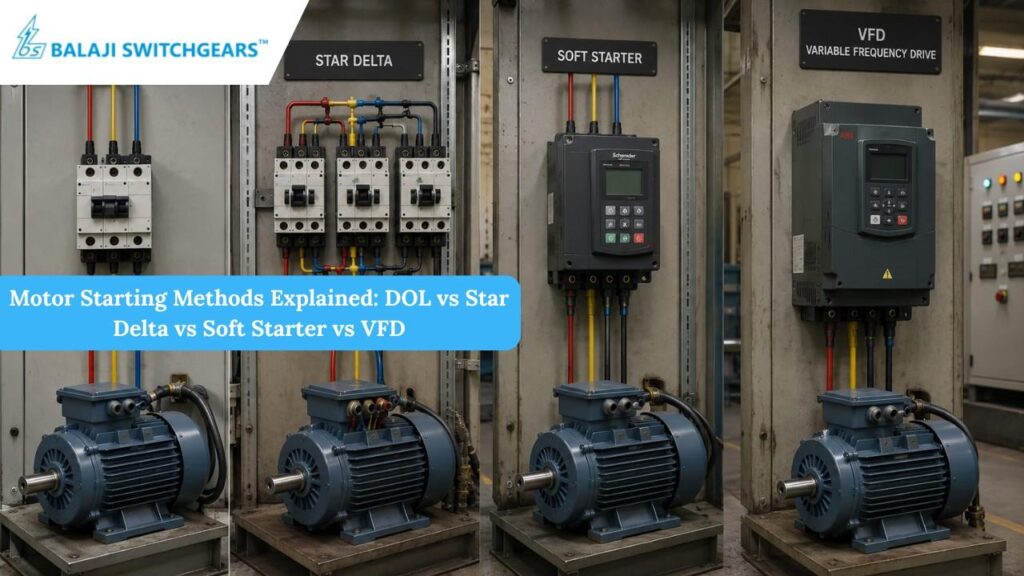
Choosing the right motor starting method is one of those decisions that looks simple on paper but has a real impact on equipment life, energy bills, and overall plant reliability. Electrical engineers and maintenance teams often have to choose between four common approaches, Direct On Line starting, Star Delta starting, Soft Starters, and Variable Frequency Drives. Each one controls how a motor draws current and builds torque during startup, and each comes with its own set of advantages and limitations.
This guide breaks down how each method works, where it fits best, and how to decide which one suits your application.
Why Motor Starting Method Even Matters
When an induction motor is switched on, it does not gently ease into operation. Left unchecked, it can draw an inrush current several times higher than its normal running current, sometimes five to eight times higher. This surge puts stress on cables, transformers, switchgear, and the motor windings themselves. It can also cause voltage dips that affect other equipment connected to the same supply.
The purpose of a starting method is to manage this inrush, protect the electrical system, and in some cases, control the mechanical shock delivered to coupled equipment like pumps, conveyors, and compressors. The four methods below take very different approaches to solving this same problem.
Direct On Line Starting
Direct On Line starting, often called DOL, is the simplest and oldest method used to start a motor. As soon as the start button is pressed, the contactor closes and connects the motor directly to full supply voltage across all three phases at once. There is no ramp up, no intermediate step, just an instant jump from stopped to full speed.
This simplicity is exactly why DOL remains popular for small motors. It uses a contactor along with a thermal or electronic overload relay for protection, making it one of the most affordable and easiest systems to maintain. Most guidance suggests DOL is best suited for motors up to around 5 HP, though it can be used for slightly larger loads if the power supply can handle the current spike without tripping breakers or causing voltage disturbances elsewhere in the facility.
The tradeoff is that DOL delivers full torque and full current from the very first instant, which can be too aggressive for larger motors, sensitive mechanical loads, or facilities with limited power supply capacity. It works best for small pumps, fans, and conveyors where starting current is not a major concern and immediate full torque is actually desirable.
Star Delta Starting
Star Delta starting was developed to reduce the high inrush current associated with DOL, particularly for larger motors. It works by first connecting the motor windings in a star configuration during startup, which lowers both the voltage across each winding and the resulting starting current. Once the motor picks up speed, or after a preset time interval, the system switches the connection to a delta configuration for full voltage, full torque operation.
This method can meaningfully lower starting current compared to DOL, with many sources citing reductions to roughly a third of the DOL starting current. It remains popular because it uses relatively simple electromechanical components, contactors and a timer, making it cost effective and mechanically straightforward.
However, Star Delta starting has real limitations. The torque produced during the star phase is also reduced, sometimes to a level that struggles with loaded starts. This makes it best suited for motors that start unloaded or lightly loaded, such as centrifugal pumps or fans without a heavy initial mechanical resistance. It also requires motors with six accessible terminals, and the transition between star and delta needs to be timed precisely, since a poorly tuned transition can create its own current spike.
Most references place Star Delta starting in the range of medium sized motors, typically from around 5 HP up to 100 HP, where the cost savings over a soft starter or VFD are meaningful but the reduced starting torque is not a dealbreaker.
Soft Starters
A soft starter takes a more refined approach by using thyristors, sometimes called SCRs, to gradually ramp up the voltage supplied to the motor during startup. Rather than the abrupt jump of DOL or the two step switch of Star Delta, a soft starter smoothly increases voltage over a configurable period, easing the motor into full speed while keeping starting current within a controlled, adjustable limit.
This gentler startup reduces mechanical stress on belts, gearboxes, couplings, and driven equipment, which is particularly valuable for applications where sudden torque could cause damage, such as conveyor systems, compressors, or large fans. Soft starters are also relatively compact and easier to retrofit into existing systems compared to some alternatives.
That said, soft starters do have limitations worth knowing. Because they rely on thyristors, they generate heat during operation, and the number of starts per hour is often limited compared to other methods, particularly for large motors. Some lower cost soft starter designs use only four thyristors instead of six, which can cause additional motor heating and further restrict how frequently the motor can be started. Soft starters also only control voltage, not frequency, which means they do not offer true speed control once the motor reaches full speed.
Variable Frequency Drives
A Variable Frequency Drive, commonly known as a VFD or sometimes a Variable Speed Drive, takes control a step further by regulating the actual frequency of the power supplied to the motor, along with a proportional voltage adjustment. This gives a VFD complete control not just over starting, but over the motor speed and torque throughout its entire operating cycle.
Because frequency control affects both torque and current together, a VFD can provide extremely smooth acceleration, precise speed regulation, and the ability to run a motor at reduced speeds when full speed is not needed. This last point is significant for energy savings, since running a motor slower during periods of lower demand can meaningfully cut power consumption compared to a fixed speed system that runs at full output regardless of actual need.
VFDs also have no practical limitation on the number of starts per hour, since they are designed for continuous regulation and frequent cycling, unlike soft starters which are thermally limited. This makes VFDs ideal for process applications where a motor needs to maintain constant pressure, flow, or speed, adjusting continuously based on real time demand.
The main drawback of a VFD is cost. It is generally the most expensive of the four methods, both in terms of upfront investment and installation complexity. For applications where only starting current reduction is needed and ongoing speed control is not required, a soft starter can often deliver similar starting benefits at a noticeably lower cost.
Comparing the Four Methods at a Glance
Direct On Line starting is the cheapest and simplest option, best for small motors where starting current is not a concern. Star Delta starting offers a cost effective way to reduce starting current for medium sized motors, provided the load allows for reduced starting torque. Soft Starters bring smoother, more controlled starting with adjustable current limits, well suited to protecting mechanical components from shock loading. Variable Frequency Drives offer the most complete control, combining smooth starting with ongoing speed regulation and energy savings, at the highest cost of the four.
How to Choose the Right Method
Selecting between these four approaches really comes down to a few practical questions. How large is the motor, and can the power supply tolerate its inrush current without disruption? Does the driven equipment need to start under load, or can it start unloaded? Is speed control needed during normal operation, or is a fixed running speed acceptable? And finally, what does the budget allow, both for initial installation and ongoing maintenance?
Small motors with light loads generally do well with DOL. Medium motors starting without load can often use Star Delta effectively. Applications that need protection from mechanical shock but not full speed control are strong candidates for soft starters. And any system that benefits from variable speed operation, energy optimization, or frequent cycling should lean toward a VFD despite the higher initial cost.
Final Thoughts
There is no single best motor starting method, only the method that best matches your motor size, load characteristics, and operational goals. Understanding how each system behaves during startup helps engineers and maintenance teams make informed decisions that protect equipment, reduce energy waste, and keep operations running smoothly.
For facilities looking to select or upgrade their motor starting systems, working with an experienced switchgear manufacturer can make the process far easier. Balaji Switchgears offers a reliable range of DOL starters, Star Delta panels, soft starters, and VFD solutions built to suit different motor sizes and industrial applications. With the right guidance from a trusted name like Balaji Switchgears, choosing the ideal starting method for your equipment becomes a much simpler and more confident decision.