
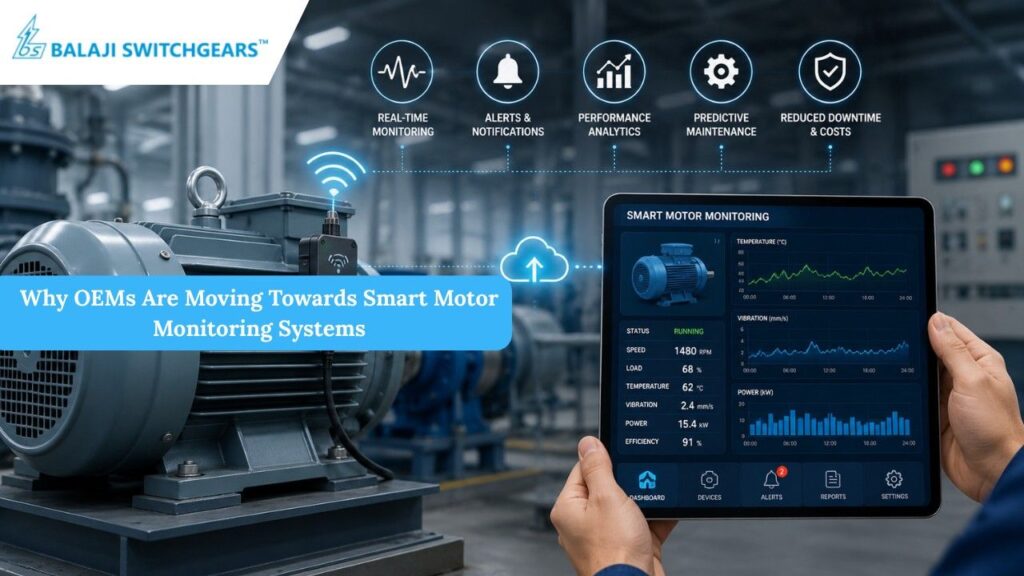
Industrial automation is evolving at an unprecedented pace. Original Equipment Manufacturers (OEMs) are no longer focused solely on building machines that perform efficiently; they are also expected to deliver equipment that is reliable, intelligent, energy-efficient, and capable of providing real-time operational insights. As industries embrace digital transformation and predictive maintenance, one technology that has gained significant attention is the smart motor monitoring system.
Electric motors power almost every industrial process, from conveyor belts and pumps to compressors, fans, mixers, packaging machines, and CNC equipment. A motor failure can bring an entire production line to a standstill, resulting in costly downtime, delayed deliveries, and expensive repairs. Traditionally, maintenance teams relied on periodic inspections or reactive maintenance, where motors were repaired only after a fault occurred. While this approach worked in the past, it no longer meets the demands of modern manufacturing.
Today, OEMs are increasingly integrating smart motor monitoring systems into their machines to improve reliability, reduce maintenance costs, and offer greater value to end users. These intelligent solutions continuously monitor motor health, detect abnormalities at an early stage, and provide actionable insights that help prevent unexpected failures.
In this blog, we’ll explore why OEMs are moving towards smart motor monitoring systems, the benefits they offer, and how they are transforming industrial operations.
What Is a Smart Motor Monitoring System?
A smart motor monitoring system is an intelligent solution that continuously tracks the operating condition of electric motors using sensors and advanced analytics. Instead of relying on manual inspections, these systems collect real-time data from motors and convert it into useful information that maintenance teams and operators can use to improve equipment performance.
Depending on the application, a smart motor monitoring system can monitor:
- Motor temperature
- Vibration levels
- Current consumption
- Voltage fluctuations
- Power usage
- Running hours
- Speed and load conditions
- Bearing condition
- Energy efficiency
By continuously analyzing these parameters, the system can detect early signs of wear or abnormal operation long before a complete motor failure occurs.
Why OEMs Are Changing Their Approach
OEMs operate in an increasingly competitive market where customers expect more than just durable equipment. Modern buyers look for machines that are intelligent, connected, and easy to maintain.
Several industry trends are driving this shift.
Growing Demand for Predictive Maintenance
Predictive maintenance has become one of the biggest priorities in industrial automation.
Instead of waiting for equipment to fail, industries now prefer identifying potential issues before they become major problems.
Smart motor monitoring systems make predictive maintenance possible by continuously tracking motor health and alerting maintenance teams when abnormal conditions develop.
This helps reduce unplanned downtime while improving equipment reliability.
Higher Expectations from Customers
Manufacturers purchasing industrial machinery now expect:
- Better machine availability
- Lower maintenance costs
- Reduced energy consumption
- Real-time diagnostics
- Remote monitoring capabilities
OEMs that integrate smart monitoring features into their equipment provide additional value, making their machines more attractive in the market.
Increasing Cost of Downtime
Unexpected motor failures are expensive.
A single motor breakdown may result in:
- Production losses
- Missed delivery schedules
- Emergency maintenance costs
- Overtime labour expenses
- Product wastage
For industries operating around the clock, even a short interruption can have significant financial consequences.
Smart monitoring helps minimize these risks by providing early warnings before failures occur.
Key Reasons OEMs Are Moving Towards Smart Motor Monitoring Systems
1. Early Fault Detection
One of the biggest advantages of smart motor monitoring is the ability to identify developing problems at an early stage.
The system can detect abnormalities such as:
- Excessive vibration
- Overheating
- Bearing wear
- Electrical imbalance
- Increased current consumption
Instead of discovering these issues after equipment failure, maintenance teams receive alerts while corrective action is still possible.
This significantly reduces repair costs.
2. Improved Machine Reliability
OEMs build their reputation on machine performance.
Reliable equipment leads to:
- Higher customer satisfaction
- Fewer warranty claims
- Better brand reputation
- Long-term customer relationships
Smart monitoring systems help ensure machines continue operating within safe conditions throughout their lifecycle.
3. Reduced Maintenance Costs
Traditional preventive maintenance often involves replacing components according to fixed schedules, regardless of their actual condition.
This approach may lead to:
- Unnecessary part replacement
- Higher maintenance expenses
- Increased labour costs
Smart monitoring enables condition-based maintenance, where servicing is performed only when required.
This optimizes maintenance budgets while improving equipment availability.
4. Better Energy Efficiency
Electric motors account for a significant portion of industrial energy consumption.
Smart monitoring systems continuously analyze motor performance and identify:
- Overloaded motors
- Underutilized equipment
- Inefficient operating conditions
- Power quality issues
These insights help industries improve energy efficiency while reducing electricity costs.
5. Real-Time Monitoring
Modern factories require instant access to equipment information.
Smart motor monitoring systems provide real-time operational data that allows operators to:
- Track motor health
- Monitor performance trends
- Respond quickly to abnormalities
- Improve operational decision-making
Real-time visibility reduces uncertainty and increases production efficiency.
6. Support for Remote Maintenance
Industrial facilities often operate across multiple locations.
Remote monitoring allows engineers to access motor health information without being physically present at every site.
Benefits include:
- Faster troubleshooting
- Reduced travel costs
- Centralized maintenance planning
- Improved response times
Remote access has become particularly valuable for large manufacturing organizations.
7. Longer Motor Life
Continuous monitoring helps maintain motors within their recommended operating conditions.
Avoiding excessive heat, overloads, and vibration reduces mechanical stress and extends motor lifespan.
Longer equipment life means lower replacement costs and improved return on investment.
8. Better Data for Decision Making
One of the greatest advantages of Industry 4.0 is data-driven decision making.
Smart monitoring systems generate valuable operational data that helps maintenance teams identify:
- Recurring faults
- Equipment trends
- Performance degradation
- Maintenance priorities
These insights improve planning and help optimize maintenance strategies.
Common Motor Problems That Smart Monitoring Can Detect
A smart motor monitoring system can identify several developing issues before they result in complete failure.
These include:
Bearing Wear
Bearings naturally wear over time.
Monitoring vibration patterns helps detect bearing problems early, reducing the risk of catastrophic failures.
Overheating
Excessive motor temperature may indicate:
- Overloading
- Poor ventilation
- Cooling system issues
- Electrical faults
Early detection prevents insulation damage and extends motor life.
Electrical Imbalance
Voltage or current imbalance can reduce motor efficiency and increase operating temperatures.
Continuous monitoring enables corrective action before damage occurs.
Shaft Misalignment
Misalignment increases vibration and mechanical stress.
Smart monitoring systems identify abnormal vibration patterns associated with alignment issues.
Mechanical Looseness
Loose mounting bolts or worn mechanical components create vibration signatures that monitoring systems can detect.
Early correction prevents further damage.
Industries Benefiting from Smart Motor Monitoring
Smart motor monitoring is now widely adopted across multiple sectors, including:
- Manufacturing
- Automotive
- Packaging
- Food and beverage
- Pharmaceutical
- Water treatment
- Oil and gas
- Mining
- Cement
- Steel
- Chemical processing
- Material handling
- HVAC systems
- Building automation
- Renewable energy
As automation continues to expand, the demand for intelligent motor monitoring solutions is expected to grow across virtually every industry.
Benefits for OEMs
Integrating smart motor monitoring provides OEMs with several competitive advantages.
These include:
- Enhanced machine value
- Improved product differentiation
- Reduced warranty claims
- Higher customer satisfaction
- Increased equipment reliability
- Better after-sales support
- Opportunities for remote service offerings
- Stronger long-term customer relationships
Machines equipped with intelligent monitoring capabilities are increasingly viewed as future-ready solutions.
Choosing the Right Smart Motor Monitoring System
Not every monitoring solution is suitable for every application.
OEMs should evaluate several factors before selecting a system.
Important considerations include:
- Compatibility with existing automation systems
- Ease of installation
- Scalability
- Communication protocols
- Data accuracy
- Real-time monitoring capability
- Alarm and notification features
- Software usability
- Long-term reliability
- Technical support availability
Choosing the right solution ensures maximum return on investment while simplifying implementation.
The Future of Motor Monitoring
Industrial automation is rapidly moving toward connected, intelligent, and predictive systems.
As artificial intelligence, Industrial Internet of Things (IIoT), and cloud-based analytics continue to evolve, smart motor monitoring systems will become even more powerful.
Future solutions are expected to provide:
- AI-driven fault prediction
- Advanced energy optimization
- Automated maintenance recommendations
- Cloud-based performance dashboards
- Integration with digital twins
- Enhanced cybersecurity
- Predictive asset management
OEMs that adopt these technologies today will be better positioned to meet tomorrow’s industrial requirements.
Conclusion
The industrial landscape is changing rapidly, and OEMs are under increasing pressure to deliver equipment that offers not only high performance but also long-term reliability, energy efficiency, and intelligent diagnostics. Smart motor monitoring systems have become an essential part of this transformation by enabling predictive maintenance, reducing downtime, improving machine performance, and extending motor life.
By providing real-time insights into motor health, these systems help manufacturers make informed maintenance decisions, optimize energy consumption, and improve overall operational efficiency. As Industry 4.0 continues to reshape manufacturing, integrating smart motor monitoring is no longer just an added feature, it is becoming a standard expectation for modern industrial equipment.
Partner with Balaji Switchgears for Smart Industrial Solutions
Selecting the right motor monitoring solution is only part of the equation. Equally important is working with a trusted supplier who understands industrial automation and can recommend products that match your application’s specific requirements.
Balaji Switchgears is a trusted partner for industries, OEMs, panel builders, and system integrators seeking reliable industrial automation solutions. With a strong portfolio of genuine electrical and automation products, expert technical guidance, and dedicated customer support, Balaji Switchgears helps businesses implement smart technologies that improve equipment reliability, reduce maintenance costs, and enhance overall operational efficiency.
Whether you are upgrading existing machinery or designing the next generation of intelligent equipment, we can help you choose the right solutions to build smarter, safer, and more efficient industrial systems.