
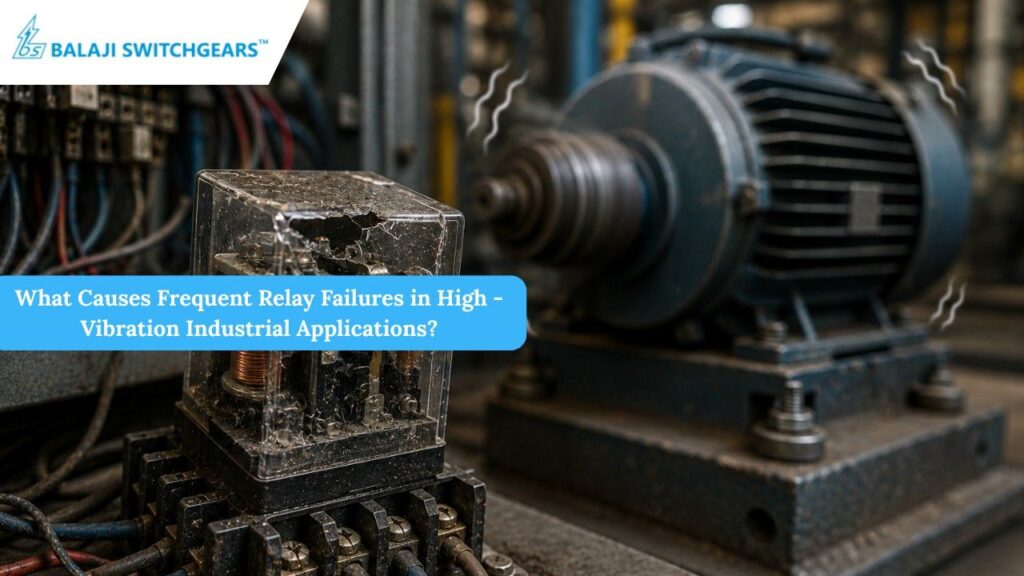
Industrial automation systems are designed to operate continuously under demanding conditions. Whether it’s a manufacturing plant, packaging line, material handling system, automotive assembly unit, or process industry, electrical components are expected to perform reliably despite exposure to dust, temperature fluctuations, electrical noise, and constant mechanical vibrations.
Among the many components inside an industrial control panel, relays play a crucial role in switching circuits, controlling loads, and ensuring smooth communication between control devices and field equipment. However, one of the most common maintenance challenges in vibration-prone environments is frequent relay failure.
Unexpected relay failures can result in machine stoppages, production losses, increased maintenance costs, and reduced equipment reliability. While many assume that relay failures are caused only by electrical overloads, the reality is that mechanical vibration is often a major contributor, especially in industries where heavy machinery operates continuously.
This blog explores the common causes of relay failures in high-vibration industrial applications, how these failures impact operations, and why the OMRON G2RV Slim Relay Series is a trusted solution for improving reliability in demanding environments.
Understanding the Role of Relays in Industrial Automation
A relay is an electrically operated switching device that allows a low-power control signal to operate a higher-power electrical circuit. Relays are used extensively in industrial control panels for:
- Machine control
- PLC output switching
- Motor control circuits
- Alarm systems
- Signal isolation
- Safety interlocks
- Process automation
Because relays operate repeatedly throughout the day, they are subjected to both electrical and mechanical stress. In high-vibration environments, these stresses become even more significant.
Why High-Vibration Environments Are Challenging
Many industrial sectors experience continuous vibration due to heavy equipment and moving machinery.
Examples include:
- Automotive manufacturing
- Steel plants
- Cement industries
- Mining operations
- Conveyor systems
- Packaging machinery
- Material handling equipment
- Textile machinery
- Food processing plants
- Power generation facilities
These vibrations are transferred through machine frames, mounting structures, and electrical panels, affecting sensitive control components over time.
If relays are not designed for such operating conditions, their reliability decreases considerably.
Common Causes of Frequent Relay Failures
1. Continuous Mechanical Vibration
One of the primary reasons for relay failure is constant mechanical vibration.
Repeated vibration can:
- Loosen internal components
- Cause unstable contact operation
- Increase mechanical wear
- Affect switching accuracy
- Reduce relay lifespan
Over time, these small mechanical movements can result in intermittent faults that are difficult to diagnose.
2. Contact Bounce
High vibration often causes relay contacts to bounce while switching.
Instead of making a clean electrical connection, the contacts repeatedly open and close for a very short duration.
This leads to:
- Electrical arcing
- Increased contact wear
- Unstable signals
- Reduced switching life
Contact bounce becomes especially problematic in high-speed automation systems where timing is critical.
3. Loose Terminal Connections
Vibration can gradually loosen screw terminals if they are not properly secured.
Loose connections result in:
- Increased electrical resistance
- Heat generation
- Voltage drops
- Intermittent relay operation
Eventually, excessive heating can damage both the relay and surrounding wiring.
Routine inspection helps, but selecting relays with reliable connection systems significantly reduces this risk.
4. Electrical Arcing
Every switching operation generates a small electrical arc.
In harsh industrial environments, vibration can make contact engagement less stable, increasing the duration and intensity of arcing.
Excessive arcing causes:
- Contact erosion
- Carbon deposits
- Increased resistance
- Reduced relay performance
Over time, the contacts become unreliable and require replacement.
5. Dust Combined with Vibration
Industrial environments often contain:
- Dust
- Metal particles
- Oil mist
- Moisture
- Fine debris
When combined with continuous vibration, these contaminants may enter poorly protected relay assemblies, leading to:
- Contact contamination
- Reduced insulation performance
- Poor switching reliability
- Premature failures
Proper panel design and high-quality relay construction help minimize these risks.
6. Heat Build-Up Inside Control Panels
High-vibration environments frequently include heavy electrical loads, which generate additional heat inside control panels.
Elevated temperatures accelerate:
- Coil ageing
- Contact degradation
- Plastic component deterioration
- Insulation wear
When vibration and heat occur together, relay life can reduce significantly.
7. Improper Mounting
Even the best relay can experience reliability issues if it is mounted incorrectly.
Common installation mistakes include:
- Poor DIN rail fixation
- Excessive panel vibration
- Weak mounting structures
- Improper panel layout
A secure mounting system reduces the mechanical stress transmitted to relays during operation.
8. Frequent Switching Operations
Industrial relays often perform thousands of switching operations every day.
When this high switching frequency is combined with mechanical vibration, wear accelerates considerably.
Applications involving motors, solenoid valves, conveyors, and automated production equipment are particularly demanding.
Selecting relays designed for industrial switching cycles becomes essential.
How Relay Failures Affect Industrial Operations
A failed relay may appear to be a small issue, but its impact can be extensive.
Common consequences include:
Unexpected Machine Downtime
A single faulty relay can stop an entire production line, leading to missed production targets and costly delays.
Increased Maintenance Costs
Frequent relay replacement requires additional labor, spare parts, and troubleshooting time.
Reduced Equipment Reliability
Repeated relay failures create uncertainty in machine performance and reduce overall operational confidence.
Lower Productivity
Production interruptions affect output, delivery schedules, and overall plant efficiency.
Higher Safety Risks
Intermittent relay failures in safety-related circuits may lead to unsafe operating conditions, making reliable component selection even more critical.
How the OMRON G2RV Slim Relay Series Addresses These Challenges
When reliability, compact design, and dependable switching performance are required, the OMRON G2RV Slim Relay Series is a preferred choice for industrial automation professionals.
Designed for modern control panels, the G2RV series combines space-saving construction with proven performance, making it well suited for demanding industrial applications.
Slim and Compact Design
The OMRON G2RV relay features a slim profile that allows higher wiring density without compromising accessibility.
This helps panel builders:
- Save panel space
- Improve cable management
- Create organized control panels
- Simplify future maintenance
Reliable Switching Performance
The G2RV series is engineered to provide stable switching performance even in applications requiring frequent operation.
Its dependable contact mechanism helps reduce switching-related failures and contributes to consistent machine operation.
Easy Installation
The relay is designed for quick DIN rail mounting, making installation and replacement straightforward.
This reduces:
- Installation time
- Maintenance effort
- Machine downtime during servicing
High-Quality Engineering
OMRON is globally recognized for manufacturing industrial automation components known for their precision and long service life.
The G2RV relay reflects this commitment through:
- Consistent performance
- Reliable operation
- Durable construction
- Long operational life under industrial conditions
Simplified Maintenance
The slim relay design improves accessibility inside crowded control panels.
Technicians can:
- Replace relays quickly
- Identify wiring easily
- Reduce maintenance time
- Minimize production interruptions
Best Practices to Prevent Relay Failures
Even with high-quality relays, following good engineering practices improves long-term reliability.
Some recommendations include:
- Select relays designed for industrial environments.
- Ensure secure DIN rail mounting.
- Tighten terminals according to manufacturer specifications.
- Minimize excessive vibration through proper panel installation.
- Maintain adequate ventilation inside control panels.
- Conduct periodic inspections of relay connections.
- Keep electrical enclosures clean and free from dust accumulation.
- Replace ageing relays during preventive maintenance rather than waiting for failure.
Choosing the Right Relay Makes a Difference
Industrial environments continue to become more demanding as automation systems operate faster and production expectations increase.
In such conditions, selecting the right relay is not simply about completing a circuit, it is about ensuring long-term reliability, reducing downtime, lowering maintenance costs, and protecting overall productivity.
The OMRON G2RV Slim Relay Series offers an excellent combination of compact design, dependable switching performance, ease of installation, and reliable operation, making it an ideal solution for modern industrial control panels where consistent performance is essential.
Investing in quality relay technology today helps prevent costly maintenance issues and unexpected production losses tomorrow.
Why Choose Balaji Switchgears?
Choosing genuine automation products from a trusted supplier is just as important as selecting the right component.
Balaji Switchgears is an authorized distributor of OMRON Industrial Automation products, supplying genuine OMRON G2RV Slim Relays along with expert technical guidance for a wide range of industrial applications.
Whether you are building a new control panel, upgrading an existing automation system, or replacing relays in a high-vibration environment, Balaji Switchgears can help you identify the right OMRON relay solution for your application.
With a commitment to quality products, application expertise, and customer-focused support, we help OEMs, panel builders, system integrators, contractors, and industries improve system reliability, reduce maintenance challenges, and achieve dependable long-term performance.