
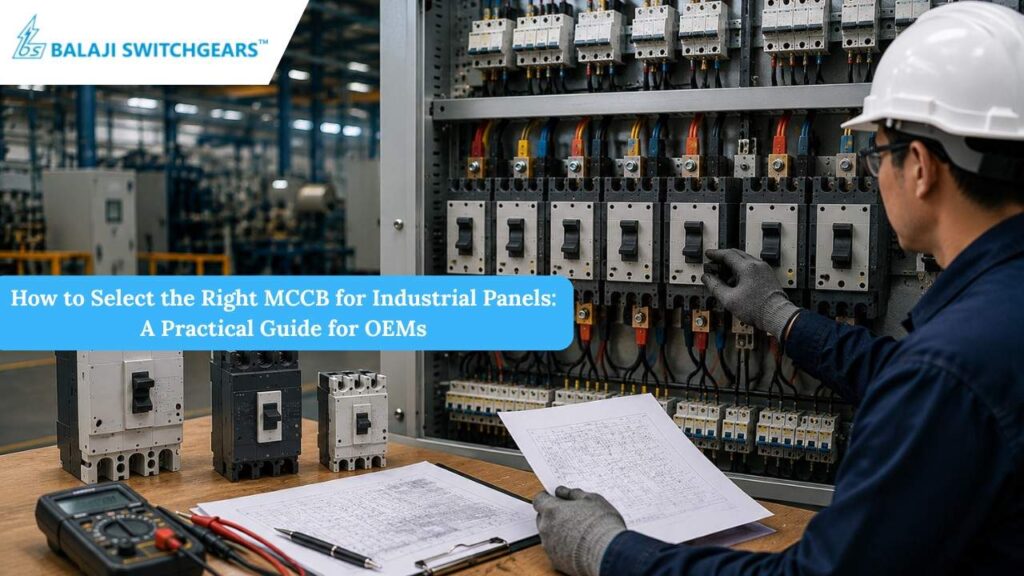
In today’s industrial landscape, electrical systems are becoming more advanced, automated, and energy-intensive. As factories, processing plants, warehouses, and commercial facilities continue to expand, the demand for reliable power distribution and protection has become more important than ever. At the heart of every industrial panel lies a critical safety component, the Molded Case Circuit Breaker (MCCB).
For Original Equipment Manufacturers (OEMs), selecting the right MCCB is not simply about choosing a breaker with the correct current rating. It involves understanding the application’s electrical requirements, safety standards, environmental conditions, and future expansion needs.
An incorrectly selected MCCB can lead to nuisance tripping, equipment damage, operational downtime, increased maintenance costs, and even safety hazards. On the other hand, the right MCCB ensures optimal protection, system reliability, and long-term operational efficiency.
This practical guide explains everything OEMs need to know about selecting the right MCCB for industrial panels.
What Is an MCCB?
A Molded Case Circuit Breaker (MCCB) is an electrical protection device designed to safeguard electrical circuits from overloads, short circuits, and fault conditions.
Unlike Miniature Circuit Breakers (MCBs), MCCBs are designed to handle higher current capacities and are widely used in industrial and commercial applications.
An MCCB automatically interrupts the flow of electricity when it detects abnormal conditions, protecting both equipment and personnel.
Industrial panels commonly use MCCBs for:
- Main incoming power protection
- Motor protection
- Generator protection
- Power distribution systems
- Capacitor banks
- HVAC systems
- Large machinery applications
Their versatility and reliability make them an essential component in industrial electrical infrastructure.
Why Selecting the Correct MCCB Is Important
Choosing the wrong MCCB can create several operational problems.
An undersized breaker may trip frequently and interrupt production.
An oversized breaker may fail to provide adequate protection during fault conditions.
Poor selection can lead to:
- Equipment damage
- Increased downtime
- Safety risks
- Reduced system efficiency
- Higher maintenance costs
- Lower equipment lifespan
Proper MCCB selection ensures the electrical system operates safely and efficiently under both normal and abnormal conditions.
Step 1: Determine the Load Current Requirement
The first step is understanding the total load current.
OEMs must calculate the actual current requirement of the equipment or system that the MCCB will protect.
Consider all connected loads, including:
- Motors
- Pumps
- Compressors
- Lighting systems
- Automation equipment
- HVAC systems
- Auxiliary devices
It is important to consider both current demand and future expansion requirements.
Many industries design electrical panels with additional capacity to accommodate future growth.
As a general practice, avoid selecting an MCCB that operates continuously at its maximum rating.
Providing a safety margin improves performance and extends equipment life.
Step 2: Identify the System Voltage
The MCCB voltage rating must match the system voltage.
OEMs should verify:
- Operating voltage
- Frequency
- Number of phases
Common industrial systems include:
- 230V single-phase
- 415V three-phase
- 440V three-phase
- 690V industrial systems
Selecting an MCCB with an incorrect voltage rating can compromise both safety and performance.
Always choose a breaker rated for the system’s operating conditions.
Step 3: Calculate the Short-Circuit Current
Short-circuit capacity is one of the most critical factors in MCCB selection.
The breaker must safely interrupt fault currents without sustaining damage.
This is measured in kiloamperes (kA).
Industrial facilities often have varying fault levels depending on:
- Transformer capacity
- Cable lengths
- Power source characteristics
- Distribution network design
The MCCB’s interrupting capacity should always exceed the maximum prospective fault current at the installation point.
Selecting a breaker with insufficient breaking capacity can result in catastrophic failure during a fault event.
Step 4: Understand Trip Unit Requirements
The trip unit is the intelligence behind the MCCB.
It determines when the breaker should interrupt the circuit.
There are generally two types.
Thermal-Magnetic Trip Units
These use two mechanisms:
- Thermal protection for overload conditions
- Magnetic protection for short circuits
They are commonly used for standard industrial applications.
Electronic Trip Units
Electronic trip units offer advanced protection and monitoring capabilities.
They provide:
- Adjustable settings
- Greater accuracy
- Enhanced diagnostics
- Communication capabilities
- Remote monitoring options
For modern industrial facilities, electronic trip units are increasingly becoming the preferred choice.
Step 5: Evaluate Selectivity and Coordination
Industrial electrical systems contain multiple protective devices.
Proper coordination ensures that only the faulty section is isolated during an electrical fault.
This is known as selectivity.
Without proper coordination, an entire production line may shut down due to a fault in one small section.
OEMs should carefully coordinate MCCBs with:
- Upstream breakers
- Downstream breakers
- Motor protection devices
- Relays
- Fuses
Good selectivity improves system reliability and minimizes operational disruptions.
Step 6: Consider Environmental Conditions
Industrial environments can be extremely demanding.
Factors such as temperature, humidity, dust, chemicals, and vibrations can impact MCCB performance.
OEMs should evaluate:
Temperature
High temperatures can reduce breaker performance.
Humidity
Moisture can accelerate corrosion.
Dust
Dust accumulation can affect electrical components.
Chemical Exposure
Certain industries expose equipment to corrosive substances.
Vibrations
Heavy machinery can create continuous vibrations.
Selecting an MCCB designed for the operating environment improves durability and reliability.
Step 7: Evaluate Communication and Smart Monitoring Features
Modern industries are rapidly adopting smart technologies.
Traditional protection devices are evolving into intelligent devices.
Many advanced MCCBs now support communication protocols that enable integration with:
- SCADA systems
- Building Management Systems (BMS)
- Energy Management Systems (EMS)
- Industrial automation platforms
These capabilities allow operators to monitor electrical performance in real time.
Smart MCCBs provide valuable information such as:
- Load status
- Fault history
- Energy consumption
- Alarm notifications
- Predictive maintenance alerts
This data helps organizations improve operational efficiency.
Step 8: Consider Future Expansion
Industrial facilities rarely remain static.
Production capacities increase, new equipment is installed, and operational demands grow over time.
OEMs should account for future expansion during panel design.
Selecting an MCCB with some additional capacity helps avoid costly upgrades later.
However, avoid excessive oversizing, as this may compromise protection sensitivity.
The goal is to find the right balance between current needs and future growth.
Step 9: Ensure Compliance with Industry Standards
Electrical safety standards are essential for reliable installations.
OEMs should ensure that selected MCCBs comply with relevant international standards.
Common standards include:
- IEC 60947
- IEC 61439
- IS standards
- Local electrical regulations
Compliance ensures safety, reliability, and regulatory acceptance.
It also simplifies future inspections and certifications.
Step 10: Choose a Reliable Brand and Supplier
The quality of the MCCB is just as important as its specifications.
Low-quality products may lead to:
- Frequent failures
- Inconsistent performance
- Safety concerns
- Increased maintenance costs
OEMs should work with trusted brands and experienced suppliers who provide:
- Technical support
- Product expertise
- Application guidance
- After-sales service
Reliable partners can help ensure the correct selection for every application.
Common Mistakes OEMs Should Avoid
Many OEMs make avoidable mistakes during MCCB selection.
Selecting Based Only on Current Rating
Current rating alone is insufficient.
Multiple factors must be evaluated.
Ignoring Short-Circuit Capacity
Fault current calculations are essential.
Overlooking Future Expansion
Panels should accommodate future growth.
Neglecting Environmental Conditions
Operating environments significantly impact performance.
Poor Coordination Planning
Improper selectivity can cause unnecessary shutdowns.
Choosing Based Only on Price
Low-cost products may increase long-term operational expenses.
Avoiding these mistakes improves both reliability and safety.
Why Smart MCCBs Are Becoming the Future
Industrial facilities are becoming increasingly digital.
The rise of Industry 4.0 is changing how electrical systems are managed.
Smart MCCBs offer several advantages:
- Real-time monitoring
- Remote diagnostics
- Predictive maintenance
- Improved energy management
- Better fault analysis
- Enhanced operational visibility
These capabilities allow organizations to move from reactive maintenance to proactive management.
As industries embrace digital transformation, smart protection systems will become standard practice.
Applications That Require Careful MCCB Selection
MCCBs are widely used across various industries, including:
Manufacturing Plants
Protect production lines and heavy machinery.
Data Centers
Ensure uninterrupted power availability.
Commercial Buildings
Manage large electrical distribution systems.
Water Treatment Plants
Protect pumps and control systems.
Pharmaceutical Industries
Support critical production environments.
Food Processing Units
Maintain continuous operations.
Warehouses and Logistics Centers
Power automation and material handling systems.
Each application requires careful evaluation to ensure the MCCB matches operational requirements.
Conclusion
Selecting the right MCCB for industrial panels is one of the most important decisions OEMs make during panel design. A properly selected MCCB not only protects electrical systems but also improves reliability, minimizes downtime, enhances safety, and supports future expansion.
Rather than focusing solely on current ratings, OEMs must evaluate fault levels, environmental conditions, trip units, selectivity, communication capabilities, and long-term operational needs.
As industrial facilities become smarter and more connected, intelligent protection systems will play a larger role in ensuring efficient and resilient operations.
For businesses seeking reliable electrical solutions, Balaji Switchgears provides expert guidance and industry-leading products that help OEMs build safe, efficient, and future-ready industrial panels. With extensive expertise in industrial power distribution and automation solutions, We support organizations in selecting the right MCCBs and creating robust electrical infrastructures designed for long-term performance and reliability.