
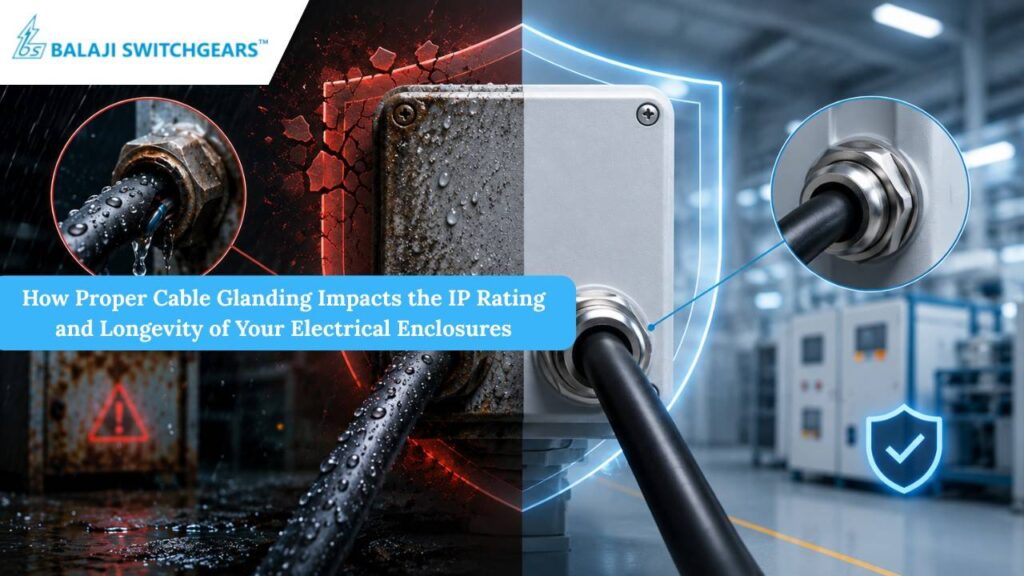
In industrial electrical installations, significant attention is often given to switchgear, protection devices, cables, and control systems. However, one critical component that is frequently overlooked is the cable gland. While small in size compared to other electrical equipment, cable glands play a major role in protecting electrical enclosures and ensuring long-term system reliability.
Many enclosure failures that appear to be caused by poor equipment quality are actually the result of improper cable entry management. Moisture ingress, dust contamination, corrosion, insulation degradation, and premature equipment failure often begin at the cable entry point.
This is where proper cable glanding becomes essential. A correctly selected and installed cable gland not only secures cables mechanically but also helps maintain the enclosure’s Ingress Protection (IP) rating, ensuring protection against environmental hazards.
Understanding the relationship between cable glanding, IP ratings, and enclosure longevity is essential for anyone involved in electrical panel design, installation, or maintenance.
Understanding the Purpose of Cable Glands
A Cable gland is a device used to securely attach and seal the end of an electrical cable where it enters an enclosure, panel, junction box, or switchgear assembly.
Although its function may appear simple, a cable gland performs multiple critical roles simultaneously.
It provides mechanical retention to prevent cable movement, protects cables from excessive strain, maintains environmental sealing, and ensures safe cable entry into electrical equipment.
Without a properly installed cable gland, even the highest-quality enclosure can become vulnerable to external contaminants.
In many industrial environments, the cable gland serves as the first line of defense against harsh operating conditions.
What Is an IP Rating?
To understand the importance of cable glanding, it is necessary to understand IP ratings.
Ingress Protection ratings indicate the degree of protection provided by an enclosure against solid particles and liquids.
The first digit represents protection against dust and solid objects, while the second digit represents protection against water ingress.
For example:
- IP54 provides protection against limited dust ingress and water splashes.
- IP65 offers complete dust protection and resistance to water jets.
- IP66 provides protection against powerful water jets.
- IP67 allows temporary immersion protection.
- IP68 provides protection under prolonged immersion conditions.
Many industrial electrical enclosures are designed and tested to achieve specific IP ratings. However, these ratings are only valid when every opening in the enclosure maintains the same level of protection.
This includes cable entry points.
Why Cable Entry Points Are Vulnerable
Electrical enclosures are carefully engineered to prevent external contaminants from reaching internal components.
However, every cable entering the enclosure creates an opening that can compromise this protection.
If cable entry points are not sealed correctly, they become pathways for:
- Dust
- Water
- Oil
- Chemical vapors
- Humidity
- Insects
- Corrosive contaminants
Even a small gap around a cable can gradually allow contaminants to enter the enclosure.
Over time, this can affect electrical performance, reduce insulation resistance, and accelerate equipment deterioration.
A properly selected cable gland eliminates these vulnerabilities by creating a secure environmental seal around the cable.
The Direct Relationship Between Cable Glands and IP Ratings
One of the biggest misconceptions in industrial installations is assuming that purchasing an IP66 enclosure automatically guarantees IP66 protection.
In reality, the enclosure can only maintain its rated protection if all cable entries are sealed to the same standard.
For example, an IP66 enclosure fitted with an improperly selected cable gland may effectively perform at a much lower protection level.
The weakest point determines the actual protection achieved in the field.
Proper cable glanding ensures that:
- Dust cannot enter the enclosure.
- Water cannot penetrate through cable entry points.
- Internal components remain protected.
- Environmental certification requirements are maintained.
This is why cable gland selection is a critical part of enclosure design rather than an afterthought during installation.
Moisture Ingress: The Silent Equipment Killer
Among all environmental threats, moisture is one of the most damaging to electrical systems.
Water entering an enclosure may not cause immediate failure. Instead, damage often develops gradually.
Moisture can lead to:
- Corrosion of busbars and terminals
- Oxidation of electrical contacts
- Reduced insulation resistance
- Increased leakage currents
- Short circuits
- Protection device malfunctions
In humid environments, condensation can accumulate inside enclosures if cable entries are not properly sealed.
A high-quality cable gland prevents moisture migration and helps maintain a dry internal environment.
This significantly increases the lifespan of electrical components.
Dust Contamination and Performance Degradation
Industrial facilities often contain high levels of airborne dust.
Manufacturing plants, cement facilities, mining operations, woodworking industries, and processing plants generate contaminants that can enter electrical enclosures if sealing is inadequate.
Dust accumulation creates several risks.
It can block ventilation paths, interfere with moving components, and create insulation problems.
Conductive dust particles can even create unintended electrical paths, leading to faults or equipment damage.
Proper cable glanding helps preserve the enclosure’s dust protection rating and prevents contamination of sensitive electrical equipment.
Preventing Mechanical Stress on Cables
Cable glands do more than provide environmental sealing.
They also provide mechanical support.
Industrial cables are frequently exposed to vibration, movement, pulling forces, and mechanical stress.
Without proper cable retention, these forces can transfer directly to internal terminals and electrical connections.
Over time, this may cause:
- Loose connections
- Terminal damage
- Conductor fatigue
- Signal interruptions
- Increased contact resistance
A correctly installed cable gland absorbs mechanical stress and prevents excessive movement of the cable.
This contributes significantly to system reliability.
Extending the Lifespan of Electrical Enclosures
The longevity of an electrical enclosure depends largely on its ability to protect internal components from environmental exposure.
Even premium enclosures can experience premature deterioration if contaminants repeatedly enter through poorly sealed cable entries.
Proper cable glanding helps maintain the enclosure’s protective barrier throughout its operational life.
This reduces exposure to damaging environmental conditions and minimizes wear on internal components.
As a result, maintenance requirements decrease and equipment lifespan increases.
Importance of Material Selection
Cable gland performance is heavily influenced by material selection.
Different environments require different gland materials.
Brass cable glands are widely used for industrial applications due to their strength and durability.
Stainless steel cable glands are preferred in corrosive environments such as chemical plants, offshore installations, and marine applications.
Polyamide cable glands offer excellent resistance to chemicals and are commonly used in lightweight installations.
Selecting the wrong material can lead to corrosion, degradation, and sealing failure.
Proper material selection ensures long-term performance and environmental protection.
The Role of Cable Glands in Outdoor Installations
Outdoor electrical installations face particularly challenging conditions.
Rain, ultraviolet radiation, temperature fluctuations, humidity, and airborne contaminants constantly attack enclosure systems.
In such environments, cable entry points become critical protection zones.
Poor cable glanding can quickly compromise enclosure integrity and allow environmental damage to develop.
Properly rated cable glands help maintain enclosure performance even under harsh outdoor conditions.
This is especially important for:
- Solar installations
- Water treatment plants
- Telecommunications infrastructure
- Utility substations
- Industrial outdoor control panels
Common Cable Glanding Mistakes
Despite their importance, cable glands are often installed incorrectly.
Common mistakes include selecting the wrong gland size, improper tightening, using incompatible materials, and failing to match gland ratings with enclosure ratings.
Another common issue is using standard glands in environments that require higher protection levels.
These errors can significantly reduce enclosure protection and increase the likelihood of premature failures.
Proper installation practices are just as important as proper gland selection.
Supporting Compliance and Safety
Modern electrical standards place significant emphasis on enclosure protection and safe cable management.
Proper cable glanding contributes to compliance by maintaining specified IP ratings and ensuring safe cable entry practices.
This not only supports equipment reliability but also improves personnel safety.
Maintaining compliance becomes increasingly important during inspections, audits, and safety assessments.
Looking Beyond Initial Cost
In many projects, cable glands are viewed as low-cost accessories.
However, selecting cable glands based solely on purchase price can create significant long-term expenses.
The cost of replacing damaged equipment, addressing water ingress issues, or troubleshooting recurring faults often far exceeds the savings achieved through lower-cost components.
Investing in properly specified cable glands helps avoid these hidden costs and improves overall system performance.
Conclusion
Cable glands may appear to be small components within an electrical installation, but their impact on enclosure protection and system reliability is substantial.
A properly selected and installed cable gland helps maintain the enclosure’s IP rating, prevents moisture and dust ingress, protects cables from mechanical stress, and extends the life of critical electrical equipment.
In industrial environments where reliability, safety, and operational continuity are essential, overlooking cable glanding can lead to costly failures and increased maintenance requirements.
By treating cable entry protection as a critical part of enclosure design rather than a minor accessory, organizations can improve long-term performance and reduce operational risks.
For industries seeking dependable electrical infrastructure, careful attention to enclosure protection, cable management, and component selection remains essential. With the right engineering approach and quality electrical solutions, Balaji Switchgears helps businesses build safer, more reliable, and longer-lasting electrical systems for demanding industrial environments.