
Energy efficiency has become a top priority for industries seeking to reduce operational costs, improve sustainability, and enhance equipment performance. While many organizations invest heavily in modern machinery and automation technologies, significant energy losses often remain hidden within everyday utility systems.
Among the biggest contributors to industrial energy waste are compressed air systems and Heating, Ventilation, and Air Conditioning (HVAC) systems. These systems are essential for maintaining production processes, worker comfort, and equipment reliability. However, when not properly monitored and maintained, they can become major sources of energy leakage.
The challenge is that energy leaks are rarely visible. Unlike water leaks that create puddles on the floor, energy losses often occur silently and continuously, increasing electricity consumption without obvious warning signs.
Understanding how to identify and eliminate these hidden inefficiencies can significantly reduce operating expenses while improving overall system performance.
Understanding What Energy Leaks Really Mean
An energy leak does not necessarily refer to a physical hole or visible damage.
In industrial environments, energy leaks occur whenever a system consumes more energy than necessary to perform its intended function.
This may result from:
- Compressed air leakage
- Poor control strategies
- Improper equipment sizing
- Excessive operating hours
- Inefficient automation settings
- Faulty sensors
- Poor maintenance practices
Over time, even small inefficiencies can translate into substantial financial losses.
In facilities operating around the clock, these hidden losses often accumulate into thousands of units of wasted energy every year.
Why Compressed Air Systems Are Often Called the Fourth Utility
Compressed air is one of the most widely used utilities in manufacturing plants.
It powers pneumatic tools, actuators, packaging equipment, conveyors, and automation systems.
However, compressed air is also one of the most expensive forms of energy used in industry.
Generating compressed air requires significant electrical power. Unfortunately, a large percentage of that energy is often wasted before it reaches the point of use.
Industry studies frequently show that many facilities lose a substantial portion of their compressed air through leaks and system inefficiencies.
This makes compressed air systems one of the first areas that should be examined during any energy optimization initiative.
Common Sources of Energy Leaks in Compressed Air Systems
One of the biggest causes of wasted energy is air leakage from the distribution network.
Leaks can occur at:
- Pipe joints
- Quick-connect fittings
- Valves
- Hoses
- Couplings
- Pressure regulators
- Pneumatic equipment connections
Even a small leak may seem insignificant. However, when the system operates continuously, the cumulative energy loss becomes considerable.
Many facilities unknowingly operate compressors for longer periods simply to compensate for air losses occurring throughout the network.
This increases electricity consumption, maintenance requirements, and equipment wear.
Identifying Compressed Air Leaks
Detecting compressed air leaks requires a systematic approach.
One common indicator is a compressor that runs excessively even when production demand is low.
Pressure fluctuations throughout the system can also indicate leakage issues.
Audible hissing sounds often point to air escaping from fittings or connections.
However, some leaks are too small to be detected by hearing alone.
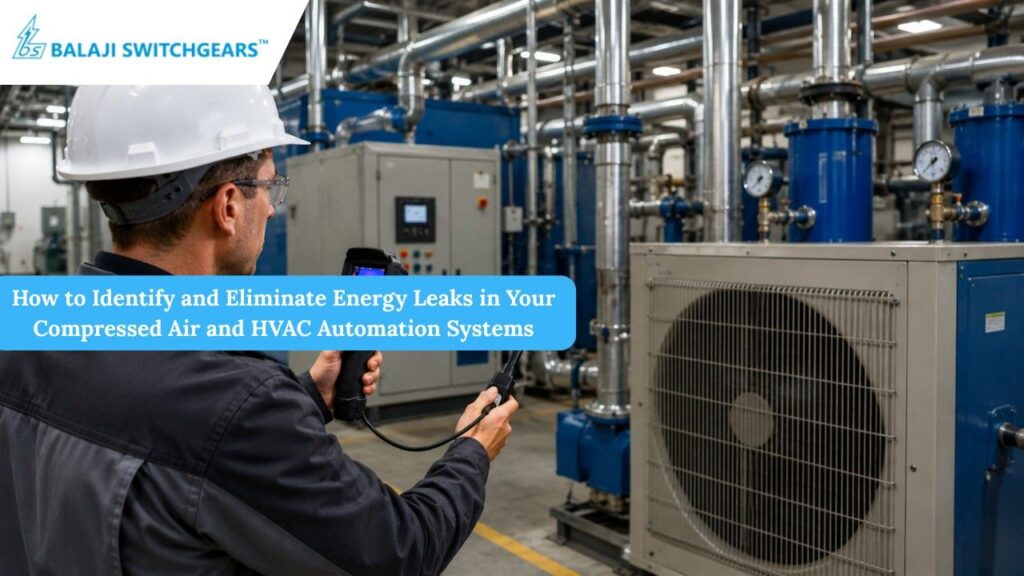
Modern facilities increasingly use ultrasonic leak detection equipment. These devices identify high-frequency sounds generated by escaping compressed air, allowing maintenance teams to locate leaks accurately.
Regular inspections help identify problem areas before energy losses become significant.
The Hidden Cost of Excessive System Pressure
Many facilities increase compressor pressure to compensate for performance issues.
While this may temporarily solve operational problems, it often increases energy consumption significantly.
Higher pressure results in:
- Increased compressor workload
- Greater leakage rates
- Higher operating temperatures
- Reduced equipment life
In many cases, addressing underlying inefficiencies allows systems to operate effectively at lower pressure levels.
Proper automation and control strategies help maintain optimal pressure while minimizing energy consumption.
Understanding Energy Leaks in HVAC Systems
Heating, Ventilation, and Air Conditioning systems are another major source of energy consumption in industrial facilities.
These systems are responsible for maintaining environmental conditions necessary for both personnel and equipment.
However, HVAC systems frequently operate inefficiently due to poor control practices, equipment degradation, or improper system configuration.
Energy losses in HVAC systems often remain unnoticed because comfort conditions appear normal even when efficiency is declining.
Common Causes of HVAC Energy Waste
One of the most common issues is simultaneous heating and cooling.
This occurs when one part of the system is attempting to heat a space while another is cooling it.
Such conflicts waste significant amounts of energy without providing any operational benefit.
Other common causes include:
- Dirty air filters
- Poorly calibrated sensors
- Damaged dampers
- Inefficient control sequences
- Faulty actuators
- Excessive ventilation rates
- Inadequate scheduling
Each of these issues increases energy consumption while reducing system efficiency.
The Role of Automation in Energy Management
Modern automation systems provide powerful tools for identifying and eliminating energy leaks.
Advanced control systems continuously monitor operating conditions and adjust equipment performance based on actual demand.
Instead of running equipment at full capacity throughout the day, automation enables systems to operate only when needed.
This dynamic control significantly reduces energy consumption.
Automation platforms can monitor:
- Air pressure
- Temperature
- Humidity
- Occupancy
- Equipment runtime
- Energy consumption trends
These insights help facility managers identify inefficiencies that would otherwise remain hidden.
Why Sensor Accuracy Matters
Sensors are the eyes and ears of an automation system.
When sensors provide inaccurate information, control systems make poor decisions.
For example, a temperature sensor reading incorrectly may cause an HVAC unit to run longer than necessary.
Similarly, faulty pressure sensors can lead to excessive compressor operation.
Regular sensor calibration is therefore essential for maintaining energy efficiency.
Even minor measurement errors can create significant energy waste over time.
Data Monitoring and Trend Analysis
One of the most effective methods of identifying energy leaks is through trend analysis.
Energy management systems collect operational data continuously.
By reviewing this information, facility managers can identify abnormal patterns such as:
- Unexpected increases in energy consumption
- Extended equipment operating hours
- Pressure instability
- Temperature deviations
- Frequent compressor cycling
These patterns often reveal hidden inefficiencies before they develop into larger problems.
Data-driven maintenance allows organizations to address issues proactively rather than reactively.
The Impact of Poor Maintenance
Maintenance plays a critical role in energy efficiency.
Neglected equipment often consumes significantly more energy than properly maintained systems.
Dirty filters restrict airflow and increase fan energy consumption.
Worn seals increase compressed air leakage.
Blocked heat exchangers reduce thermal efficiency.
Faulty valves create control instability.
A preventive maintenance program helps ensure that systems continue operating at peak efficiency throughout their service life.
Eliminating Energy Leaks Through System Optimization
The most successful energy reduction initiatives focus on system optimization rather than isolated repairs.
This involves evaluating how equipment operates as an integrated system.
Key areas for optimization include:
- Proper equipment sizing
- Efficient control strategies
- Leak detection programs
- Preventive maintenance schedules
- Real-time monitoring
- Variable speed control implementation
When these measures work together, energy savings can be substantial.
More importantly, improvements are often achieved without major capital investment.
Financial Benefits of Eliminating Energy Leaks
Reducing energy waste delivers benefits beyond lower utility bills.
Improved efficiency often leads to:
- Reduced maintenance costs
- Extended equipment life
- Improved system reliability
- Lower carbon emissions
- Increased production stability
Because compressed air and HVAC systems operate continuously in many facilities, even small efficiency improvements can generate significant annual savings.
These savings frequently provide rapid returns on investment.
Creating a Long-Term Energy Efficiency Strategy
Energy efficiency should not be treated as a one-time project.
Facilities that achieve lasting results typically establish continuous improvement programs.
Regular audits, performance reviews, maintenance inspections, and automation upgrades help sustain efficiency gains over time.
As production requirements evolve, energy management strategies should evolve as well.
A proactive approach ensures that energy leaks do not gradually return and erode operational performance.
Conclusion
Hidden energy leaks in compressed air and HVAC automation systems can significantly increase operating costs, reduce equipment reliability, and impact overall facility efficiency. Because these losses often develop gradually, they frequently remain unnoticed until utility expenses begin to rise or system performance starts to decline.
Identifying and eliminating energy leaks requires a combination of proper maintenance, accurate monitoring, intelligent automation, and ongoing system optimization. From compressed air leak detection and pressure management to HVAC control improvements and sensor calibration, every efficiency improvement contributes to long-term operational savings.
Organizations that prioritize energy management not only reduce costs but also improve sustainability, equipment performance, and business competitiveness.
For industries seeking reliable electrical and automation solutions that support efficient operations, Balaji Switchgears continues to help businesses implement smarter systems, improve energy performance, and build more sustainable industrial infrastructures for the future.