
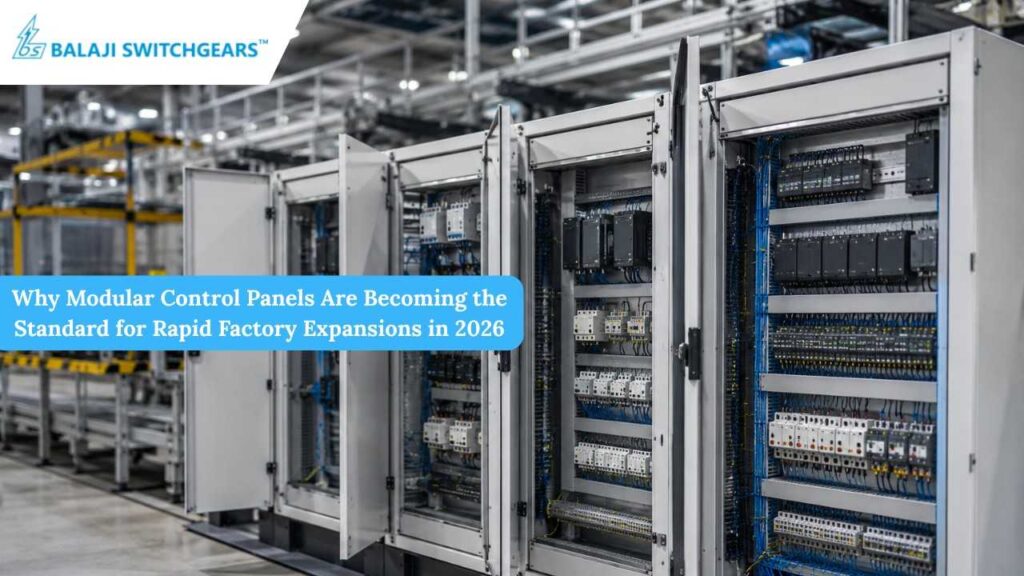
In 2026, industries across manufacturing, automation, infrastructure, and processing sectors are expanding faster than ever before. Factories are scaling production lines, integrating smart technologies, and upgrading electrical infrastructure to meet growing operational demands. In this rapidly changing industrial landscape, traditional electrical systems are no longer enough to support flexible and fast expansion needs.
This is where modular control panels are changing the game.
Modern industries now prefer modular control panels because they offer flexibility, scalability, faster installation, reduced downtime, and simplified maintenance. As factories continue to evolve toward Industry 4.0 and smart manufacturing, modular systems are becoming the preferred choice for businesses looking for efficient and future-ready electrical solutions.
The demand for modular control panels is rising because industries today need systems that can adapt quickly without disrupting operations. Whether it is expanding production capacity, adding new machinery, or integrating automation systems, modular panels provide a smarter and more reliable approach compared to traditional fixed-panel designs.
Understanding Modular Control Panels
Modular control panels are electrical panels designed using standardized sections or modules that can be added, removed, or modified easily according to operational requirements.
Unlike conventional control panels that are built as fixed structures, modular panels are designed for flexibility. Different functional sections such as motor control units, distribution systems, automation controls, and monitoring systems can be integrated seamlessly into a single scalable setup.
This modular approach allows industries to customize and expand their electrical systems without replacing the complete infrastructure.
As industries focus on operational agility, modular Control Panels are becoming essential for efficient factory expansion projects.
Why Factory Expansions Are Increasing in 2026
Several factors are driving rapid factory expansions globally in 2026:
- Increased demand for automation
- Growth in manufacturing sectors
- Smart factory adoption
- Expansion of renewable energy infrastructure
- Higher production demands
- Shift toward digital manufacturing
- Faster industrial development in emerging markets
Industries are under constant pressure to increase production while maintaining efficiency, safety, and energy optimization. Traditional electrical systems often struggle to keep up with these fast-changing requirements.
This has created a strong need for scalable and adaptable electrical infrastructure solutions like modular control panels.
Faster Installation and Deployment
One of the biggest advantages of modular control panels is speed.
In industrial expansion projects, time plays a critical role. Delays in electrical installations can affect production schedules, project costs, and operational timelines.
Modular control panels are pre-engineered and designed for quicker assembly and installation. Since different modules are manufactured separately and integrated efficiently, installation time is significantly reduced.
Factories can expand production lines much faster without long shutdown periods.
This rapid deployment capability makes modular control panels ideal for industries planning phased expansions or urgent capacity upgrades.
Scalability for Growing Operations
Scalability is one of the main reasons modular control panels are becoming the industry standard.
As factories grow, electrical requirements also increase. New machinery, automation systems, and power distribution needs require continuous upgrades.
Traditional control panels often require complete redesigning when additional capacity is needed. This process is time-consuming and expensive.
Modular systems eliminate this challenge by allowing industries to add new sections or components without replacing the existing setup.
This flexibility helps industries expand operations gradually while maintaining system continuity and cost efficiency.
Reduced Downtime During Expansion
Downtime is one of the biggest concerns during factory expansion projects.
Shutting down operations for electrical modifications can result in major production losses. Industries today cannot afford long interruptions.
Modular control panels help minimize downtime because modifications can often be completed without disturbing the entire system.
New modules can be integrated with existing systems more efficiently, reducing operational disruption.
This is especially important for industries operating continuously such as manufacturing plants, food processing units, pharmaceuticals, steel plants, and infrastructure projects.
Better Space Optimization
Modern factories focus heavily on optimized space utilization.
Traditional panel systems can occupy large areas and often become difficult to manage as operations expand.
Modular control panels are designed with compact and organized layouts that improve space management. Their flexible structure allows better arrangement of electrical components while maintaining accessibility.
This helps factories utilize available floor space more efficiently, especially in high-density industrial environments.
As industrial spaces become more technologically advanced, compact and modular electrical solutions are becoming increasingly valuable.
Simplified Maintenance and Troubleshooting
Maintenance is much easier in modular control panel systems.
In traditional systems, identifying and repairing faults can be complicated because multiple functions are integrated into a single fixed structure.
Modular systems separate different functions into organized sections, making troubleshooting faster and more efficient.
If a fault occurs in one module, it can often be repaired or replaced without affecting the entire system.
This reduces maintenance time, improves operational reliability, and minimizes production interruptions.
Industries are increasingly choosing modular control panels because they simplify long-term maintenance management.
Improved Safety Standards
Safety is a critical priority in industrial electrical systems.
As factories become larger and more automated, electrical loads and operational complexity also increase. Poorly designed systems can lead to overheating, short circuits, arc faults, and fire hazards.
Modular control panels are designed with better compartmentalization, organized wiring, and improved isolation between sections.
This enhances operational safety and reduces the risk of electrical accidents.
Modern modular systems also support advanced protection devices, monitoring systems, and intelligent fault detection technologies that improve overall plant safety.
In 2026, industries are prioritizing safety-compliant electrical infrastructure more than ever before, making modular solutions highly preferred.
Supporting Smart Factory Integration
Industry 4.0 is transforming industrial operations worldwide.
Factories are now integrating automation, IoT devices, remote monitoring systems, and smart control technologies to improve efficiency and productivity.
Modular control panels are highly compatible with smart factory environments because they support flexible integration of automation systems and digital monitoring technologies.
Industries can easily upgrade modules for new automation requirements without redesigning the complete electrical setup.
This adaptability is one of the strongest reasons modular control panels are becoming essential in modern industrial facilities.
Enhanced Energy Efficiency
Energy efficiency has become a major operational priority in 2026.
Industries are focusing on reducing energy consumption, improving power quality, and minimizing electrical losses.
Modular control panels help improve energy management by supporting organized load distribution, efficient circuit design, and advanced monitoring systems.
They also allow easier integration of energy-efficient technologies such as variable frequency drives, smart metering systems, and automated energy management solutions.
Improved energy efficiency directly contributes to reduced operational costs and sustainable industrial growth.
Cost-Effective Long-Term Investment
Although modular control panels may initially appear more advanced than traditional systems, they provide excellent long-term cost benefits.
Their scalability reduces the need for complete system replacements during expansion.
Faster installation reduces labor costs and project delays.
Simplified maintenance minimizes repair expenses and downtime losses.
Improved efficiency reduces energy consumption.
All these factors contribute to better return on investment over time.
Industries today are increasingly investing in modular electrical systems because they offer long-term operational and financial advantages.
Flexibility for Different Industries
Another major reason behind the growing popularity of modular control panels is their versatility.
They can be customized for various industrial applications including:
- Manufacturing plants
- Process industries
- Infrastructure projects
- Water treatment facilities
- Commercial complexes
- Renewable energy systems
- Steel and cement industries
- Pharmaceutical industries
- Food processing units
Their adaptable design makes them suitable for both small-scale and large-scale industrial operations.
This flexibility allows industries to build electrical systems according to their specific operational requirements.
Future-Ready Electrical Infrastructure
Industries in 2026 are not just planning for current operations. They are preparing for future expansion, automation, and digital transformation.
Traditional electrical systems often become outdated quickly because they lack adaptability.
Modular control panels offer future-ready infrastructure by allowing industries to upgrade technologies, expand capacities, and integrate new systems without major reconstruction.
This future-focused approach helps businesses remain competitive in a rapidly evolving industrial environment.
Why Industries Prefer Professional Expertise
Designing and implementing modular control panels requires technical expertise, precision engineering, and deep understanding of industrial electrical systems.
Industries today prefer experienced electrical solution providers who can deliver reliable, scalable, and customized Control panel systems.
Professional manufacturers ensure proper design, safety compliance, high-quality components, and efficient integration according to industrial requirements.
This is why trusted companies like Balaji Switchgears are becoming preferred partners for industries looking to upgrade and expand their electrical infrastructure efficiently.
With expertise in advanced electrical systems and industrial control solutions, Balaji Switchgears helps industries implement reliable modular control panels designed for modern operational needs.
As factory expansions continue to accelerate in 2026, businesses are increasingly relying on experienced electrical solution providers for scalable, efficient, and future-ready electrical solutions.
From design and engineering to installation and support, Balaji Switchgears plays an important role in helping industries achieve safer, smarter, and more flexible electrical infrastructure.
Conclusion
The industrial landscape in 2026 demands speed, flexibility, efficiency, and reliability. As factories continue to expand and modernize, electrical infrastructure must evolve to support these growing operational requirements.
Modular control panels are becoming the preferred standard because they provide scalable, adaptable, and future-ready solutions for industrial environments.
Their ability to reduce downtime, simplify maintenance, improve safety, support automation, and enable rapid expansion makes them highly valuable for modern industries.
As businesses continue moving toward smart manufacturing and advanced automation, modular control panels will remain at the center of industrial electrical transformation.
Industries looking for reliable and efficient solutions are increasingly partnering with experienced companies like Balaji Switchgears to build electrical systems that support long-term growth, operational stability, and future expansion goals.