
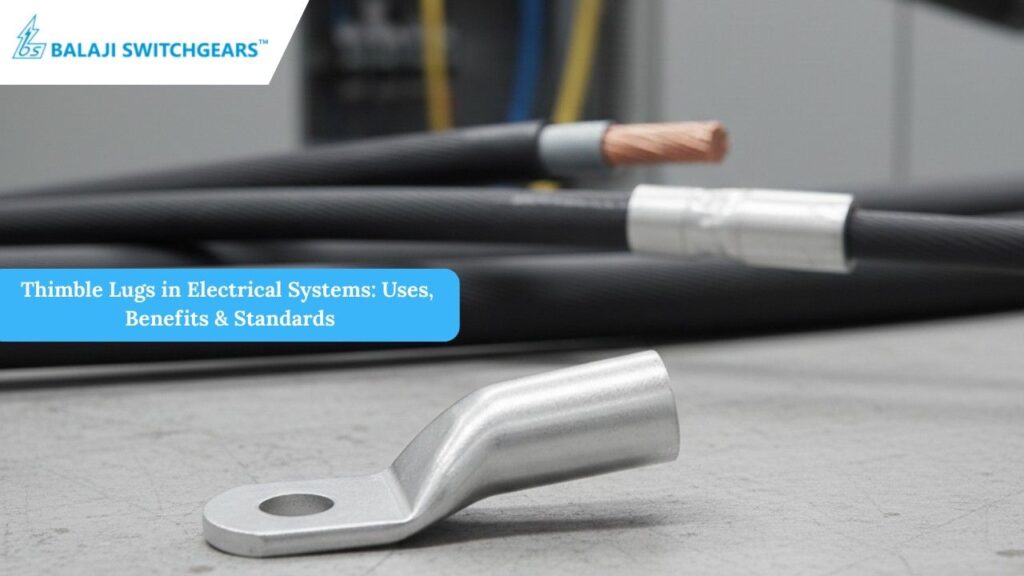
In any electrical installation—whether industrial, commercial, or infrastructure-based—the reliability of connections plays a major role in system safety and performance. While cables and conductors often get most of the attention, the importance of proper termination hardware cannot be overstated. One such essential component is the thimble lugs. Widely used across low- and medium-voltage electrical systems, thimble lugs ensure secure cable termination, improved conductivity, and long-term operational safety. This blog explores thimble lugs in electrical system applications, their uses, key benefits, and the standards that govern their manufacturing and usage.
What Are Thimble Lugs?
Thimble lugs are electrical connectors used to terminate stranded conductors securely to terminals, busbars, or electrical equipment. They consist of a tubular barrel to hold the conductor and a flat palm (or eye) with a hole for bolting.
Unlike makeshift or loose terminations, thimble lugs provide a mechanically strong and electrically stable connection, reducing risks such as overheating, arcing, or cable damage.
Role of Thimble Lugs in Electrical Systems
Thimble lugs in electrical system designs are used wherever reliable cable termination is required. They act as the interface between flexible conductors and rigid electrical terminals.
Their role includes:
- Ensuring firm mechanical grip on conductors
- Providing low-resistance current flow
- Preventing strand breakage in stranded cables
- Enhancing safety during high-load operations
In demanding environments, the quality of lugs directly affects system efficiency and lifespan.
Types of Thimble Lugs Commonly Used
Understanding the types helps in selecting the right lug for the application:
Copper Thimble Lugs
Used in most electrical panels and power distribution systems due to excellent conductivity.
Aluminium Thimble Lugs
Used with aluminium conductors, especially in utility and infrastructure projects.
Tinned Copper Thimble Lugs
Offer additional corrosion resistance, ideal for humid or outdoor environments.
Insulated vs Non-Insulated Lugs
Insulated lugs provide extra protection against accidental contact and short circuits.
Uses of Thimble Lugs in Electrical Installations
The uses of thimble lugs span across multiple industries and applications:
1. Electrical Panels and Switchgear
Thimble lugs are extensively used for terminating incoming and outgoing cables in control panels, MCC panels, and distribution boards.
2. Power Distribution Systems
In substations and power distribution networks, thimble lugs ensure safe and stable high-current connections.
3. Industrial Machinery
Machinery operating under vibration and load requires secure cable termination making thimble lugs a preferred choice.
4. Renewable Energy Installations
Solar inverters, battery banks, and wind power systems rely on properly crimped thimble lugs for consistent power flow.
5. Automotive and Rail Applications
Heavy-duty wiring systems in transportation sectors use thimble lugs for durability and safety.
Benefits of Thimble Lugs in Electrical Systems
The benefits of thimble lugs go beyond simple connectivity. They contribute significantly to system reliability and safety.
1. Improved Electrical Conductivity
A properly crimped thimble lug provides uniform contact, reducing resistance and minimizing power loss.
2. Enhanced Mechanical Strength
Thimble lugs prevent conductor pull-out and withstand vibration, making them suitable for industrial environments.
3. Reduced Risk of Overheating
Loose connections are a common cause of overheating. Thimble lugs help maintain consistent contact pressure.
4. Longer Cable Life
They protect conductor strands from bending stress and mechanical damage at termination points.
5. Ease of Installation and Maintenance
Standardized lug sizes simplify installation and allow easy inspection and replacement when required.
Why Proper Crimping Matters
Even the best-quality lug can fail if improperly crimped. Correct crimping:
- Ensures full conductor engagement
- Prevents air gaps that cause oxidation
- Maintains electrical and mechanical integrity
Using calibrated crimping tools as per manufacturer guidelines is critical for achieving reliable results.
Standards Governing Thimble Lugs
To ensure safety and performance, thimble lugs in electrical system applications must comply with recognized standards.
Common Standards Include:
- IS 8309 (Indian Standard for cable lugs)
- IEC standards for electrical connectors
- UL and DIN standards for global applications
These standards define parameters such as material quality, conductivity, mechanical strength, and dimensional accuracy.
Material Selection and Its Importance
Choosing the correct material is essential for optimal performance:
- Copper lugs are best for high-conductivity applications
- Aluminium lugs must be matched with aluminium conductors to avoid galvanic corrosion
- Tinned lugs are preferred in corrosive or outdoor environments
Matching the lug material with conductor type ensures long-term reliability.
Common Mistakes to Avoid When Using Thimble Lugs
- Using undersized or oversized lugs
- Improper crimping technique
- Mixing aluminium conductors with copper lugs without bi-metal solutions
- Ignoring environmental conditions during selection
Avoiding these mistakes significantly improves system safety and efficiency.
Thimble Lugs vs Bare Cable Termination
Compared to bare cable termination, thimble lugs offer:
- Better electrical contact
- Improved mechanical stability
- Lower maintenance requirements
- Compliance with safety standards
This makes them a standard requirement in professional electrical installations.
Future of Thimble Lugs in Modern Electrical Systems
As electrical systems become more compact and power-dense, the importance of reliable termination solutions continues to grow. Thimble lugs are evolving with:
- Improved crimp designs
- Better corrosion-resistant coatings
- Compatibility with advanced cable materials
Despite technological advancements, the fundamental role of thimble lugs remains unchanged—ensuring safe and efficient power transmission.
Conclusion
Thimble lugs may appear to be a small component, but their impact on electrical safety and system performance is significant. Understanding the uses of thimble lugs, their construction, and the benefits of thimble lugs helps engineers and installers make informed decisions.
When used correctly and in compliance with standards, thimble lugs in electrical system installations provide long-lasting, secure, and efficient connections—making them an indispensable part of modern electrical infrastructure.