
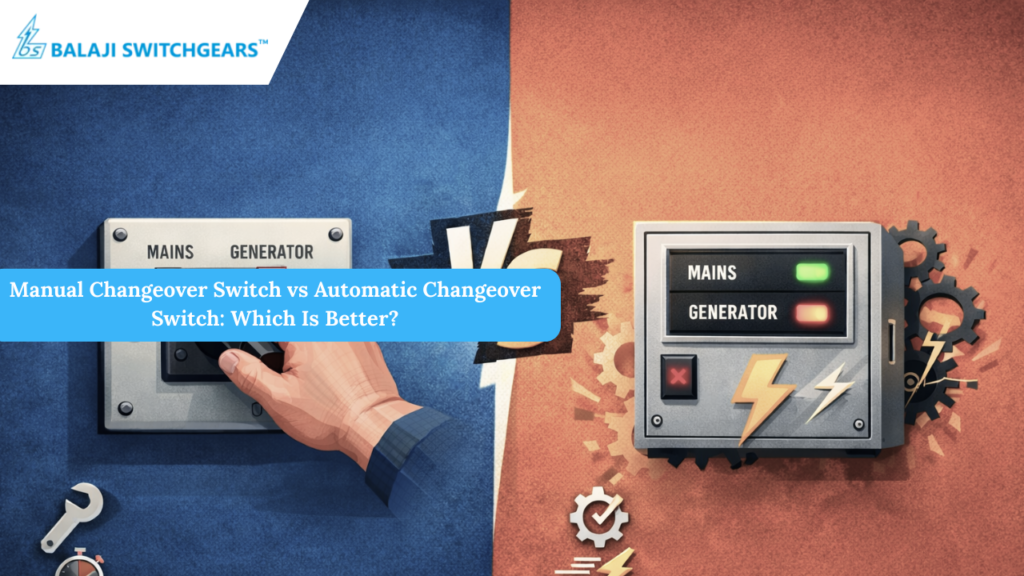
Power continuity is a top priority for residential, commercial, and industrial setups. Unexpected power failures can disrupt operations, damage equipment, or even compromise safety. Choosing the right changeover solution is critical, and the decision often comes down to Manual changeover switch vs Automatic Changeover Switch.
At Balaji Switchgears, we supply both manual and automatic solutions, helping customers select the right system based on their specific needs, budget, and operational requirements. In this article, we’ll explore the working principle, advantages, limitations, and applications of each type, providing practical guidance to make the best choice.
Understanding Changeover Switches
Changeover switches allow users to transfer the electrical load between two power sources—commonly the utility (main grid) and a backup generator. They are designed to ensure that only one power source supplies the load at a time, preventing dangerous back-feeding or short circuits.
The two main categories are:
- Manual changeover switch: Requires human intervention to switch between sources.
- Automatic Changeover Switch (ATS): Detects power failure and automatically switches to the backup source.
How Manual Changeover Switch Works
A manual changeover switch uses a mechanical lever or handle to transfer the load between the main supply and generator. Here’s a simple step-by-step overview:
- When mains supply is available, the switch is in the “Mains ON” position.
- In the event of a power failure, the operator moves the switch to the “Generator ON” position after starting the generator.
- When utility power is restored, the operator returns the switch to the mains position and stops the generator.
Key Components:
- Input terminals (mains and generator)
- Output terminals (load connection)
- Mechanical switching mechanism
- Operating handle
- Protective enclosure
Advantages of Manual Changeover Switch:
- Simple, robust design
- Lower initial cost
- Minimal maintenance
- Clear operator control
Limitations:
- Requires human intervention
- Switching time depends on operator availability
- Not suitable for critical loads that need uninterrupted power
How Automatic Changeover Switch Works
An Automatic Changeover Switch detects power failure in the main supply and automatically starts the generator or switches to an alternate source. Once utility power is restored, it switches back seamlessly.
Key Components:
- Sensor for voltage/frequency detection
- Control circuitry for automatic switching
- Relay or contactor mechanism
- Generator start/stop interface
- Load connection terminals
Advantages of Automatic Changeover Switch:
- Instant switching without human intervention
- Ensures uninterrupted power supply
- Ideal for critical loads like hospitals, data centers, and industrial machines
- Can be integrated with remote monitoring
Limitations:
- Higher initial cost
- More complex installation
- Requires occasional maintenance of control electronics
Manual vs Automatic Changeover Switch: Side-by-Side Comparison
| Feature | Manual Changeover Switch | Automatic Changeover Switch |
| Operation | Operator-controlled | Automatic detection and switching |
| Cost | Low | High |
| Reliability | Mechanical simplicity | Dependent on sensors and control electronics |
| Downtime | Depends on operator | Minimal, almost instant |
| Maintenance | Minimal | Moderate (electronics need care) |
| Applications | Residential, small commercial | Hospitals, data centers, industrial setups |
| User Control | High | Moderate |
Factors to Consider When Choosing
- Load Type and Criticality
- If uninterrupted power is critical, an ATS is the preferred choice.
- For non-critical loads or supervised environments, a manual switch may suffice.
- If uninterrupted power is critical, an ATS is the preferred choice.
- Budget Constraints
- Manual switches are cost-effective upfront.
- ATS provides higher value for critical applications despite higher initial cost.
- Manual switches are cost-effective upfront.
- Frequency of Power Failures
- Frequent outages justify automatic switching for convenience and protection.
- Rare interruptions may make manual switching acceptable.
- Frequent outages justify automatic switching for convenience and protection.
- Maintenance and Technical Expertise
- Manual switches require little technical knowledge.
- ATS may require periodic testing and electronic maintenance.
- Manual switches require little technical knowledge.
- Safety and Compliance
- Both types prevent back-feeding when installed correctly.
- ATS ensures consistent operation even if the operator is unavailable.
- Both types prevent back-feeding when installed correctly.
Applications and Suitability
Manual Changeover Switch Applications:
- Small homes with backup generators
- Shops and offices with occasional power interruptions
- Light industrial setups with supervised backup
Automatic Changeover Switch Applications:
- Hospitals and clinics
- Data centers and IT infrastructure
- Process industries with continuous operations
- Commercial buildings with critical electrical loads
At Balaji Switchgears, our clients often combine both options depending on their facility design, ensuring a balance between cost and reliability.
Practical Buyer Guidance
Step 1: Evaluate Your Power Requirements
- Determine load size (kW or kVA)
- Identify critical and non-critical circuits
- Assess peak load and backup generator capacity
Step 2: Decide Between Manual vs Automatic
- Use the Manual changeover switch for smaller, supervised applications.
- Choose an Automatic Changeover Switch for critical or unsupervised environments.
Step 3: Consider Brand and Quality
- Work with trusted suppliers like Balaji Switchgears
- Ensure compliance with safety and electrical standards (IEC, IS)
- Check for long-term support and warranty
Step 4: Installation and Maintenance
- Ensure correct installation to prevent back-feeding
- Schedule periodic inspections, especially for ATS electronics
- Train operators for manual switching if needed
Why Balaji Switchgears?
Balaji Switchgears provides both manual and automatic changeover switches, engineered for reliability, safety, and compliance. Our solutions are designed for:
- Residential, commercial, and industrial installations
- Easy integration with electrical panels
- Long-term durability and consistent performance
With expert guidance, Balaji Switchgears helps customers choose the right solution based on load requirements, operational priorities, and budget.
Conclusion
Choosing between a manual changeover switch and an Automatic Changeover Switch depends on the application, criticality of the load, budget, and operational convenience.
- Manual switches are simple, cost-effective, and reliable for supervised, non-critical applications.
- Automatic switches provide instant switching, higher safety, and minimal downtime for critical environments.
At Balaji Switchgears, we guide our customers through the selection process, ensuring they invest in the right changeover system for uninterrupted, safe, and efficient power supply. Understanding the differences and operational needs is key to making the Manual vs Automatic Changeover Switch decision confidently.