
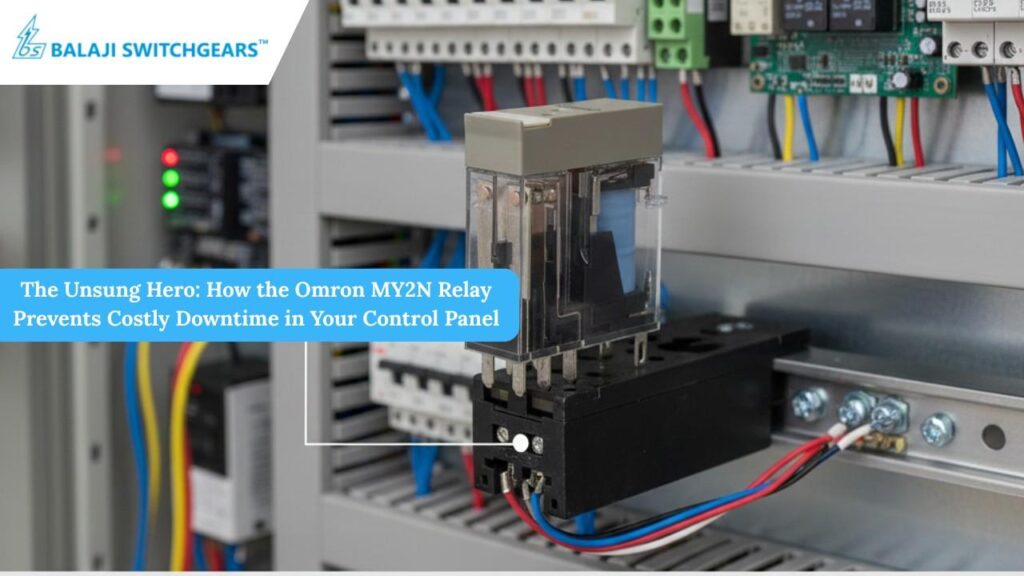
When it comes to industrial control panels and automation systems, much of the attention goes to big components — motors, contactors, drives, and PLCs. But one small, often-overlooked part plays a quiet yet critical role: the general-purpose relay. Among these, the Omron MY2N relay stands out as a proven component that keeps circuits safe, prevents unexpected failures, and ultimately saves maintenance time and downtime costs.
In this post, we’ll look at why the MY2N relay earns the “unsung hero” nickname, how its design and specifications contribute to system reliability, and practical guidance on using it right — so your control panels remain stable and failure-resilient.
What is the Omron MY2N Relay — and why it matters
At its core, the Omron MY2N relay is a compact, plug-in, double-pole double-throw (DPDT) power relay designed for control panels, automation circuits, and general switching tasks.
Key characteristics of the MY2N series that make it valuable:
- It supports various coil voltages (DC or AC depending on model), giving flexibility based on control-circuit voltage
- Its contact ratings are sufficient for many control and auxiliary loads; for example, some variants support switching at 220 VAC / 5 A resistive (or higher depending on exact model) when used properly.
- It uses a plug-in socket base (often 8-pin) which makes installation and replacement easy — a benefit for maintenance and servicing.
- The relay is built for durability: reliable operation under varied ambient conditions (wide temperature range), predictable switching behavior, and a long mechanical and electrical lifespan when used within specification.
Because it’s small, inexpensive, easy to replace, and well-specified, MY2N relays are widely used in countless control-panel designs — from HVAC, pumps, conveyors, to interlock circuits in industrial automation.
But beyond these specs, what truly sets a component like the MY2N apart is how it contributes to preventing downtime and failures in real-world installations.
Three ways the MY2N Relay protects your control panel — avoiding unexpected failures
1. Reliable switching and consistent isolation — preventing circuit overload and failure
Relays like MY2N act as “electrical guards”: they isolate control logic from high-power circuits, and reliably switch loads on or off based on control signals. This isolation is essential: without a proper relay, sensitive control electronics could be exposed to surges, overloads, or noise — risking failure.
With the DPDT contact configuration, the MY2N can switch two independent circuits or provide changeover functionality. That gives system designers flexibility: a single relay can control multiple loads, or switch between alternate circuits. Also, because the relay is rated for standard loads and designed according to international standards (UL/CSA/VDE etc for general-purpose relays under the manufacturer’s catalog) reliability is engineered-in from the start.
Thus, using the MY2N correctly prevents contact welding, unintended circuit closure, or accidental cross-connections — all of which can cause downtime or even damage to equipment.
2. Long life, predictable maintenance — minimizing unexpected breakdowns
One of the biggest risks in control panels is “wear-out” — over many switching cycles, contacts deteriorate, insulating materials age, and failures become more probable. A cheap or untested relay might work fine today, but fail after months of use.
The MY2N’s design addresses this head-on. As part of the widely used “MY” series of miniature power relays, it benefits from proven manufacturing standards. Many variants offer robust contact materials (e.g. silver alloy), good insulation, surge suppression (in DC-coil versions), and consistent performance across operating conditions.
In practical terms: when a control panel is built using MY2N relays, the maintenance schedule becomes predictable. Since the relay is socket-mounted, swapping a worn relay requires minimal downtime. Instead of rewiring or reworking a circuit, one can simply unplug the old relay and plug a new one — making maintenance quick, clean, and low-cost.
This “replace rather than repair” model ensures control panels stay operational, avoids unpredictable failures, and reduces maintenance overhead over the long run.
3. Versatility and adaptability — enabling safer upgrades and future-proofing
Because the MY2N comes in various coil-voltage options (DC or AC), and because its contact configuration (DPDT) offers flexibility, it’s suitable for a wide range of applications: motor control, interlocking, signaling circuits, switching auxiliary loads, and more. This versatility means when your system evolves — you add more sensors, actuators, or control logic — you don’t need to redesign the panel entirely. You can often reuse the same relay footprint, or swap to a variant with a different coil voltage, while preserving the wiring and socket layout. That adaptability reduces engineering overhead and minimizes chances of wiring errors during upgrades — a common cause of failures in evolving industrial setups.
Moreover, because the MY2N relay is standardized and documented, replacement parts are widely available. Engineering teams don’t need specialized or proprietary parts to maintain reliability over years.
How to Use MY2N Correctly — Best Practices for Maximum Reliability
While the MY2N relay brings many advantages, getting the most reliability — and truly preventing downtime — depends on proper application. Here are some guidelines:
- Match coil voltage and contact load ratings exactly. Choose the MY2N variant that matches your control-circuit voltage (12 VDC, 24 VDC, 110 VAC, etc). Using a coil at wrong voltage can cause unreliable switching or failure.
- Ensure load on contacts is within rated limits. Don’t overload the relay — stay within resistive or inductive load ratings (for example many MY2N variants handle ~5 A at 220 VAC resistive load safely; exceeding that risks contact failure or welding).
- Use surge suppression where required. For DC coils especially, choose versions with built-in diodes (e.g. “MY2N-D2”) to suppress coil-back EMF when the coil is de-energized. This prevents voltage spikes that could damage other electronics in the panel.
- Prefer socket-mounting with standard bases. Using the proper socket (often 8-pin) simplifies installation, replacement, and maintenance. Also, it reduces wiring errors and improves serviceability.
- Plan periodic inspection and relay replacement as part of preventive maintenance. Even though MY2N relays are durable, mechanical wear over many cycles or harsh environmental conditions (temperature, humidity, dust, vibration) can gradually degrade contacts or coil insulation. Proactive replacement before failure is better than reactive repair — and a socketed relay makes this low-effort.
- Design for easy access in the control panel. Since control-panel downtime is often triggered by relay failures, avoid burying relays. Leave space and easy access so maintenance staff can safely inspect or swap out relays without shutting down entire systems.
By following these practices, the MY2N relay becomes not just a switching component — but a reliability backbone of your panel design.
Real-World Use Cases: Where MY2N Makes a Difference
To understand the value of a small relay like MY2N, consider these common scenarios in industrial or commercial settings:
- Motor control circuits in manufacturing lines — A motor starter circuit might rely on a relay to energize contactor coils. If the relay is reliable, the motor starts and stops cleanly, even after thousands of cycles. A worn-out relay would cause erratic starting, contact welding, or failure to engage — leading to production halts.
- Interlocking and safety logic — Control panels managing conveyor belts, doors, or emergency shutdown logic often depend on relays for safety interlocks. A dependable relay ensures that safety circuits trigger precisely, preventing hazardous situations or equipment damage.
- Lighting, HVAC, or utility control in commercial buildings — In buildings or complexes where lighting, HVAC, or other subsystems are controlled automatically (via timers or building management systems), relays like MY2N offer a low-cost, reliable way to switch loads. Their compact size and socket mounting make panel design clean and maintenance straightforward.
- Backup or redundant control circuits — In systems requiring redundancy (dual circuits, alternate control paths), DPDT relays help switch between circuits — ensuring that if one path fails, another can take over seamlessly.
In all these cases, a cheap or poorly specified relay can lead to intermittent failures, contact wear, or system instability — resulting in downtime, production loss, or safety risks. But when MY2N is chosen, installed, and maintained properly, the relay becomes a stable, predictable component — significantly reducing the chance of unexpected failures.
Why Engineers Still Trust the Omron MY Series — Industry Reputation & Standards
The family of miniature relays from the manufacturer (the “MY” series) — including the MY2N — enjoys a strong reputation in industrial automation. According to the manufacturer’s documentation:
- The relays are tested and built to international standards (UL, CSA, VDE, CE, etc.), ensuring safety and global compliance.
- They come with features such as LED indicators (in many “N” variants), mechanical flags, surge suppression options (diode for DC, CR for AC), plug-in socket mounting, and long mechanical/electrical life.
- Their design supports flexibility — coil voltage options, contact forms, and terminal options — which helps system designers standardize across multiple panels and applications
Because of these properties, many control-panel builders, OEMs, and maintenance engineers still choose MY2N relays when they prioritise reliability, predictability, and ease of maintenance over lowest-cost “throwaway” components.
In effect: with proper specification and maintenance, a MY2N relay can serve for years without causing failures — making it a foundational part of a robust control-panel design.
Example Specification — A Typical MY2N Relay for Control Panels
One commonly used variant is Omron MY2N Relay (DC-coil, plug-in). Typical specs:
- Contact form: DPDT (Double Pole, Double Throw) — controlling two circuits or changeover.
- Contact rating: Suitable for typical control and auxiliary loads (check exact load vs rating)
- Coil voltages: Options include DC (e.g. 12 VDC, 24 VDC) or AC (depending on variant) — giving design flexibility.
- Mounting: Standard plug-in socket base (8-pin or standard MY-series socket), enabling easy replacement and maintenance.
- Indicators: Some “N” variants include LED coil-energized indicators or mechanical flags — helpful for quick status checks in control cabinets.
- Environmental resilience: Operational across a wide temperature range, suitable for industrial environments — ensuring reliability even under stress.
When chosen and used properly, this relay becomes a dependable switching device — not the star of the panel, but the steady foundation.
When You Should Consider Upgrading or Replacing MY2N — And What to Watch Out For
While MY2N relays are robust, there are situations where you might need to reconsider or plan ahead:
- High-current or heavy-duty loads: MY2N is generally suited for control, auxiliary, and small-to-medium loads. If you have heavy motors, high inrush loads, or large contactor coils, you may need a more heavy-duty contactor or relay designed for high current and inductive loads.
- Frequent switching under heavy load: While MY2N supports many operations, constant switching under heavy load (especially inductive) can accelerate wear, increasing risk of contact degradation or welding. In such cases, design for periodic inspection or use a relay/contactors rated for higher duty cycles.
- Environmental extremes or harsh conditions: In high-humidity, dusty, or high-vibration environments — or where temperature swings are big — ensure that the socketing is secure, contacts are protected, and replacement relays are sourced from reliable suppliers to avoid counterfeit or substandard parts.
- Critical safety systems: For safety-critical circuits (fire systems, life-safety interlocks, fail-safe mechanisms), consider relays with appropriate certifications or redundancy — do not rely solely on a general-purpose relay unless it meets the needed safety ratings.
Used wisely and maintained properly, MY2N still remains a strong relay choice. But awareness of its limits ensures that reliability stays high and unexpected failures are avoided.
Conclusion — Small Relay, Big Impact
In the vast industrial landscape of contactors, drives, PLCs, and complex automation logic, it’s easy to overlook small components like relays. Yet the Omron MY2N relay — simple, compact, and inexpensive — quietly plays a vital role in safeguarding control panels against failure, wear, and unexpected downtime.
Because of its reliable switching, predictable durability, versatility in coil-voltage and mounting options, easy maintenance via socket bases, and globally recognized quality standards, MY2N makes control systems more robust and maintenance-friendly. For engineers and maintenance teams, choosing MY2N is less about glamour — and more about insurance: protection against the small failures that, over time, can become costly disruptions.
If you are designing or upgrading a control-panel — whether for machinery, HVAC, building automation, or industrial processes — including MY2N relays (or equivalent quality general-purpose relays) in your plans is not just good design — it’s smart, cost-effective engineering that prevents downtime before it even occurs.