
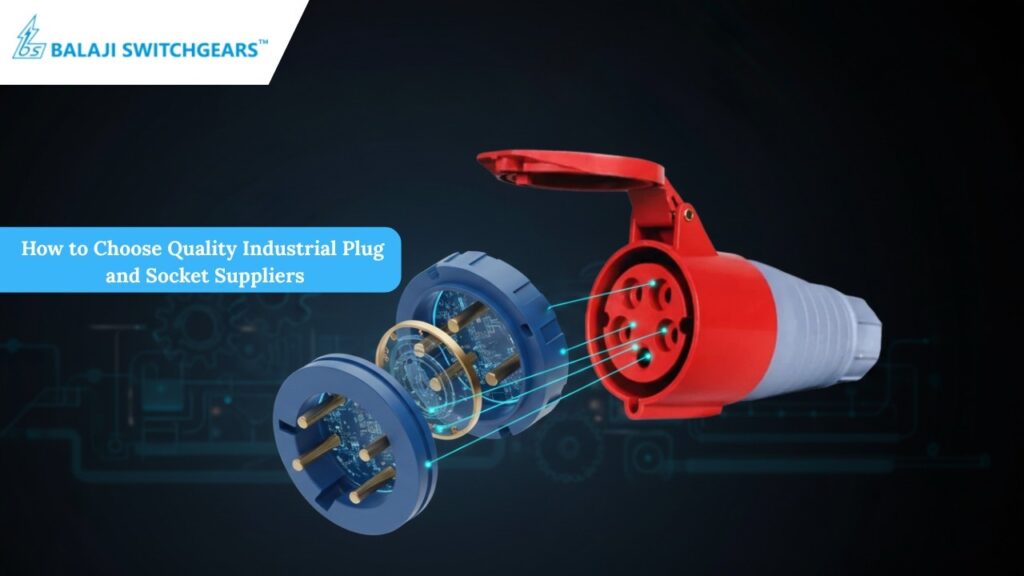
Selecting the right partner when sourcing industrial connectors is critical. When you specify industrial plug and socket suppliers, you aren’t just choosing a product—you’re choosing a long-term support partner for your operations. Whether your facility needs a reliable industrial plug for a heavy-duty machine or you’re a panel-builder sourcing from top-rated socket suppliers, the decision directly impacts equipment uptime, worker safety, and total cost of ownership.
Working with an authorised distributor like Balaji Switchgears Pvt. Ltd. (BSPL) offers an additional layer of confidence because you get certified products, verified quality, and trusted after-sales support. In this article, you’ll learn how to identify true quality suppliers, what to check in the plug-and-socket products themselves, and how to apply practical buyer guidance to make the best choice for your application.
Why Supplier Quality Matters
Quality is about more than avoiding failures. Industrial environments expose connectors to dust, heat, moisture, vibration, and high current loads. If your plug or socket fails, you face downtime, repair costs, and possible safety risks.
Industry guidance consistently highlights the importance of working with reliable industrial plug and socket suppliers:
“Partnering with trusted suppliers helps reduce downtime, maintain safety, and extend the lifespan of electrical systems.”
Suppliers who are authorised distributors—such as BSPL, which partners with global electrical brands—provide traceability, certified products, and stronger technical support. When evaluating “industrial plug and socket suppliers,” buyers should look well beyond price and prioritise certifications, durability, service, product diversity, and supply chain stability.
1. Certifications & Compliance
Always begin by checking whether the supplier offers globally compliant and fully certified products. Industrial connectors often follow standards like IEC 60309 for high-current industrial plugs and sockets.
Ask suppliers:
- Do you provide test data, IP rating verification, and material certificates?
- Are your products built according to IEC, EN, and local electrical standards?
- Is your manufacturing or distribution process audited (ISO 9001, etc.)?
- Are you an authorised distributor for the brands you sell?
Working with a certified partner like BSPL, known for supplying globally compliant electrical components, ensures product authenticity and reduces technical risks.
2. Material Quality & Product Durability
A top-level supplier ensures that every component—body material, terminals, contacts, seals—is engineered for long service life. Many premium industrial plugs and sockets use high-grade polyamide or thermoplastic with excellent heat and impact resistance.
Questions to ask:
- What materials are used—polyamide, thermoplastic, or heavy-duty metal housings?
- What is the IP rating?
- Industrial indoor: IP44
- Harsh/outdoor: IP67 or higher
- Industrial indoor: IP44
- Are units tested for corrosion, thermal cycling, vibration, and heat rise?
- Do plugs and sockets undergo routine mechanical endurance testing?
A trusted supplier such as BSPL ensures that all components follow strict quality parameters and brand-specified durability guidelines.
3. Range, Compatibility & Customisation
Industrial applications vary widely. A true quality supplier must offer a broad, compatible range covering multiple current ratings, voltages, pole counts, and environmental protection levels.
Consider checking whether the supplier offers:
- Multiple ampere options: 16A, 32A, 63A, 125A, 400A
- Plug–socket matched sets
- Interlocked sockets or mechanical keying
- Variants for harsh environments: mining, marine, outdoor, chemical zones
- Custom or fast-delivery versions
A specialised provider such as Balaji Switchgears Pvt. Ltd. ensures that the product range matches your installation requirements and maintains consistency across multiple sites.
4. Supply Chain, Stock & Support
Product quality is meaningless if you can’t get timely deliveries or support. Suppliers must have strong stock levels, predictable lead times, and local distributor networks.
Evaluate:
- Stock availability and minimum order quantities
- Shipping timelines
- Warranty terms
- Replacement and spare-parts support
- Technical assistance availability
- Whether they maintain long-term partnerships with global brands
Buying from an authorised distributor like BSPL ensures steady stock availability and reliable nationwide delivery, reducing downtime for industrial users.
5. Traceability & Quality Assurance Processes
True quality suppliers ensure full traceability—from raw material to batch-level testing. Reliable partners maintain documented quality assurance processes and transparent reporting.
Ask suppliers:
- Are test reports available per batch or per product family?
- Can you provide evaluation samples before bulk purchase?
- Do you have traceability for each batch of industrial plugs and sockets?
- Are there clear maintenance, inspection, and replacement guidelines?
With BSPL, traceability and transparent product documentation are part of the standard process, making procurement more reliable.
Practical Buyer Guidance: Step-by-Step
Step A — Understand Your Application Requirements
Document your specific use case:
- Current and voltage
- Single-phase or three-phase
- Environmental conditions (heat, dust, moisture, outdoor exposure)
- Frequency of plugging/unplugging
- Space and mounting limitations
This clarity helps you specify exactly what the supplier must provide.
Step B — Shortlist Suppliers & Review Credentials
With your requirements ready, shortlist 2–3 suppliers labelled as Socket Suppliers or Industrial Plug and Socket Suppliers.
Review:
- Technical catalogues, certifications, test data
- Lead times, logistics support, stock availability
- Industry references and past installations
- Whether the supplier is an authorised distributor
BSPL, for instance, supplies to manufacturing, mining, infrastructure, and heavy-industry clients—evidence of robust experience.
Step C — Evaluate a Sample or Pilot Installation
Before bulk ordering, request product samples.
Inspect:
- Build quality and finish
- Colour coding, terminal strength, gland quality
- Wiring ease and mechanical fit
- Load behaviour and thermal performance
- Feedback from technicians/maintenance teams
This step reduces risks and exposes any design flaws early.
Step D — Negotiate Terms & After-Sales Support
Clarify:
- Delivery schedules
- Warranty coverage
- On-site support availability
- Technical training, if required
- Replacement timelines
- Spare-parts readiness
A knowledgeable supplier like BSPL adds value through its customer-first support structure and reliable fulfilment.
Step E — Monitor Performance and Feedback
Once installed, track:
- Overheating
- Disconnection issues
- Maintenance frequency
- Availability of replacements
- User complaints or failure patterns
Share this data with the supplier to maintain consistent quality.
Common Mistakes to Avoid
- Choosing based purely on price
- Ignoring specific environmental conditions
- Mismatching plug–socket compatibility
- Overlooking supplier support
- Failing to demand test certificates
- Buying from unauthorised resellers
Working with authorised distributors like BSPL prevents most of these issues.
Real-World Example
A manufacturing plant needed secure mobile-machine connections across its floor. Instead of using basic hardware vendors, the team engaged a specialised industrial plug and socket supplier. They selected IP67-rated, 63A three-phase units due to high moisture and dust exposure. The supplier also provided spare covers and batch-wise test certification.
Because they verified supplier credentials and performed a pilot installation, the facility reported fewer downtime incidents and improved maintenance efficiency. The procurement specification referenced:
“Socket suppliers with certified IP67 units and authorised distribution support,”
ensuring quality.
This demonstrates how partnering with the right distributor significantly improves operational reliability.
Why This Investment Is Worth It
Choosing the right supplier and connectors delivers long-term benefits:
- Better safety
- Lower downtime
- Longer equipment life
- Lower maintenance cost
- Reliable replacements
- Standardised installation quality
In heavy industries—manufacturing, mining, process plants—the cost of a failed connector is far higher than the cost of buying a certified product from a trusted authorised distributor.
Conclusion
Selecting the right industrial plug and socket suppliers goes far beyond choosing a part. It requires evaluating product quality, supplier competency, certifications, support, and long-term suitability. By focusing on compliance, durability, product range, supply chain capability, and by following a structured purchase roadmap—requirements → shortlist → sample evaluation → negotiation → monitoring—you ensure dependable performance.Partnering with a trusted and authorised distributor like Balaji Switchgears Pvt. Ltd. (BSPL) provides the assurance of certified products, reliable stock, technical support, and long-term value. When you choose right, your industrial plug and socket infrastructure becomes safer, stronger, and more efficient—protecting both your equipment and your people.