
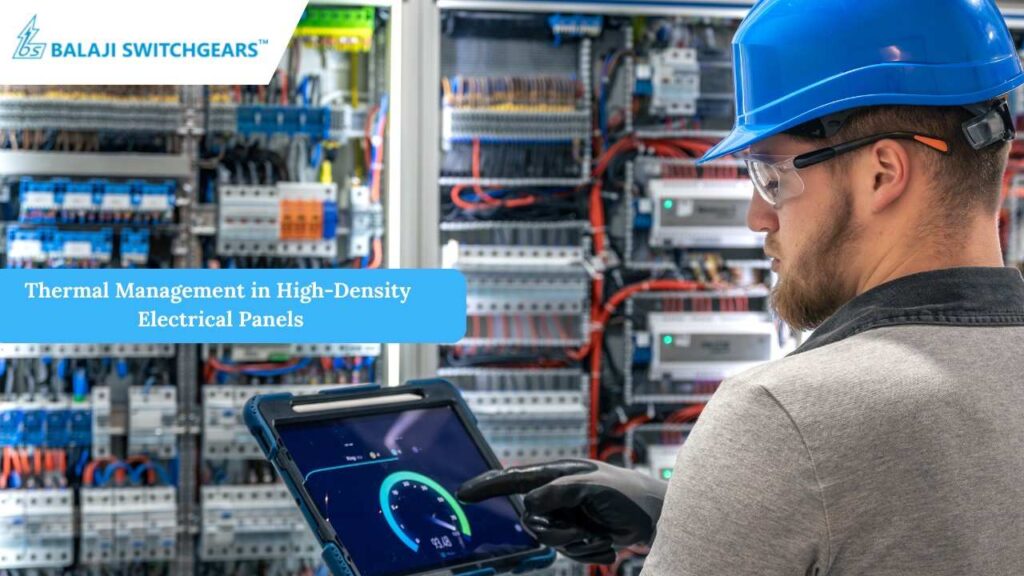
Modern industrial facilities demand more automation, more monitoring, and more control all within increasingly compact spaces. As a result, high density electrical panels are becoming the standard across manufacturing plants, commercial buildings, data infrastructure, and process industries.
However, as component density increases, so does heat generation.
Without proper thermal management, excessive heat inside electrical panels can reduce equipment life, increase downtime, compromise safety, and lead to unexpected system failures.
Thermal management in high-density electrical panels is not just about cooling – it is about designing systems that remain stable, efficient, and safe under continuous load conditions.
This comprehensive guide explains why thermal control is critical, what causes overheating, and how to implement effective cooling strategies in modern electrical enclosures.
Why Thermal Management Matters
Every electrical component generates heat when current flows through it. In low-density panels, natural air circulation may be sufficient to dissipate this heat. But in high density electrical panels – where multiple breakers, contactors, PLCs, VFDs, relays, and power supplies are tightly packed – heat accumulation becomes a serious engineering challenge.
Excessive heat can cause:
- Premature component aging
- Insulation degradation
- Nuisance tripping of breakers
- Reduced efficiency
- Unexpected shutdowns
- Fire hazards
Electronic components typically follow a rule of thumb: for every 10°C rise above their rated operating temperature, lifespan can be reduced by nearly half.
That is why thermal management must be integrated at the design stage – not treated as an afterthought.
Understanding Heat Generation Inside Panels
To manage heat effectively, it is important to understand its sources.
1. Conduction Losses
Whenever current flows through conductors, resistance generates heat. This is governed by Joule’s Law.
𝑃=𝐼2𝑅P=I2R
Where:
- P = power loss (heat)
- I = current
- R = resistance
In high density electrical panels, higher current loads increase heat generation significantly due to the square relationship with current. This means doubling the current results in four times the heat generation.
2. Power Electronics and Drives
Variable Frequency Drives (VFDs), power supplies, and inverters generate substantial heat during operation. These devices are common in automation-heavy industrial panels.
3. Overcrowding and Poor Airflow
When components are installed too closely, airflow paths become restricted. Heat accumulates faster than it can dissipate.
4. External Environmental Conditions
Ambient temperature plays a major role. A panel installed in a hot industrial shop floor or outdoor environment starts at an already elevated baseline temperature.
If ambient temperature is 45°C and internal components add another 30°C, internal temperatures may exceed safe operating limits.
The Risks of Poor Thermal Management
Ignoring thermal management in high-density electrical panels can result in long-term operational risks.
Reduced Equipment Life
Heat accelerates insulation breakdown in wires and internal components. Capacitors, in particular, are highly sensitive to temperature variations.
Unexpected Downtime
Thermal overload protection devices may trip frequently if internal temperatures exceed design limits. This leads to production interruptions.
Efficiency Loss
High temperatures increase conductor resistance. Higher resistance means more heat and more energy loss – creating a harmful feedback loop.
Safety Hazards
Overheated panels increase the risk of fire, arc faults, and insulation failure, posing safety risks to personnel.
Key Thermal Management Strategies
Effective thermal management involves a combination of design planning, cooling systems, and component layout optimization.
1. Load Assessment and Heat Calculation
Before selecting cooling methods, engineers must estimate total heat dissipation within the panel.
Heat load is typically calculated by summing:
- Power losses from breakers
- Heat output of drives
- Transformer losses
- Busbar heating
- Control device dissipation
Accurate heat calculation prevents under-designing the cooling system.
2. Proper Component Spacing
High density does not mean overcrowding.
Maintaining adequate spacing between:
- VFDs
- Contactors
- Power supplies
- Breakers
allows air circulation and reduces localized hotspots.
Vertical alignment of heat-generating components also helps natural convection move warm air upward.
3. Ventilation Systems
Natural ventilation may suffice in moderate conditions.
Ventilation options include:
- Louvered vents
- Filter fans
- Exhaust fans
Airflow must be designed to create a proper intake-to-exhaust path, avoiding dead air pockets.
However, in extremely high-density panels, forced ventilation alone may not be sufficient.
4. Active Cooling Solutions
When internal heat exceeds manageable levels, active cooling becomes necessary.
Common solutions include:
Panel Air Conditioners
Designed specifically for electrical enclosures, panel AC units maintain internal temperature below critical thresholds.
Heat Exchangers
These transfer heat from inside the panel to the external environment without mixing internal and external air – useful in dusty environments.
Thermoelectric Cooling Units
Used in smaller panels requiring precise temperature control.
Selection depends on:
- Ambient temperature
- Dust levels
- Panel size
- Heat load
5. Using High-Quality Components
Components with higher efficiency generate less heat.
For example:
- Low-loss breakers
- High-efficiency drives
- Copper busbars with adequate cross-sectional area
Efficient components reduce overall thermal load inside high density electrical panels.
6. Intelligent Panel Layout Design
Thermal management is strongly influenced by layout.
Best practices include:
- Placing high-heat devices at the top
- Separating control circuits from power circuits
- Using dedicated compartments
- Routing cables to avoid airflow blockage
Panel design software can simulate airflow and temperature distribution before manufacturing.
7. Environmental Sealing vs Cooling Balance
In many industrial environments, panels must be sealed against dust and moisture (IP-rated enclosures).
However, sealed enclosures trap heat.
Balancing environmental protection with heat dissipation is crucial. In such cases, closed-loop cooling systems like heat exchangers are preferred.
8. Thermal Monitoring Systems
Modern high density electrical panels increasingly integrate:
- Temperature sensors
- Thermal alarms
- Smart monitoring systems
Real-time temperature tracking allows preventive maintenance before overheating causes failure.
Designing for High-Density Panels in Modern Industries
Today’s industrial panels include:
- PLC racks
- SCADA systems
- VFD clusters
- Communication modules
- IoT gateways
This integration increases power density significantly compared to traditional panels.
Thermal management must therefore evolve alongside automation trends.
As industries move toward compact control rooms and modular systems, proper heat dissipation planning becomes central to operational reliability.
Energy Efficiency and Sustainability
Thermal management also impacts energy efficiency.
Overheated panels:
- Increase resistive losses
- Reduce system efficiency
- Demand higher cooling power
Well-managed panels:
- Maintain stable operating temperature
- Reduce electrical losses
- Improve equipment longevity
- Lower maintenance frequency
Efficient thermal design contributes to sustainable energy usage across industrial facilities.
Common Mistakes in Thermal Management
Several common mistakes compromise panel performance:
- Ignoring ambient temperature during design
- Underestimating heat load
- Overcrowding components
- Using undersized ventilation fans
- Sealing panels without active cooling
- Neglecting maintenance of filters and cooling systems
Avoiding these errors significantly enhances panel reliability.
The Future of Thermal Management in Electrical Panels
As electrical systems become more compact and digitized, heat density will continue to rise.
Emerging trends include:
- Smart thermal sensors
- Predictive temperature analytics
- Advanced airflow simulation
- High-efficiency low-loss components
- Modular cooling systems
Thermal management will increasingly become an integral part of electrical engineering design rather than a secondary consideration.
Conclusion
Thermal management in high-density electrical panels is essential for ensuring safety, performance, and longevity.
High-density installations generate significant heat due to increased current loads, power electronics, and compact component layouts. Without proper thermal control, systems face overheating, reduced efficiency, premature equipment failure, and safety risks.
By focusing on:
- Accurate heat load calculation
- Intelligent panel layout
- Proper ventilation
- Active cooling systems
- Efficient component selection
- Real-time temperature monitoring
Engineers can create stable, reliable, and long-lasting electrical systems.
In modern industrial environments where downtime is costly and safety is non-negotiable, thermal management is not optional, it is foundational.
For organizations planning advanced electrical panels and automation systems, partnering with experienced electrical solution providers like Balaji Switchgears ensures access to technical expertise, quality components, and system designs that prioritize both performance and thermal reliability. Effective thermal management today safeguards operational continuity tomorrow.