
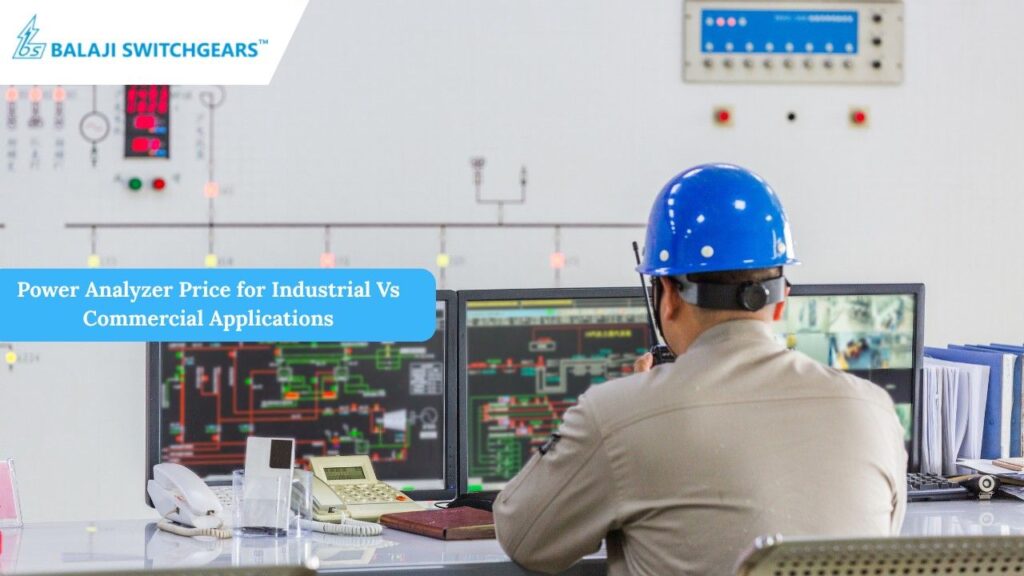
As energy efficiency, reliability, and compliance become critical priorities, power monitoring is no longer optional. Industries and commercial facilities alike rely on accurate electrical data to reduce losses, prevent failures, and optimise operating costs. However, one of the most common questions buyers ask is: Why does the power analyzer price vary so widely between industrial and commercial applications?
The answer lies in application complexity, measurement depth, durability requirements, and integration capabilities. A power quality analyzer used in a heavy manufacturing plant serves a very different purpose compared to one installed in a commercial building or retail facility.
At Balaji Switchgears, customers frequently seek clarity on selecting the right power analyzer for their specific needs without overspending or under-specifying. This article explains the pricing differences, technical factors, and buyer considerations for both industrial and commercial environments.
What Is a Power Analyzer and Why Is It Needed?
A power analyzer is an advanced electrical measurement device used to monitor, record, and analyse parameters such as:
- Voltage and current
- Active, reactive, and apparent power
- Energy consumption
- Power factor
- Harmonics and power quality disturbances
Unlike basic energy meters, power analyzers provide detailed insights that help diagnose inefficiencies, detect abnormalities, and ensure compliance with power quality standards.
The power analyzer price depends largely on how much detail, accuracy, and robustness the application demands.
Understanding Power Analyzer Applications
Before comparing prices, it is important to understand how requirements differ between industrial and commercial settings.
Power Analyzer for Commercial Applications
Commercial environments include:
- Office buildings
- Shopping malls
- Hospitals
- Hotels
- Educational institutions
Typical Objectives
- Monitor energy consumption for cost allocation
- Track demand and peak usage
- Improve power factor
- Ensure basic power quality compliance
Feature Requirements
A Power Analyzer for commercial applications typically focuses on:
- Basic to mid-level accuracy
- Energy and demand monitoring
- Simple harmonic analysis
- Compact design for panel installation
- Limited communication (Modbus, basic BMS integration)
Pricing Perspective
Because the operational environment is relatively stable and loads are predictable, commercial power analyzers are:
- Less rugged
- Lower in channel count
- Limited in advanced analytics
As a result, the power analyzer price for commercial applications is generally lower and suitable for budget-conscious facilities focused on billing accuracy and energy efficiency.
Power Analyzer for Industrial Applications
Industrial environments are far more demanding. These include:
- Manufacturing plants
- Process industries
- Data centres
- Utilities
- Oil & gas facilities
Typical Objectives
- Detect power quality issues affecting machinery
- Identify harmonics and transients
- Prevent unplanned downtime
- Analyse load behaviour under varying conditions
- Support energy audits and compliance
Feature Requirements
A Power Analyzer for Industrial Applications must handle:
- High accuracy across wide current and voltage ranges
- Advanced harmonic and waveform analysis
- Event and transient capture
- Continuous data logging
- High immunity to electrical noise
- Multiple communication protocols (SCADA, EMS integration)
Pricing Perspective
Industrial analyzers are engineered for performance and durability. This increases:
- Hardware complexity
- Software capabilities
- Testing and certification requirements
Consequently, the power analyzer price for industrial use is significantly higher—but justified by the level of insight and protection it provides.
Key Factors Affecting Power Analyzer Price
1. Measurement Accuracy and Class
Higher accuracy means tighter tolerances, better sensors, and advanced calibration—adding to cost. Industrial analyzers usually demand higher accuracy than commercial ones.
2. Power Quality Analysis Depth
A basic analyzer may measure THD, while advanced models capture:
- Individual harmonic orders
- Voltage dips, swells, and interruptions
- Transient events
Advanced power quality analyzer features increase price but are essential in sensitive industrial setups.
3. Data Logging and Storage
Industrial applications often require:
- Long-term data storage
- High-resolution sampling
- Exportable reports
More memory and processing capability directly influence pricing.
4. Communication and Integration
Commercial buildings may only need basic BMS connectivity.
Industrial sites often require:
- SCADA integration
- Ethernet, RS485, multiple protocols
- Remote monitoring
Each added communication layer impacts the power analyzer price.
5. Environmental and Electrical Robustness
Industrial analyzers must withstand:
- Heat, vibration, dust
- High fault levels
- Electrical noise
This ruggedisation increases manufacturing cost.
Industrial vs Commercial: Price Comparison Summary
| Aspect | Commercial Application | Industrial Application |
| Accuracy | Moderate | High |
| Harmonic Analysis | Basic | Advanced |
| Event Detection | Limited | Extensive |
| Integration | BMS-level | SCADA / EMS |
| Durability | Standard | Heavy-duty |
| Power Analyzer Price | Lower | Higher |
Choosing the Right Analyzer: Buyer Guidance
Step 1: Define Your Objective
Are you tracking energy bills or diagnosing power quality problems? The answer determines whether a commercial or industrial analyzer is appropriate.
Step 2: Match Features to Application
Avoid paying for advanced features you will never use. At the same time, under-specifying can result in missed issues and higher long-term costs.
Step 3: Consider Future Expansion
Choose a scalable solution that supports future loads, expansion, or integration needs.
Step 4: Partner with an Experienced Supplier
An experienced supplier helps you:
- Select the right analyzer
- Ensure proper installation
- Interpret data correctly
This is where Balaji Switchgears adds value by offering application-driven recommendations rather than one-size-fits-all solutions.
Why Power Analyzer Price Should Not Be the Only Criterion
While price is important, focusing only on upfront cost can be misleading. A low-cost analyzer that fails to detect harmonics or voltage disturbances can result in:
- Equipment damage
- Production losses
- Higher maintenance costs
A well-chosen power quality analyzer pays for itself by preventing failures and improving efficiency.
Role of Balaji Switchgears
Balaji Switchgears supports clients across industrial and commercial sectors by:
- Supplying reliable power monitoring solutions
- Advising on application-specific analyzer selection
- Supporting panel builders and consultants
- Ensuring compliance and long-term reliability
By understanding both technical and operational requirements, Balaji Switchgears helps customers achieve optimal performance without unnecessary expenditure.
Conclusion
The difference in power analyzer price between industrial and commercial applications reflects the difference in performance, durability, and analytical depth required. A Power Analyzer for commercial applications focuses on energy monitoring and cost control, while a Power Analyzer for Industrial Applications provides advanced diagnostics essential for reliability and protection.
Selecting the right power quality analyzer is not about choosing the cheapest option—it’s about choosing the right tool for the job. With proper guidance and a trusted partner like Balaji Switchgears, organisations can make informed investments that deliver long-term value, reduced risk, and smarter energy management.