
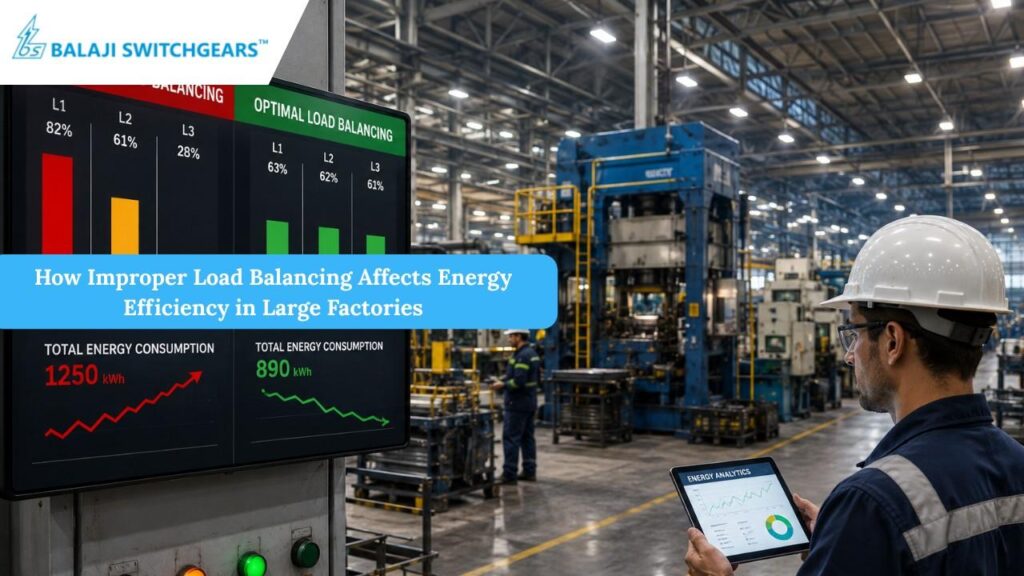
In large industrial facilities, energy efficiency is not just a cost concern, it directly impacts productivity, equipment life, and overall operational stability. Modern factories operate with complex electrical networks where multiple machines, drives, and control systems run simultaneously. In such environments, maintaining a balanced electrical load across phases becomes essential. However, improper load balancing is a common yet often overlooked issue in many factories. While systems may continue to operate, the hidden inefficiencies caused by uneven load distribution can lead to increased energy consumption, overheating, equipment stress, and long-term reliability problems.
Understanding how load imbalance affects energy efficiency is critical for industries aiming to optimize performance and reduce operational costs.
Understanding Load Balancing in Industrial Systems
In a three-phase electrical system, load balancing refers to the equal distribution of electrical load across all three phases. Ideally, each phase should carry similar current levels to ensure stable operation.
When loads are evenly distributed, the system operates efficiently with minimal losses. Voltage remains stable, equipment performs optimally, and power quality is maintained.
However, in real-world factory conditions, loads are rarely balanced perfectly. Different machines operate at different capacities, and uneven distribution often develops over time. When this imbalance becomes significant, it starts affecting system performance.
What Causes Load Imbalance in Factories
Load imbalance in large factories usually develops gradually due to operational and design-related factors.
One common reason is the uneven connection of single-phase loads across phases. Lighting systems, control circuits, and smaller machines are often not distributed properly, leading to one phase carrying more load than the others.
Another contributing factor is the addition of new equipment without re-evaluating the existing load distribution. As factories expand, new machines are connected wherever convenient, rather than where they should be.
Operational variations also play a role. Machines may not run continuously, and fluctuating usage patterns can create temporary or persistent imbalance conditions.
Over time, these small issues accumulate and result in significant load imbalance.
Increased Energy Losses Due to Imbalance
One of the most direct impacts of improper load balancing is increased energy loss.
When current is unevenly distributed, the heavily loaded phase carries more current than it ideally should. This leads to higher resistive losses in cables and conductors, commonly referred to as I²R losses.
As current increases, these losses grow exponentially, causing unnecessary energy wastage.
Even if the factory is not increasing production, energy consumption rises due to inefficiencies in the system. This directly affects electricity bills and reduces overall energy efficiency.
Overheating of Electrical Components
Load imbalance often results in overheating of electrical components.
Cables, transformers, and switchgear connected to the overloaded phase experience higher thermal stress. This not only reduces efficiency but also accelerates wear and tear.
Overheating can lead to insulation degradation, increasing the risk of faults and failures. In severe cases, it may even cause shutdowns or safety hazards.
Maintaining balanced loads helps distribute thermal stress evenly, improving system stability and longevity.
Impact on Equipment Performance
Industrial machines are designed to operate under stable electrical conditions.
When load imbalance occurs, voltage variations may develop across phases. This affects the performance of motors, drives, and sensitive equipment.
Motors, in particular, are highly sensitive to voltage imbalance. Even a small imbalance can cause uneven magnetic fields, leading to increased vibration, reduced efficiency, and higher operating temperatures.
Over time, this can shorten the lifespan of equipment and increase maintenance requirements.
Neutral Current and Associated Losses
In a perfectly balanced three-phase system, the neutral current is minimal or zero.
However, when loads are unbalanced, excess current flows through the neutral conductor. This additional current contributes to further energy losses and increases heating in the neutral line.
High neutral currents can also indicate poor system design or improper load distribution, both of which affect overall efficiency.
Reduced Power Factor and Efficiency
Load imbalance can indirectly affect power factor, especially in systems with inductive loads such as motors and drives.
When phases are unevenly loaded, the overall system efficiency drops, and reactive power consumption may increase.
A lower power factor results in higher demand charges from utility providers and reduces the effective utilization of electrical power.
Improving load balance helps maintain a better power factor and enhances overall system efficiency.
Increased Maintenance and Downtime
An unbalanced electrical system requires more frequent maintenance.
Components operating under stress are more likely to fail, leading to unexpected downtime. Maintenance teams may spend additional time troubleshooting issues that are difficult to trace back to load imbalance.
Repeated failures not only increase maintenance costs but also disrupt production schedules.
By maintaining proper load balance, industries can reduce stress on components and minimize maintenance requirements.
Challenges in Large-Scale Industrial Environments
In large factories, achieving perfect load balance is not always easy.
The complexity of electrical networks, combined with varying operational demands, makes it challenging to maintain equal distribution at all times.
However, this does not mean imbalance should be ignored. Regular monitoring and corrective actions can significantly reduce its impact.
Modern systems allow better visibility into load distribution, enabling industries to identify and correct imbalances before they become critical.
Strategies to Improve Load Balancing
Improving load balance requires a systematic approach rather than a one-time correction.
Regular load analysis helps identify uneven distribution across phases. Based on this analysis, loads can be redistributed to achieve better balance.
Proper planning during system expansion is equally important. New equipment should be connected with consideration of existing load conditions.
Using advanced monitoring systems also helps track real-time performance and detect imbalances early.
While achieving perfect balance may not always be possible, reducing imbalance to acceptable levels can significantly improve efficiency.
Long-Term Benefits of Proper Load Balancing
Maintaining balanced electrical loads offers several long-term advantages.
Energy efficiency improves as losses are minimized. Equipment operates under optimal conditions, reducing wear and extending lifespan.
Power quality remains stable, supporting consistent production output. Maintenance requirements decrease, and system reliability improves.
Over time, these benefits contribute to lower operational costs and better overall performance.
A Practical Perspective on Energy Efficiency
Energy efficiency in industrial systems is influenced by multiple factors, and load balancing is one of the most critical among them.
Ignoring imbalance may not cause immediate failure, but it gradually reduces system efficiency and increases operational costs.
By focusing on proper load distribution, industries can achieve better utilization of electrical power and improve system stability.
This approach not only enhances performance but also supports sustainable and cost-effective operations.
Conclusion
Improper load balancing is a hidden challenge in many large factories, but its impact on energy efficiency is significant.
From increased energy losses and overheating to reduced equipment performance and higher maintenance costs, the effects of imbalance can affect every aspect of industrial operations. Addressing this issue requires awareness, regular monitoring, and a proactive approach to system design and maintenance.
For industries aiming to improve efficiency and reliability, focusing on balanced electrical systems is a crucial step.
With the right expertise and solutions, companies can optimize their electrical infrastructure and achieve long-term operational stability, something that experienced partners like Balaji Switchgears actively support through reliable and efficient electrical system practices.