
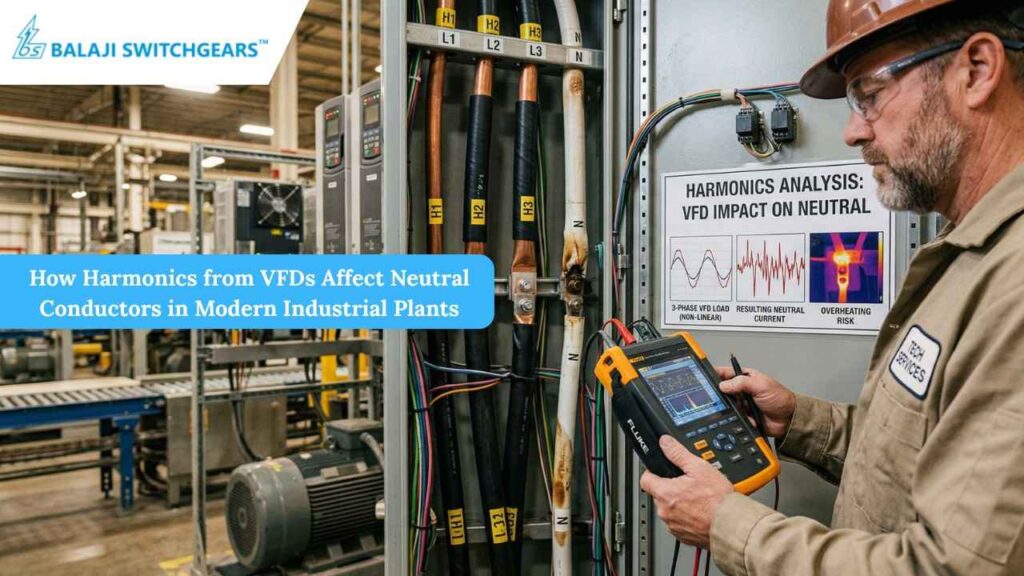
Industrial plants today rely heavily on automation, energy efficiency, and precise motor control. One of the key technologies enabling this transformation is the Variable Frequency Drive (VFD). VFDs are widely used to control motor speed, reduce energy consumption, and improve process efficiency. However, along with their advantages, VFDs introduce a critical power quality issue – harmonics. Among the various challenges caused by harmonics, one of the most overlooked yet serious problems is their impact on neutral conductors. In many modern facilities, excessive neutral conductor harmonics lead to overheating, energy losses, and potential system failures.
Understanding how VFD harmonics affect neutral conductors is essential for engineers, plant managers, and electrical designers working in today’s industrial environments.
Understanding Harmonics in Industrial Power Systems
Before diving into the impact on neutral conductors, it is important to understand what harmonics are. In an ideal electrical system, current and voltage waveforms are perfectly sinusoidal. However, when non-linear loads such as VFDs, UPS systems, and electronic equipment are introduced, they distort the waveform.
These distortions are called harmonics.
Harmonics are currents or voltages that occur at multiples of the fundamental frequency (50 Hz in most industrial systems). For example:
- 3rd harmonic = 150 Hz
- 5th harmonic = 250 Hz
- 7th harmonic = 350 Hz
In modern facilities, harmonics in industrial plants have become increasingly common due to the widespread use of power electronics.
What are VFD Harmonics?
Variable Frequency Drives operate by converting AC power to DC and then back to AC with controlled frequency and voltage. This process involves switching devices such as IGBTs, which do not draw current in a smooth sinusoidal manner.
Instead, VFDs draw current in pulses, which creates VFD harmonics.
These harmonics flow back into the power system and affect:
- Power cables
- Transformers
- Switchgear
- Distribution panels
- Neutral conductors
The level of harmonics depends on factors such as load type, drive design, and system configuration.
Role of Neutral Conductors in Electrical Systems
In three-phase electrical systems, the neutral conductor serves as a return path for unbalanced current. Under ideal balanced conditions, the current in the neutral conductor should be zero because the phase currents cancel each other out.
However, in real-world installations – especially in facilities with non-linear loads this balance is rarely achieved. When harmonics are present, particularly triplen harmonics (multiples of 3rd harmonic), they behave differently compared to fundamental frequency currents.
Why Harmonics Accumulate in Neutral Conductors
One of the most critical aspects of neutral conductor harmonics is the behavior of triplen harmonics. Triplen harmonics (3rd, 9th, 15th, etc.) are known as zero-sequence harmonics. Unlike normal phase currents, these harmonics do not cancel out in a three-phase system.
Instead, they add up in the neutral conductor.
For example:
- In a balanced system, fundamental currents cancel in the neutral
- But 3rd harmonic currents from all three phases combine
- This results in high current flowing through the neutral
This phenomenon is one of the main reasons why neutral conductors experience unexpected overloading in systems with VFDs.
Effects of VFD Harmonics on Neutral Conductors
1. Overheating of Neutral Conductors
The most immediate impact of VFD harmonics is excessive heating.
Since harmonic currents accumulate in the neutral, the conductor may carry higher current than the phase conductors. This leads to:
- Insulation degradation
- Increased conductor temperature
- Risk of fire hazards
In many cases, neutral conductors are not sized to handle such high harmonic currents, making them vulnerable to overheating.
2. Increased Energy Losses
Harmonic currents increase resistive losses in conductors.
This results in:
- Higher I²R losses
- Reduced system efficiency
- Increased energy costs
In large industrial setups, these losses can significantly impact operational expenses over time.
3. Voltage Distortion
Excessive harmonics flowing through the neutral conductor can also contribute to voltage distortion in the system.
This affects the performance of:
- Sensitive electronic equipment
- Control systems
- Measurement devices
Voltage distortion can lead to malfunctioning or inaccurate readings in critical industrial processes.
4. Transformer Overloading
Neutral conductor harmonics also impact transformers.
Triplen harmonics circulate within transformer windings, causing:
- Additional heating
- Reduced transformer efficiency
- Shortened lifespan
Transformers supplying VFD loads must be designed to handle harmonic currents.
5. Nuisance Tripping of Protection Devices
Harmonics can interfere with protective devices such as circuit breakers and relays.
This may result in:
- False tripping
- Reduced reliability
- Unexpected downtime
In industrial plants, such interruptions can lead to production losses.
Real-World Impact in Industrial Plants
In modern facilities, harmonics in industrial plants are no longer a minor issue.
Industries such as:
- Manufacturing
- Oil and gas
- Pharmaceuticals
- Data centers
- Food processing
are heavily dependent on VFD-driven systems.
Without proper harmonic management, these plants may face:
- Frequent maintenance issues
- Equipment failures
- Increased operational costs
- Reduced power quality
Neutral conductor failures, in particular, can be difficult to detect until significant damage has already occurred.
How to Mitigate Neutral Conductor Harmonics
Managing neutral conductor harmonics requires a combination of design improvements and corrective measures.
Proper Sizing of Neutral Conductors
One of the simplest solutions is to increase the size of neutral conductors.
In harmonic-rich environments, the neutral conductor should be equal to or larger than phase conductors to safely handle additional current.
Use of Harmonic Filters
Harmonic filters are widely used to reduce distortion caused by VFDs.
Types of filters include:
- Passive harmonic filters
- Active harmonic filters
These devices reduce harmonic currents before they spread through the system.
Installation of Isolation Transformers
Special transformers designed for harmonic loads can help mitigate the effects of triplen harmonics.
These transformers prevent harmonic currents from propagating through the system and reduce stress on neutral conductors.
Phase Load Balancing
Ensuring proper load balancing across all three phases helps reduce neutral current.
Although it does not eliminate harmonics, it minimizes overall imbalance in the system.
Use of Multi-Pulse or Low Harmonic Drives
Modern VFD designs include low harmonic drives or multi-pulse configurations.
These systems generate fewer harmonics compared to conventional drives, improving overall power quality.
Proper Grounding and Earthing
A well-designed grounding system ensures safe dissipation of harmonic currents.
It also improves system stability and reduces the impact of electrical noise.
Importance of Power Quality Analysis
Regular monitoring and analysis of power quality is essential in industrial environments.
Tools such as power analyzers help detect:
- Harmonic distortion levels
- Neutral current loading
- Voltage imbalance
By identifying issues early, engineers can take corrective action before serious damage occurs.
Future Trends in Harmonic Management
As industrial automation continues to grow, harmonic mitigation technologies are also evolving.
Emerging trends include:
- Smart harmonic filters with real-time adjustment
- Integration with energy management systems
- Advanced drive technologies with reduced distortion
- Digital monitoring of neutral conductor performance
These innovations will help improve power quality and reduce the risks associated with VFD harmonics.
Conclusion
VFDs have become essential for modern plants, but the harmonics they introduce cannot be ignored. One of the most critical impacts is on neutral conductors, where triplen harmonics build up and create hidden risks like overheating, energy loss, and unexpected failures.
Managing this is not just about adding components, it starts with correct system design, proper sizing, and selecting the right solutions from the beginning. With the right approach, these risks can be controlled before they turn into costly downtime.
Working with trusted partners like Balaji Switchgears Pvt. Ltd. ensures not just product availability but the right technical guidance. As an authorized distributor of Schneider Electric, Balaji Switchgears Pvt. Ltd. offers genuine products, competitive pricing, and application-based support helping OEMs and industries achieve reliable performance, better power quality, and long term operational stability.