
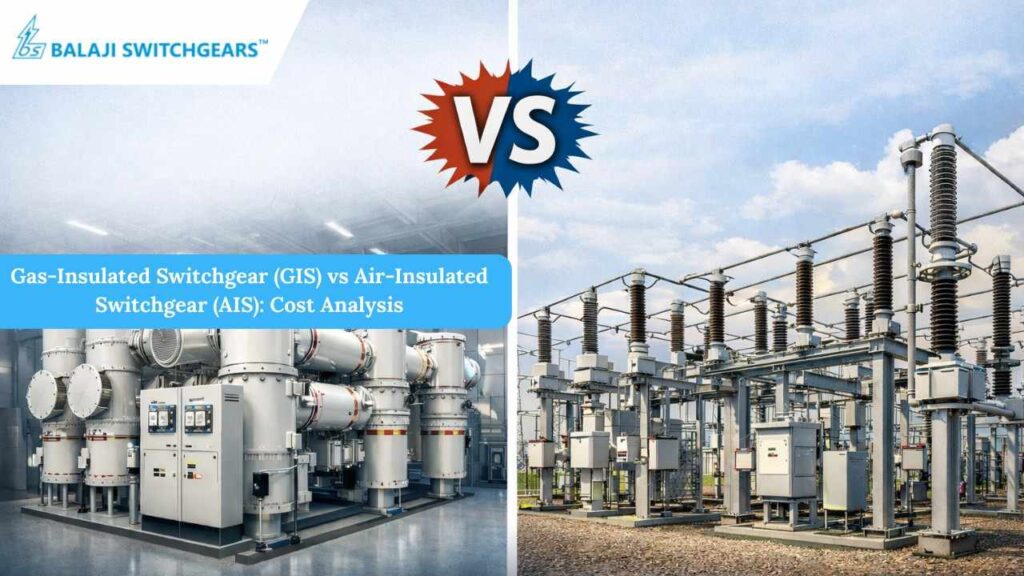
Electrical power systems rely heavily on switchgear to control, protect, and isolate electrical equipment. As power networks expand and become more complex, choosing the right switchgear technology becomes critical for efficiency, reliability, and long-term cost management. Two widely used technologies dominate modern substations and industrial power systems: Gas-Insulated Switchgear (GIS) and Air-Insulated Switchgear (AIS). Each system has unique design characteristics, installation requirements, and cost implications. Understanding the cost differences between GIS and AIS is essential for engineers, infrastructure planners, and facility managers when designing electrical systems.
This article provides a comprehensive comparison of GIS vs AIS, focusing on installation costs, operational expenses, maintenance requirements, and long-term economic value.
Understanding Air-Insulated Switchgear (AIS)
Air-Insulated Switchgear uses ambient air as the insulation medium between electrical conductors. Components such as circuit breakers, busbars, and disconnectors are installed in open structures or metal-clad panels with sufficient spacing to prevent electrical flashovers.
AIS is one of the most traditional and widely used switchgear systems in electrical substations and industrial installations.
Key characteristics of AIS include:
- Use of atmospheric air for insulation
- Open design with visible components
- Easy access for inspection and maintenance
- Larger physical footprint due to insulation clearances
Because air has lower dielectric strength compared to insulating gases, AIS requires larger spacing between live components to maintain electrical safety.
Despite its larger size, AIS remains popular because of its relatively simple design and lower initial cost.
Understanding Gas-Insulated Switchgear (GIS)
Gas-Insulated Switchgear uses sulfur hexafluoride (SF₆) gas or other insulating gases as the dielectric medium inside sealed metal enclosures.
All live components such as circuit breakers, busbars, and disconnectors are enclosed in grounded metal tanks filled with high-pressure insulating gas.
GIS systems are designed to achieve high electrical insulation within compact spaces.
Major features of GIS include:
- Fully enclosed metal housing
- Insulation using SF₆ gas or eco-friendly alternatives
- Compact design with reduced clearances
- High reliability and minimal exposure to environmental conditions
Because SF₆ gas has significantly higher dielectric strength than air, GIS equipment can be built much smaller while maintaining the same voltage ratings.
This compact design makes GIS particularly suitable for installations where space is limited.
Key Differences Between GIS and AIS
Before analyzing costs, it is important to understand the fundamental differences between these two technologies.
| Feature | Air-Insulated Switchgear (AIS) | Gas-Insulated Switchgear (GIS) |
| Insulation Medium | Air | SF₆ Gas |
| Equipment Size | Large footprint | Compact design |
| Installation Location | Outdoor substations | Indoor / space-limited areas |
| Maintenance | Frequent inspection | Less frequent maintenance |
| Environmental Exposure | Sensitive to dust and moisture | Sealed and protected |
| Initial Cost | Lower | Higher |
GIS can occupy 70–80% less space than AIS because of its superior insulation properties.
However, the compact design comes with higher manufacturing complexity and equipment cost.
Initial Investment Cost Comparison
One of the most important factors in choosing between AIS and GIS is the capital expenditure (CAPEX) required during project development.
Cost of Air-Insulated Switchgear
AIS is generally more economical during the initial installation phase.
Reasons for lower cost include:
- Simpler construction design
- No need for specialized gas handling equipment
- Easier installation procedures
- Lower manufacturing complexity
AIS equipment typically costs 30–50% less than GIS systems depending on voltage levels and project scale.
Because of this, AIS is often preferred in projects where land is available and cost sensitivity is high.
Typical applications include:
- Large outdoor substations
- Rural power distribution networks
- Industrial plants with sufficient space
Cost of Gas-Insulated Switchgear
GIS systems require a significantly higher initial investment.
Several factors contribute to higher costs:
- Gas-tight metal enclosures
- High-precision manufacturing
- SF₆ gas insulation systems
- Monitoring and gas management equipment
These specialized components increase the price of GIS equipment compared to conventional AIS systems.
However, the higher upfront cost often delivers benefits in areas where space constraints or reliability requirements are critical.
Examples include:
- Urban substations
- Underground electrical facilities
- Metro rail networks
- Offshore power platforms
Space and Land Cost Considerations
One major cost factor often overlooked is land and infrastructure requirements.
AIS installations require significant space because of the clearances needed between high-voltage conductors.
This means additional expenses for:
- Larger substation land area
- Extended structural supports
- Larger cable routing layouts
- More civil construction work
GIS systems, on the other hand, offer compact layouts that reduce land requirements dramatically.
In many cases, GIS substations occupy one-third of the space required by AIS installations.
In urban areas where land costs are high, the smaller footprint of GIS can offset its higher equipment cost.
Installation and Construction Costs
Installation costs also differ between the two systems.
AIS Installation
AIS installations are generally easier to install due to their open structure.
Advantages include:
- Simple mechanical assembly
- Minimal specialized tools required
- Easy alignment of components
- Lower installation training requirements
However, AIS installations may require larger support structures and additional cabling infrastructure.
GIS Installation
GIS installations require more precise engineering and specialized handling.
Installation challenges include:
- Gas-tight enclosure assembly
- SF₆ gas filling procedures
- Leak detection and testing
- Specialized commissioning equipment
While installation may be technically complex, GIS systems often require fewer components and shorter busbar arrangements, which can reduce overall construction time.
Maintenance Cost Analysis
Maintenance is another critical factor when evaluating the lifecycle cost of switchgear systems.
Maintenance Cost of AIS
Because AIS equipment is exposed to the environment, it requires more frequent maintenance.
Common maintenance activities include:
- Cleaning of insulation surfaces
- Checking electrical clearances
- Tightening connections
- Replacement of worn mechanical parts
Environmental conditions such as dust, humidity, and pollution can accelerate insulation degradation.
As a result, AIS systems typically require inspection every one to two years in many installations.
This increases operational maintenance costs over time.
Maintenance Cost of GIS
GIS equipment is sealed within metal enclosures, protecting it from environmental contamination.
Advantages include:
- Minimal exposure to dust and moisture
- Longer inspection intervals
- Reduced component wear
- Lower risk of insulation failure
Because of this sealed design, GIS systems often require less frequent maintenance.
However, maintenance procedures involving SF₆ gas require trained technicians and specialized equipment.
Despite this complexity, overall maintenance frequency is typically lower compared to AIS systems.
Reliability and Operational Cost
Reliability directly impacts operational costs and system downtime.
Reliability of AIS
AIS systems are more susceptible to environmental factors such as:
- Pollution
- Moisture
- Salt contamination
- Industrial dust
These factors may increase the likelihood of insulation flashovers or mechanical wear.
However, the open structure allows faults to be easily identified and repaired quickly.
Reliability of GIS
GIS systems are highly reliable due to their sealed construction.
Advantages include:
- Protection from environmental conditions
- Reduced insulation contamination
- Lower probability of external faults
This makes GIS suitable for harsh environments such as coastal areas, industrial zones, and underground installations.
Higher reliability often results in lower long-term operational costs.
Environmental and Regulatory Costs
Environmental considerations also affect the cost analysis between AIS and GIS.
AIS uses air as the insulating medium, which has no greenhouse gas impact.
GIS, however, commonly uses SF₆ gas, which has a very high global warming potential.
Because of this, many regulatory frameworks require:
- Gas leakage monitoring
- SF₆ recovery during maintenance
- Strict environmental compliance procedures
These regulatory requirements can increase lifecycle management costs for GIS systems.
However, new technologies using alternative insulating gases are emerging to reduce environmental impact.
Lifecycle Cost Comparison
When evaluating switchgear systems, the most accurate approach is to consider Total Cost of Ownership (TCO) rather than only initial purchase price.
Lifecycle cost includes:
- Equipment procurement
- Land and infrastructure costs
- Installation expenses
- Maintenance requirements
- Operational reliability
- Environmental compliance
AIS typically has lower initial cost but higher maintenance and space requirements.
GIS has higher upfront investment but lower maintenance frequency and compact installation benefits.
The optimal choice depends on project priorities, available space, and reliability requirements.
Choosing the Right Switchgear Technology
The decision between GIS and AIS depends on several project factors.
AIS is usually preferred when:
- Land availability is not a constraint
- Lower initial cost is a priority
- Easy maintenance access is required
GIS is more suitable when:
- Installation space is limited
- High reliability is critical
- Environmental exposure is severe
- Infrastructure must be compact
Both technologies have proven performance in power transmission and distribution systems.
Conclusion
The comparison between Gas-Insulated Switchgear (GIS) and Air-Insulated Switchgear (AIS) highlights the importance of balancing initial investment with long-term operational benefits.
AIS systems provide an economical solution for large outdoor installations where space and environmental conditions are manageable. Their lower upfront cost and easy maintenance make them suitable for many industrial and utility applications.
GIS systems, while more expensive initially, offer superior compactness, higher reliability, and reduced maintenance frequency. These advantages make them ideal for urban substations, underground facilities, and high-reliability infrastructure projects.
Ultimately, selecting the right switchgear technology requires a comprehensive evaluation of project requirements, site conditions, and lifecycle cost considerations.For organizations planning modern electrical infrastructure, working with experienced electrical solution providers like Balaji Switchgears ensures the right balance between safety, performance, and cost efficiency in switchgear system design.